
Taiga Biome Diorama: Printable Boreal Forest Project
Explore one of Earth’s largest and coldest ecosystems with this printable taiga biome diorama. Children can construct a three-dimensional boreal forest complete with conifers, rocky terrain, water, and wildlife adapted to cold winters and short summers.
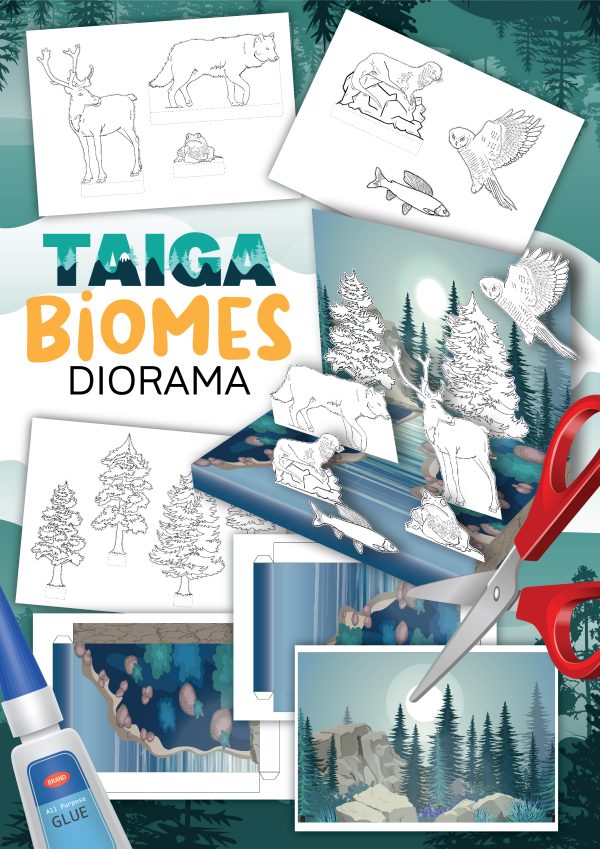
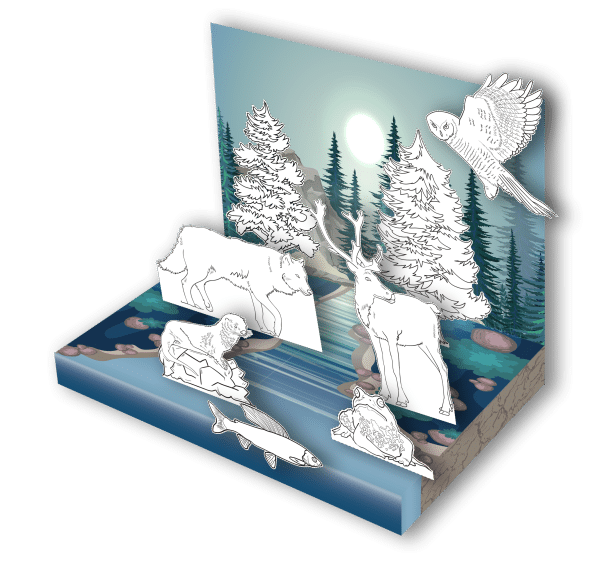
The six-page printable provides the pieces needed to build a freestanding 3D scene, including a colorful background, foldable habitat base, conifers, and six taiga animals. Children color the black-and-white figures, cut along the outlines, fold the tabs, and arrange each piece to recreate this northern natural environment.
Taiga Biome Diorama: Printable Boreal Forest Project
This hands-on project is suitable for science units, geography lessons, homeschool use, habitat studies, biome project assignments, and elementary school presentations.
Purchase the Taiga Biomes Shoebox Diorama Printable HERE
What Is the Taiga Biome?
The taiga is a vast woodland biome found across cold northern areas of North America, Europe, and Asia. It is also known as the boreal forest or snow forest and is considered the largest land biome on Earth.
The word boreal means northern, which accurately describes where this biome is located. It forms a broad band across Canada, Alaska, Scandinavia, and Russia, generally between the tundra to the north and temperate woodlands or grasslands to the south.
Conifers dominate the landscape. Spruce, fir, pine, and larch are well suited to cold conditions, thin soil, and a short growing season.
What Does a Taiga Look Like?
A typical northern landscape contains dense conifers, rocky ground, lakes, rivers, wetlands, and open areas. Mountains or rocky outcrops may appear in some locations.
The natural environment changes dramatically with the seasons. Winters are long, cold, and snowy. Summers are much shorter but may bring warmer weather, rain, long daylight hours, insects, wildflowers, and active wildlife.
Although people sometimes imagine this area as permanently frozen and covered in snow, it has a distinct growing season. Shrubs, mosses, lichens, and other vegetation grow during the warmer months.


What Is Included in the Taiga Diorama Printable?
The attached PDF contains six landscape-oriented A4 pages:
- One page with caribou, wolf, and frog figures
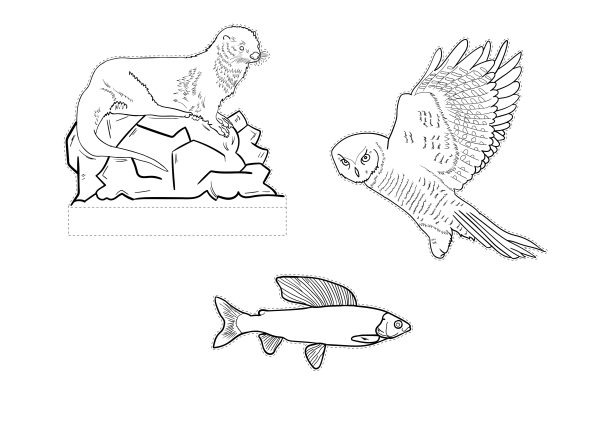
- One page with a wolverine, owl, and fish
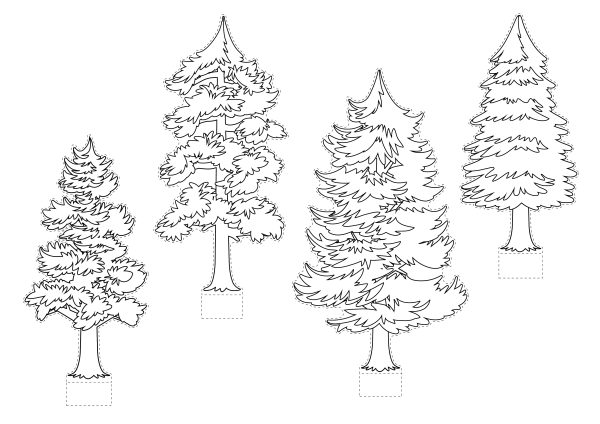
- One page with four conifer figures
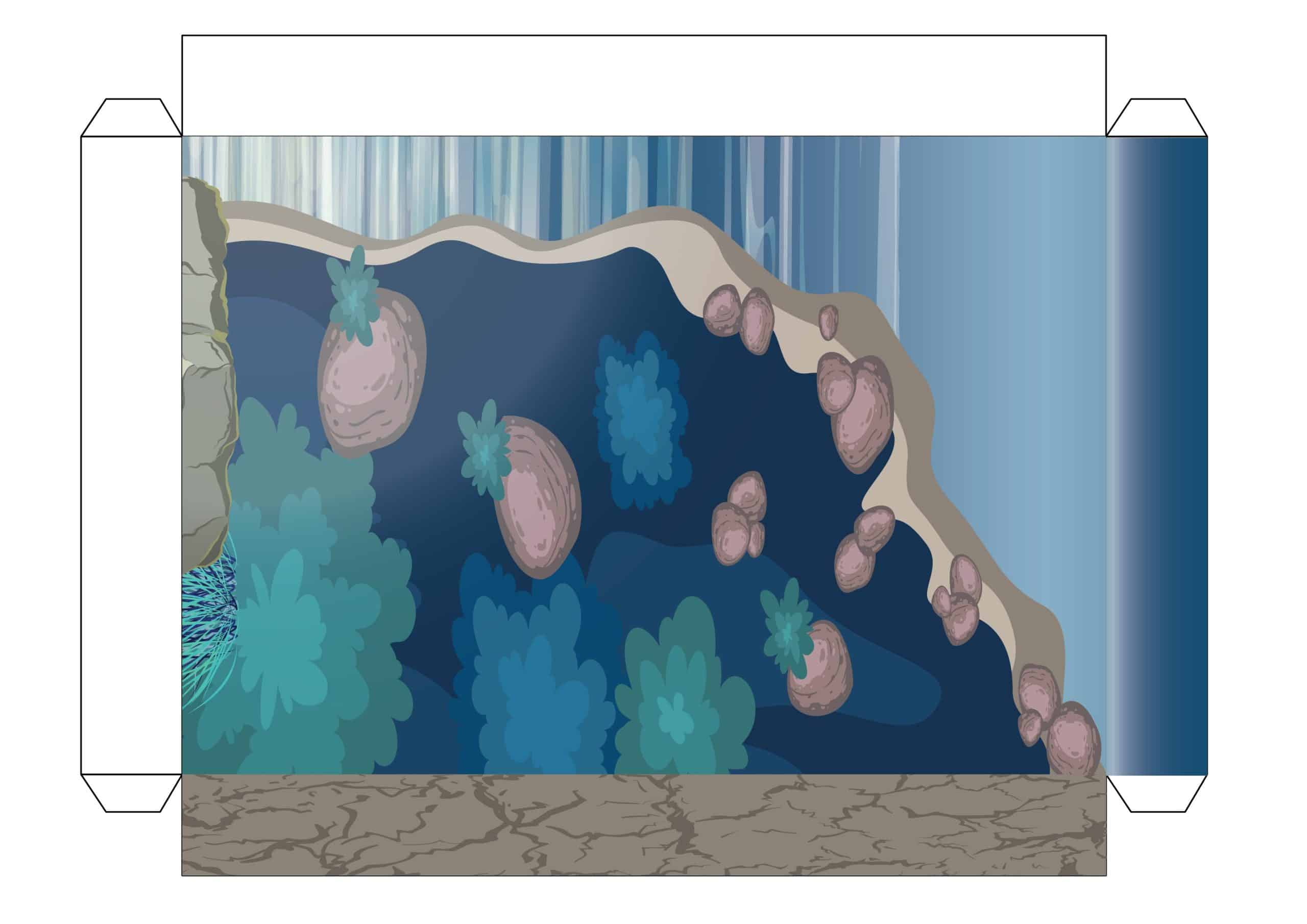
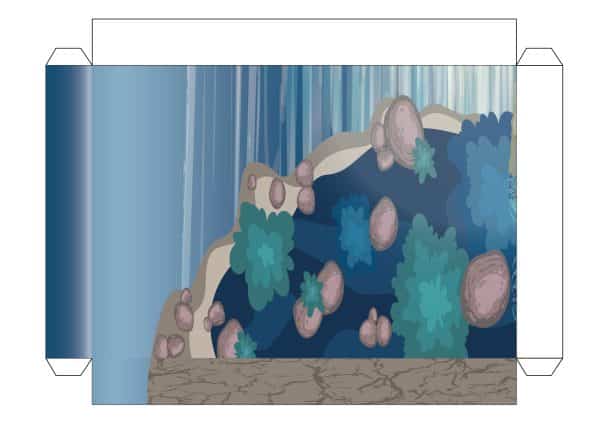
- Two foldable habitat pieces that create the ground and side sections
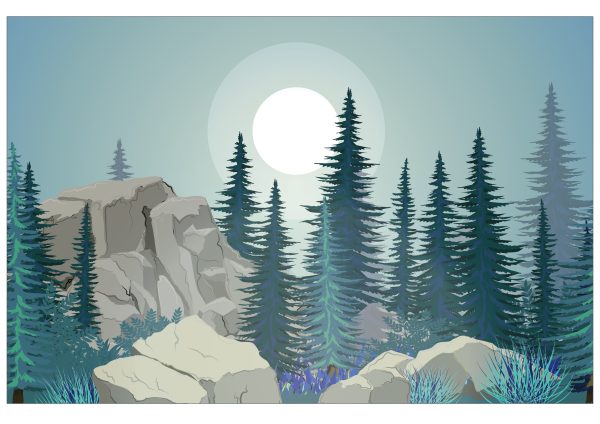
- One full-color northern woodland background
- Folding tabs on the standing creatures and conifers
- A colorful stream, rocks, vegetation, and woodland scenery
The scenery pieces are already colored. The conifers and wildlife are black-and-white so children can add their own details before assembling the display.
This craft creates a freestanding paper habitat, although it can also be placed inside a shoe box or attached to a sturdier cardboard base.
Animals Included in the Taiga Printable
The printable includes six animals of the taiga representing different parts of the ecosystem.
Caribou
Caribou, also called reindeer in some areas, are large members of the deer family. Their broad hooves help them travel across snow and soft ground. Caribou eat lichens, grasses, leaves, and other vegetation.
Their dense coat helps keep them warm in cold conditions. Many caribou herds migrate long distances to reach seasonal feeding and breeding areas.
Gray Wolf
This northern predator may hunt caribou, moose, deer, and smaller creatures, depending on what is available nearby.
A thick double coat helps it remain warm during the colder months. These animals also live and hunt cooperatively in family groups called packs.
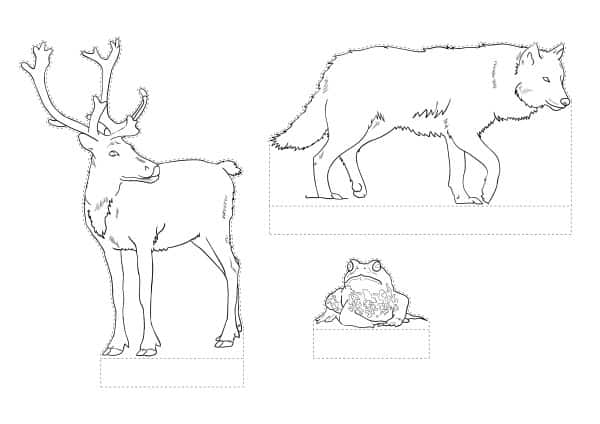
Wood Frog
A frog may seem surprising in such a cold biome, but wood frogs inhabit parts of the North American boreal zone. They remain inactive during the colder months and emerge when conditions warm.
Frogs are important members of wetland and woodland food webs. They consume insects and other small invertebrates and are eaten by fish, snakes, mammals, and larger hunters.
Wolverine
Wolverines are strong, stocky mammals related to weasels. Their thick fur, powerful legs, and broad feet help them move through deep snow and survive in northern habitats.
They eat a variety of foods and may hunt small creatures or feed on the remains of larger ones. Wolverines require large territories and are usually found in remote areas.
Owl
Several owl species live in boreal areas, including the great gray owl, boreal owl, northern hawk owl, and snowy owl along the biome’s northern edges.
These hunters use keen hearing and vision to locate prey. Many feed on voles, mice, squirrels, and other small inhabitants that live on or beneath the woodland floor.
Fish
Northern lakes and rivers support fish adapted to cold, oxygen-rich water. Species vary by location and may include grayling, whitefish, trout, pike, and salmon.
Fish connect aquatic and land food webs. They eat insects and smaller aquatic organisms and become food for mammals, larger fish, and other predators.
Plants Found in the Taiga
Coniferous vegetation is one of the most recognizable features of this environment.
Spruce
Spruce has short, stiff needles and cones that hang from its branches. Its narrow shape helps prevent heavy snow from accumulating and breaking the limbs.
Fir
Fir also keeps its needles through the colder season. Flexible, sloping branches help shed snow, while waxy needles reduce water loss.
Pine
Pine grows in many northern areas. Its needles are grouped in bundles, and seeds develop inside cones.
Larch
Unlike most conifers, larches lose their needles each year. Their soft needles turn yellow before falling in autumn.
Mosses and Lichens
Mosses and lichens grow on rocks, soil, and woody surfaces. Lichens are an especially important seasonal food for caribou.
Low-Growing Shrubs
Blueberries, cranberries, Labrador tea, and other hardy shrubs grow beneath openings in the canopy. Their presence varies according to moisture, soil, location, and amount of sunlight.
How Taiga Conifers Survive the Cold
Vegetation must cope with low temperatures, limited liquid water, nutrient-poor soil, and a short growing season.
Conifers have several useful features:
- Needle-shaped leaves have less exposed surface area than broad leaves.
- A waxy outer layer helps retain moisture.
- Dark green needles absorb sunlight.
- Flexible branches bend under the weight of snow.
- Sloping shapes help snow slide away.
- Many conifers keep their needles year-round.
- Shallow roots can use nutrients near the soil’s surface.
These features make conifers valuable to discuss while children assemble the printable habitat.
Taiga Climate for Kids
This taiga biome has long, cold winters and short, generally mild or cool summers. Most precipitation falls as snow during colder months or rain during the warmer season.
Weather conditions vary considerably because the biome stretches across several continents. A classroom report should use location-specific data rather than presenting one figure as true for the entire area.
For example, a student could choose:
- Interior Alaska
- Northern Canada
- Sweden
- Finland
- Siberia
- Another boreal area
They could then research average seasonal conditions and annual precipitation for that location.
Taiga Soil
Soil here is often thin, acidic, and relatively low in nutrients. Cool conditions slow decomposition, so dead organic material breaks down more slowly than it would in a warm environment.
Fallen conifer needles can also contribute to acidic conditions. In some areas, the ground remains wet because evaporation is slow or because underlying frozen layers interfere with drainage.
Rocks, moss, needles, and shallow soil are appropriate details to represent in a taiga biome project.
Supplies for the Printable Taiga Diorama
Gather these materials before beginning:
- Taiga biome diorama printable
- Color printer
- White cardstock or heavyweight paper
- Crayons, colored pencils, or markers
- Scissors
- Adhesive
- Ruler for making straight folds
- Optional scoring tool
- Optional shoe box or cardboard base
- Optional natural materials
Cardstock is recommended because the standing pieces need enough support to remain upright. Regular printer paper can work, but the tabs may need reinforcement with folded heavyweight paper.
How to Make a Taiga Biome Diorama
Step 1: Print the Template
Print all six pages. Use color printing for the full effect because the habitat base and boreal background are already illustrated.
Choose “fit to printable area” if your printer cuts off any tabs or outer edges. Print one test sheet before printing the complete file.
Step 2: Color the Animals
Color the caribou, frog, wolverine, owl, fish, gray hunter, and conifers.
Children can research each creature’s natural appearance or choose creative colors. If the work is being graded as a science assignment, natural coloring will make the scene more realistic.
Step 3: Cut Out the Figures
Carefully cut around each creature and conifer. Do not cut off the rectangular tabs beneath the standing figures.
The owl and fish do not have standing tabs. They can be attached directly to the background or habitat pieces.
Adult assistance may be helpful for children who are still learning to cut around detailed shapes.
Step 4: Cut Out the Habitat Base
Cut around the outer edges of the two illustrated habitat pieces. Keep all white tabs intact.
The foldable sections form the ground, stream, riverbank, and upright sides of the finished 3D display.
Step 5: Fold the Tabs
Fold the white tabs inward along the printed edges. A ruler can help create crisp, straight folds.
For especially clean results, an adult can lightly score the fold lines with a blunt tool before folding. Do not cut through the paper.
Step 6: Assemble the Base
Apply adhesive to the side tabs and connect the habitat sections. Hold the pieces in place until it begins to set.
The assembled base should form a shallow three-dimensional setting with raised side areas and a stream running through the middle.
Step 7: Add the Background
Cut out the illustrated scenery and attach it to the rear edge of the habitat base.
Make sure the conifers and rocky landscape face forward. Reinforce the back with a strip of cardstock if it bends.
Step 8: Fold the Figure Stands
Fold the dotted rectangular tabs at the bottom of the standing pieces. The tabs should sit flat against the habitat floor while the figures remain upright.
Test the placement of everything before securing anything down.
Step 9: Arrange the Conifers
Place them at different depths to make the setting feel dense.
Larger ones can go near the back, with smaller ones closer to the front. Leave enough space for the wildlife and water features to remain visible.
Step 10: Position the Animals
Arrange the wildlife according to where each inhabitant might live:
- Place the caribou near open vegetation.
- Position the predator along the woodland floor.
- Put the frog beside the water.
- Place the wolverine near the rocky section.
- Attach the owl to the background or above the conifers.
- Secure the fish in the stream.
This provides an opportunity to discover how different species use different portions of the same ecosystem.
Step 11: Secure Everything in Place
Once satisfied with the arrangement, attach the tabs to the base. Hold each one for a few seconds so it remains upright.
Allow the display to dry completely before moving it or preparing to diorama and present the finished work.
Can This Printable Be Used in a Shoebox?
Absolutely. Although the template creates its own paper habitat, the finished pieces can also be arranged inside a shoebox.
To make this version:
- Turn the box on its side.
- Attach the illustrated background to the inside back wall.
- Secure one habitat piece across the bottom.
- Trim the second piece if necessary.
- Arrange the conifers and animals inside.
- Add a title and biome facts to the outside.
A box provides additional support and more room for natural or handmade materials.
Optional Materials to Make the Diorama More Realistic
Children can personalize their work with safe craft or natural materials:
- Small pebbles
- Pine needles
- Tiny pinecones
- Twigs
- Moss
- Cotton for snow
- Blue cellophane for water
- Tissue paper greenery
- Modeling clay
- Brown construction paper
- White paint
- Artificial snow
- Crumpled paper rocks
Make sure natural materials are clean and completely dry before bringing them inside.
Create a Summer or Winter Taiga Scene
The provided background shows a northern woodland during a relatively mild season. Children can leave it as designed or adapt it to represent snowy conditions.
Summer Taiga
For a summer scene, include:
- Flowing water
- Green moss
- Blue or purple flowers
- Active frogs and fish
- Migrating wildlife
- Green shrubs
- Exposed rocks
Winter Taiga
For a colder version, add:
- Cotton or artificial snow
- White paint on branches
- A partially frozen stream
- Animal tracks
- Pale skies
- Snow-covered rocks
Ask children how wildlife behavior might change between the two seasons.
Add a Taiga Food Chain
A food chain shows how energy moves through an ecosystem.
One simplified example using organisms connected to the printable is:
Vegetation and lichens → caribou → gray hunter
Another possible aquatic example is:
Aquatic vegetation or algae → aquatic insects → fish → owl or mammal predator
Real food webs are more complicated than a single chain. Wildlife may eat several kinds of food, and diets can change with the seasons.
For a classroom presentation, children can add arrows to a separate informational card showing who eats what.
Taiga Animal Adaptations
Wildlife uses different strategies to survive cold conditions and seasonal food shortages.
Examples include:
- Thick fur or feathers for insulation
- Broad feet or hooves for traveling over snow
- Migration to reach food or warmer areas
- Hibernation or reduced seasonal movement
- Changes in diet
- Food storage
- Camouflage
- Shelters, dens, or burrows
- Layers of body fat
Ask children to choose two creatures from the printable and explain one feature that helps each in its habitat. Older students could also research a lynx or snowshoe hare for comparison.
Taiga Diorama Project Report
If the model is part of a school assignment, pair it with a one-page biome report.
The report could include:
- Names of the biome: taiga, boreal forest, snow forest
- Continents where it is found
- One example location
- Typical weather patterns
- Seasonal changes
- Common vegetation
- Common wildlife
- Flora survival features
- Wildlife survival features
- Soil conditions
- One food chain
- Environmental threats
- A labeled drawing, collage, or map
Children can also create small labels for each figure in the display.
Questions to Ask During the Project
Use these prompts to turn the craft into a science discussion and engage children as they explore the taiga biome:
- Why are conifers common here?
- How do needle-shaped leaves help them?
- Why are there lakes and wetlands in many boreal areas?
- How does this large canine remain warm during cold weather?
- Why might an owl or other flying species migrate away from this area?
- What would happen if the fish disappeared from the stream?
- Which creature in the model hunts other animals?
- Which ones might be prey?
- Where would the frog go during the colder months?
- How is this biome different from the tundra?
- How is it different from a temperate woodland?
- What might happen if much of the vegetation were removed?
Taiga Versus Tundra
The taiga and tundra are both cold biomes, but they are not the same.
| Feature | Taiga | Tundra |
|---|---|---|
| Dominant vegetation | Coniferous forest | Mosses, lichens, grasses, and low shrubs |
| Tall vegetation | Abundant | Few or no tall forms |
| Location | South of much of the Arctic tundra | Farther north or at high elevations |
| Growing season | Short | Very short |
| Soil | Often acidic and nutrient-poor | Often affected by permafrost |
| Familiar wildlife | Wolves, caribou, moose, bears, and owls | Caribou, Arctic foxes, lemmings, and snowy owls |
This comparison helps prevent a common biomes project mistake: covering a northern woodland scene with snow but forgetting its defining feature—the coniferous vegetation.
Threats to the Taiga
The boreal forest faces pressures from logging, mining, roads, resource development, wildfires, insect outbreaks, and changing weather patterns.
Wildfire is also a natural part of many northern ecosystems, helping recycle nutrients and create new habitat. However, shifts in precipitation and seasonal conditions may alter how often fires occur and how intensely they burn.
For an elementary assignment, children can add a short conservation card explaining why large, connected habitats are important for wildlife.
Learning Benefits of a Biome Diorama
Creating a 3D display allows children to represent scientific ideas visually and spatially. This fun way to explore a habitat can support practice with:
- Habitat vocabulary
- Animal classification
- Food chains and food webs
- Flora and wildlife survival features
- Geography
- Research
- Fine-motor control
- Following directions
- Planning and organization
- Oral presentations
The model is especially helpful for children who learn well through hands-on projects.
More Printable Biome Dioramas
Continue your ecosystem study with these related projects:
- Shoebox Diorama Printables
- Desert Diorama
- Rainforest Diorama
- Ocean Diorama
- Tundra Biome Diorama
- African Savanna Diorama
- Coral Reef Diorama
Linking this post from the main diorama hub with the anchor text taiga biome diorama will help establish its place within your printable biome collection.
Build Your Printable Taiga Biome Diorama
This taiga biome project turns a geography or ecosystem lesson into an interactive display children can build and share. With its illustrated scenery, stream, conifers, and six figures, the printable gives students a strong foundation for exploring habitats, seasonal conditions, survival features, and food webs.
Print the six-page template, color the figures and conifers, assemble the foldable habitat, and arrange the pieces to create a unique miniature northern environment.
For additional inspiration for taiga diorama projects, families and teachers can also discover Pinterest’s best ideas and inspiration, find and save ideas, or save ideas about taiga diorama projects for future lessons.
Purchase the Taiga Biomes Shoebox Diorama Printable HERE
What is another name for the taiga?
It is also called the boreal forest or snow forest. Boreal means northern.
Is a taiga a forest or a tundra?
It is a forest biome dominated by conifers. Tundra is generally farther north or at high elevations and has few or no tall woody forms.
What animals are included in the printable?
The six-page printable includes a caribou, wolf, frog, wolverine, owl, and fish.
What trees are included?
The printable includes four conifer figures in different sizes and shapes.
How many pages are in the PDF?
The PDF contains six landscape-oriented A4 pages.
Is a shoebox required?
No. The template includes foldable habitat pieces that create a freestanding paper display. A shoebox or cardboard base can be added for extra support.
What type of paper works best?
White cardstock is best for the figures and foldable structure. Regular printer paper may bend or collapse unless reinforced.
Should children color the printable before cutting?
Yes. Coloring the figures while they are still on full sheets is generally easier than adding details after cutting.
What age is this project for?
The science content works well for elementary-age students. Younger children may need adult help with detailed cutting, folding, and assembly.
How long does the project take?
Allow approximately 45–90 minutes for coloring, cutting, folding, arranging, and securing the pieces. Drying time and additional research may extend the project.
Where is the taiga located?
This biome stretches across northern parts of North America, Europe, and Asia, including large areas of Canada, Alaska, Scandinavia, and Russia.
