
Time Capsule Ideas: What to Put in a Time Capsule
A time capsule captures the small details of life that are easy to forget—favorite songs, everyday prices, handwritten notes, family jokes, school memories, and hopes for the future.
Whether you are making one at home, in a classroom, at a family reunion, or before graduation, the best time capsule ideas combine personal memories with a snapshot of life today.

Time Capsule Ideas for Kids, Families, and School
You do not need a special kit or an enormous collection. Choose a safe container, add a few meaningful paper items and photos, decide when you will open it, and label the outside clearly. This guide includes plenty of ideas for what to put in a time capsule, along with age-specific suggestions and practical storage tips.
10 Things to Put in a Time Capsule
If you want to keep the project simple, begin with these ten things to include:
- A letter to your future self
- A current family or class photograph
- A list of favorite things
- A drawing or short piece of schoolwork
- A list of current goals and predictions
- A receipt showing everyday prices
- A printed list of favorite songs, books, movies, or shows
- A newspaper front page or printed summary of current events
- A small paper keepsake, such as a ticket or invitation
- A message from a parent, teacher, friend, or relative
These items create a balanced picture of the person, family, or class making it. Add more items only when each one has a clear story or meaning.
Time Capsule Ideas for Kids
A kids’ time capsule works best when children help choose and explain what goes inside. Their handwriting, funny answers, and drawings will often become the most treasured pieces. These suggestions for kids are easy to personalize for different ages.
- A self-portrait
- Hand and foot outlines
- A page describing “All About Me”
- Current height, age, shoe size, and lost-tooth count
- Favorite food, book, toy, game, song, and color
- A list of best friends
- A drawing of the family or family pet
- A recent photograph
- A sample of handwriting
- A short interview with the child
- A birthday card or party invitation
- A copy or photo of a favorite piece of artwork
- A list of things the child can do now
- Three wishes or an aspiration for the future
- A letter or message from a parent or grandparent
Photograph a favorite stuffed animal, large toys, books, trophies, and art projects rather than placing the originals inside. The picture preserves the memory without filling the box or risking damage to something the child may want later. It also gives them a fun glimpse of childhood when they look back years from now.
Family Time Capsule Ideas
Creating a family time capsule is a meaningful New Year’s activity, moving-day tradition, anniversary project, or way to remember an ordinary season of life. It is a great way to involve the whole family in preserving memories together.
- A family photo with names and ages written on the back
- A page describing each family member’s favorites
- A family bucket list
- A copy of a favorite family recipe
- A floor plan or drawing of the current home
- Photos of bedrooms, vehicles, pets, and the neighborhood
- A local map
- A list of common household expenses
- A grocery or restaurant receipt
- Notes about jobs, school, hobbies, and weekly routines
- Vacation postcards or copies of ticket stubs
- A family tree
- A list of funny sayings and inside jokes
- Predictions about where everyone will be when the capsule opens
- Individual messages from each family member
For a family reunion time capsule, invite each household to contribute one photo, one written memory, and one prediction for the next reunion. Add a reunion program, a group picture, a family recipe, and an updated family tree. Open the capsule at a future reunion and replace it with a new one for future generations.
For more ideas centered on a child’s earliest memories, see these baby time capsule ideas.
School Time Capsule Ideas
A time capsule activity gives students an authentic reason to write, reflect, measure, compare, and make predictions. Students can complete it at the beginning of the school year and open it during the final week, or save it until they finish elementary, middle, or high school.
Kindergarten Time Capsule Ideas
Keep the writing short and let children draw or dictate answers. These simple ideas can capture an important milestone without requiring much writing.
- First-day photo
- Self-portrait
- Name-writing sample
- Handprint or traced hand
- Height measurement
- Favorite classroom activity
- Favorite book or read-aloud
- Drawing of the teacher and class
- “When I grow up” picture
- One thing the child wants to learn
Opening the capsule at the end of kindergarten makes growth easy to see. Children can compare their handwriting, drawings, height, interests, and confidence and look back at how much has changed.
Elementary and Middle School Ideas
- Class photo
- Writing sample or short journal entry
- Favorite memory from the school year
- List of books read
- Current goals
- Predictions about school and technology
- Copy of a class schedule or lunch menu
- Drawing of the classroom
- Note from the teacher
- Class survey showing favorite subjects, music, games, and trends
Protect student privacy. Do not include home addresses, phone numbers, private records, or identifying account information in a class capsule.
High School and Senior Time Capsule Ideas
A senior time capsule can capture both the end of high school and the uncertainty of what comes next. Graduation is a great opportunity to record goals, friendships, favorite trends, and plans before the big day.
- Senior photo or graduation announcement
- Copy of the graduation program
- A letter to your future self
- Favorite high school memory
- Current playlist written on paper
- Career and education plans
- Goals for one, five, and ten years from now
- A list of people who made a difference
- Photos with friends, teachers, teams, or clubs
- Copies of event tickets
- School newspaper or yearbook-page photocopy
- A list of current fashions, slang, apps, and technology
- Predictions about future work, family, travel, and interests
- A message from a parent, teacher, coach, or mentor
Use copies or photos instead of an original diploma, transcript, school ID, graduation tassel, or irreplaceable keepsake.
DIY Time Capsule Box Ideas
For a capsule stored indoors, you can use:
- A sturdy photo-storage box
- An archival document box
- A clean metal tin
- A plastic bin with a tight lid
- A decorated shoebox placed inside a larger protective container
- A wooden box kept in a safe indoor location
- A large envelope for a one-year classroom capsule
You can decorate the box with drawings, stickers, or wrapping paper to personalize it. Write the creation date, intended opening date, items inside, and owner’s name on both the inside and outside. For a child’s capsule, you can also add the child’s name and opening date.
Make a note explaining why the capsule was created. Store it in a cool, dry, dark place where someone will remember it—but away from an attic, garage, basement, or exterior shed where heat or moisture can cause damage.
Do not bury an ordinary box or container. Soil and water can quickly ruin the items inside, and digging may disturb utility lines or violate local property rules. If you want an outdoor capsule, use a purpose-made, durable waterproof container and obtain the property owner’s permission first.
Steps for Making a Time Capsule
- Pick the event or moment. Decide whether the capsule represents a birthday, school year, graduation, reunion, move, holiday, baby’s first year, or ordinary day.
- Set an opening date. One year works well for younger children and classrooms. Five, ten, or twenty years can be meaningful for families and graduates.
- Find a suitable container. Match the box to the storage location and amount of material.
- Decide what will go inside. Include in your time capsule a mix of photos, handwriting, facts about today, and future predictions.
- Label everything. Write names, dates, locations, and short explanations on acid-free paper or separate labels.
- Prepare the items. Use clean, completely dry materials. Place photographs and papers in archival-safe sleeves, if possible, to keep them intact.
- Record everything you added. Keep one copy of the list inside and another with your household or school records.
- Seal and store it. Mark the name and opening date prominently, and add a calendar reminder.
If you include digital photos, audio, or video, do not rely on a flash drive as the only copy. File formats and devices change. Keep the files in at least two maintained storage locations, include printed descriptions, and migrate them to newer storage over time.
What Not to Put in a Time Capsule
Leave out anything that can spoil, leak, attract pests, create a safety problem, or expose private information. Avoid:
- Food, candy, drinks, or fresh plants
- Makeup, lotion, batteries, aerosols, or liquids
- Damp materials
- Sharp, flammable, or hazardous items
- Prescription medicine
- Original birth certificates, passports, diplomas, or legal records
- Credit card, banking, password, or Social Security information
- Original valuables or sentimental, irreplaceable heirlooms
- Copyrighted books, movies, or music when a written list or photo will tell the story
Use copies, photographs, written descriptions, or empty clean packaging when you want to represent an artifact that should not be stored.
Printable Time Capsule Pages
Printable prompts help children and adults record details they might otherwise overlook. Useful pages include an “All About Me” interview, a favorite-things list, a current-events page, a family profile, predictions, goals, and a note to their future selves.
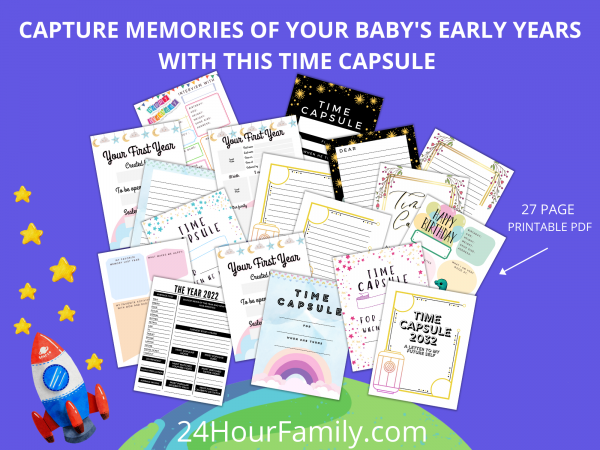
For a more complete keepsake, the 27-page Time Capsule for a Child’s Early Years includes birthday interview pages, current-event prompts, and stationery for messages to a child or future self. This paid US Letter PDF is delivered digitally, not as a physical item.
More Family Activities and Keepsakes
A time capsule is all about capturing memories, personalities, and special moments. These activities offer even more ways for kids and families to learn about each other and save memories to look back on later.
- All About Me Printables for Teens – A fun way for teens to record their interests, favorites, goals, and details about who they are right now.
- Would You Rather Family Game Night Questions – Get everyone talking and laughing with entertaining questions that can spark memorable family conversations.
- First Day of School All About Me Printable – A simple back-to-school activity that captures a child’s favorites and personality at the beginning of a new school year.
Putting together a time capsule can be simple. A thoughtful message, one photograph, and a few details about everyday life can become fascinating years later.
The most important step is to include the people involved, explain each item’s meaning, and make sure someone remembers when and where to open the capsule.
How long should you keep a time capsule closed?
Choose a period that fits the age and occasion. One school year is ideal for young children; five to ten years works well for families; graduating seniors may choose ten or twenty years. Write the exact opening date on the container.
What could you include in a child’s time capsule?
A simple example includes a current photo, self-portrait, handwriting sample, favorite-things page, height measurement, drawing of the family, three future predictions, and a note from a parent. Let them help choose what goes inside when they are old enough to make their own selections.
Can a time capsule be created digitally?
Yes, but digital files require maintenance. Keep multiple copies, name files clearly, save a printed inventory, and transfer the collection to current storage formats every few years.
Is it a good idea to bury a time capsule?
Indoor storage is safer and easier for most family and school projects. If you bury one, use a container designed for underground storage, choose a legal, safe location, and record its exact position.
How do you keep paper from deteriorating?
Use clean, dry paper; remove rubber bands and metal clips; choose archival-safe sleeves or folders; and store the sealed box in a cool, dry, dark indoor location.
