
Tundra Biome Diorama Printable for a School Project
Build a miniature cold-weather arctic ecosystem with this tundra biome diorama printable. The seven-page template includes mountain scenery, tundra animals, plants, trees, clouds, and both color-your-own and precolored landscape options.
Kids can color, cut, fold, and arrange the printable pieces to assemble a three-dimensional biome diorama model. Display the finished scene as a tundra shoebox project, homeschool science activity, classroom display, or fun visual aid for an animal habitat lesson.

Tundra Biome Diorama With Printable Templates
The printable animal pieces include a caribou or reindeer, polar bear, wolf, Arctic hare, and snowy owl. Children can arrange them among the low grasses, mountains, wetlands, and optional evergreen forest pieces to design their own cold-region habitat.
This is a paid printable available in my shop. The complete template can be purchased through the link near the bottom of this post.
You can purchase the Tundra Biome Printable Diorama here
What Is a Tundra Biome?
The tundra is a cold, dry, and generally treeless biome with a short growing season. Winters are long, while summers are brief and cool.
Tundra plants remain low to the surface, where they have some protection from strong winds and cold temperatures. Grasses, sedges, mosses, lichens, dwarf shrubs, and small flowering plants are more common than tall trees.
There are two principal types of tundra:
Arctic tundra
Arctic tundra is found at high northern latitudes in areas of Alaska, Canada, Greenland, Scandinavia, and Russia.
Permafrost covers much of the soil. It is a layer of soil or sediment that remains frozen for at least two consecutive years. The surface may thaw during the short summer, allowing low plants to grow, while the deeper layers remain frozen.
Alpine tundra
Alpine tundra occurs high in mountains above the treeline.
It shares many characteristics with Arctic tundra, including cold temperatures, strong winds, low-growing plants, and a short growing season. However, continuous permafrost is less common in alpine tundra than it is in the Arctic.
The mountain background in this printable makes it especially suitable for an alpine tundra diorama. The included polar bear and other northern animals also allow children to assemble an Arctic-inspired version.

What Is Included in the Printable?
This seven-page printable provides the scenery and freestanding pieces needed to build a layered tundra biome display.
Mountain background
The mountain landscape forms the upright backdrop of the diorama. It includes several snowcapped peaks and space for children to add clouds, a flying snowy owl, or additional picture elements for their Arctic tundra diorama.
Two versions are included:
- A black-and-white mountain background to color
- A precolored blue and purple mountain background
Tundra landscape scene
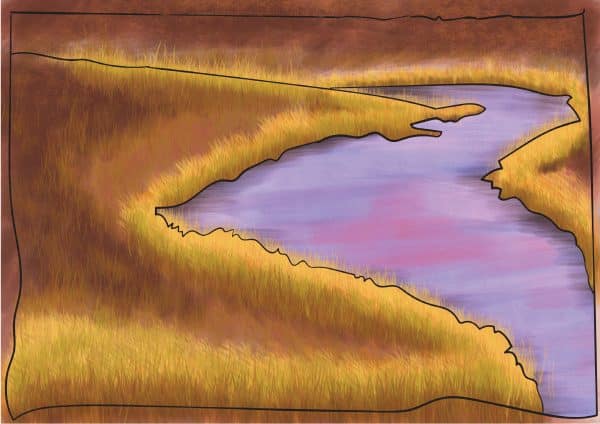
The second large landscape page forms the bottom section of the diorama. It features a gently sloping landscape with a river, pond, or wetland.
The printable contains:
- A black-and-white landscape scene
- A precolored landscape scene with brown and golden vegetation surrounding a purple-blue pond
Wetlands, shallow lakes, ponds, and winding streams can occur across tundra landscapes because frozen soil may prevent moisture from draining deeply into the earth.
Tundra animals
The printable contains five animal pieces:
- Caribou or reindeer
- Polar bear
- Wolf
- Arctic hare
- Snowy owl
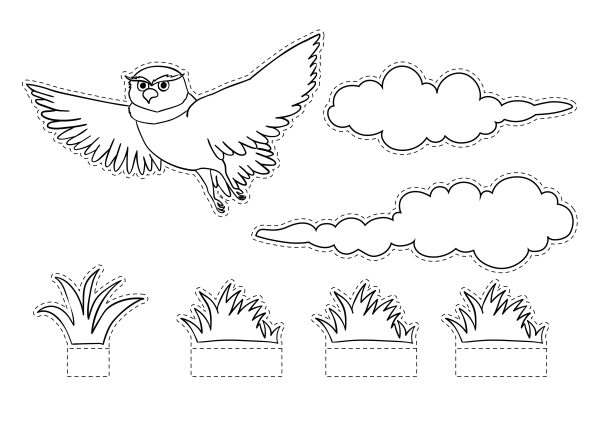
Each figure has an outlined cutting guide and, when needed, a rectangular folding tab that allows it to stand upright.
Plants and evergreens
Children can add:
- One large evergreen
- One smaller evergreen
- Four clumps of low grass
The grasses are the most scientifically accurate choice for the open tundra. The evergreens can represent the nearby treeline, a subalpine transition, or a creative northern mountain scene.
Clouds
Two large cloud pieces can be attached to the background to add additional depth.
Color-your-own and precolored choices
The backdrop and landscape are available in both black-and-white and color.
Children can:
- Color the entire ecosystem themselves
- Choose the precolored landscapes to save time
- Combine a precolored background with hand-colored animals
- Print both versions and compare seasonal color choices
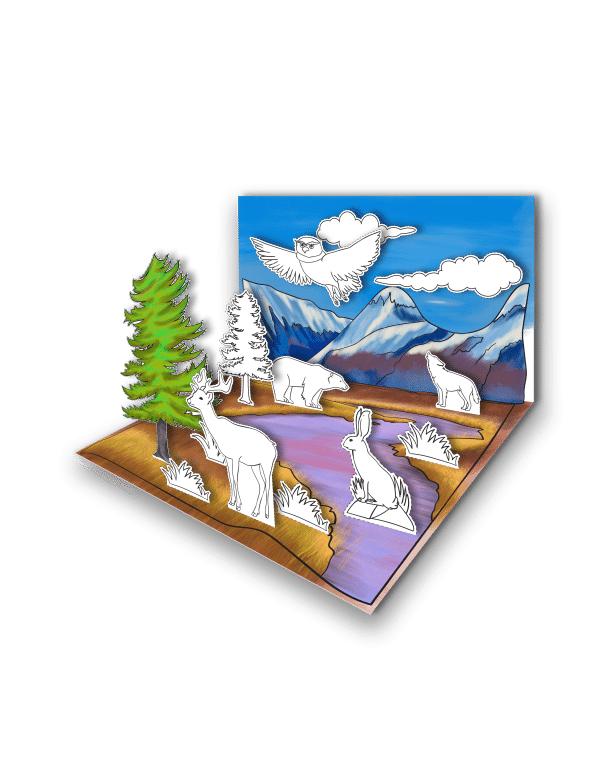
Animals in the Tundra Diorama
The animal pieces work like small paper figurines, giving children an opportunity to learn how wildlife survives in cold environments.
Caribou or reindeer
Caribou are members of the deer family. Wild populations in North America are commonly called caribou, while the name reindeer is usually associated with Eurasian and domesticated populations.
Caribou have thick coats and broad hooves. Their hooves help them travel across snow and soft terrain while also digging for food.
Arctic hare
Arctic hares have compact bodies, thick fur, and relatively short ears compared with rabbits from warmer climates. These features help reduce heat loss.
Their coats provide camouflage against snow and rocky tundra terrain.
Snowy owl
Snowy owls are large, pale owls that live and breed in northern regions. Their feathers provide insulation, and their light coloring helps them blend into open snowy landscapes.
Place the owl above the mountains or clouds to make it appear to be flying over the tundra.
Wolf
Wolves thrive in many northern habitats thanks to their adaptability. Thick coats help protect them in cold weather, and their large paws assist with traveling across snow.
Polar bear
Polar bears are closely associated with the Arctic tundra, but they spend most of their time on sea ice and along coastal areas rather than in inland alpine tundra.
If the biome diorama is being used for a strict science assignment, place the polar bear near the shoreline to represent a coastal Arctic setting.
Plants in the Tundra Biome
Tundra plants must survive cold temperatures, wind, limited precipitation, and a short growing season.
Common tundra vegetation includes:
- Grasses
- Sedges
- Mosses
- Lichens
- Dwarf willow
- Dwarf birch
- Bearberry
- Cotton grass
- Small flowering plants
Many tundra plants grow close to the surface. This growth pattern helps protect them from wind and allows them to benefit from the slightly warmer air near the soil.
The National Park Service describes the tundra as a treeless zone where hardy low-growing plants replace the forests found at lower elevations.
What about the evergreens in the printable?
Large evergreens do not grow in true tundra. If your child is creating an Arctic tundra biome, select the low grass pieces and leave out the evergreen pieces.
The evergreens can be included when depicting:
- The edge of the treeline
- A subalpine-to-alpine transition
- A northern mountain valley
- A creative winter habitat rather than a strict tundra model
This distinction makes a helpful talking point during the activity. Children can decide which pieces belong in their chosen version and explain their reasoning.
Supplies Needed:
- Tundra biome diorama printable
- Printer
- White cardstock
- Crayons, markers, colored pencils, or watercolor paints
- Scissors
- Glue stick or craft glue
- Clear tape, optional
- Shoebox or piece of cardboard, optional
Cardstock works better than regular printer paper for the freestanding animals, evergreens, and plants. It helps the figures remain upright after their tabs are folded.
Regular printer paper also works for the background and landscape scene. Glue the paper to lightweight cardboard if it needs additional support.
Adult supervision may be necessary when younger children are cutting the detailed animal and plant shapes.
How to Make a Tundra Biome Diorama
1. Choose your landscape pages
Decide whether to print the black-and-white or precolored versions of the mountain background and tundra landscape.
The black-and-white pages are a good option for children who want to color the complete environment. Choose the precolored pages for a faster school project or classroom activity.
2. Print the templates
Print the selected landscape pages and all three pages of animals, plants, clouds, and evergreens.
For the strongest results:
- Print the scenery on regular paper or cardstock
- Print the freestanding pieces on cardstock
- Select actual size or 100 percent in the printer settings
- Avoid enlarging the pages, which may cut off part of the templates

3. Color the black-and-white pieces
Color the animals, plants, evergreens, clouds, background, and landscape before cutting.
Tundra colors might include:
- White and pale blue for snow
- Gray, blue, and purple for mountains
- Brown and gold for dormant grasses
- Green for summer vegetation
- Pale blue or purple for water
- White, gray, tan, and brown for animals
Children do not have to reproduce the finished mockup exactly. They can discover seasonal colors by looking at real tundra photographs.

4. Cut out the scenery
Cut around the outside edge of the mountain background and landscape scene.
If the display will be placed in a shoebox, test the scenery against the box before gluing. Trim the outer edges only as needed to fit the back and bottom panels.

5. Connect the background and landscape
Position the mountain background upright behind the landscape scene.
Tape the adjoining edges of the two pages together to form a hinge for a freestanding paper diorama. Bend them to form an approximately 90-degree angle.
For a sturdier display, glue:
- The mountain scene to the back wall of a shoebox
- The tundra landscape to the bottom of the box
You can also attach both pages to two pieces of cardboard joined at a right angle.
6. Cut out the animals and plants
Carefully cut around the dashed outlines surrounding each animal, evergreen, cloud, and grass piece.
Do not cut off the rectangular tabs beneath the standing figures. These tabs form the bases that hold the pieces upright.

7. Fold the standing tabs
Fold each rectangular tab backward along the line where it meets the illustration.
Apply glue to the bottom of the tab and press it onto the landscape scene. Hold it in place until it begins to stay upright.
8. Plan the animal placement
Place all the pieces first, then glue them once you’re happy with the layout. This is a good idea for testing different scene layouts before attaching them.
For a layered appearance:
- Place the caribou or reindeer near the front
- Position the polar bear closer to the water
- Place the wolf farther back
- Put the Arctic hare among the low grasses
- Attach the snowy owl to the mountain background
- Arrange larger objects near the foreground
- Place smaller pieces near the back
Spacing the animals across the scene makes it easier to see each one and creates the illusion of depth.
9. Add the plants and optional evergreens
Glue the grass clumps across the landscape.
If you’re aiming for an accurate Arctic tundra model, choose the low grasses rather than the larger evergreens. For an alpine transition scene, place the evergreens near the outer edge to represent the treeline below the open tundra.
10. Add clouds and the snowy owl
Glue the clouds to the sky area of the mountain backdrop.
Place the snowy owl between or above the clouds. Attach it by the body or wing area while allowing part of the figure to extend away from the background for a dimensional effect.
11. Allow the diorama to dry
Let the glue dry completely before moving the display.
If a figure leans, add a small piece of clear tape to its base or glue its tab to a slightly larger piece of cardstock.
Tundra Shoebox Project Idea
Build the printable as an open paper scene or mount it inside a shoebox for a tundra biome project.
To create the shoebox version:
- Remove the lid and turn the shoebox onto one long side.
- Glue the mountain background against the interior back wall.
- Glue the ground scene across the bottom.
- Trim the scenery only if needed to fit the box.
- Fold and arrange the animals and plants.
- Glue the figures onto the floor.
- Attach the clouds and snowy owl to the back wall.
- Add a title and informational labels to the outside.
The box protects the paper pieces and makes the display easier to transport to school.
Tundra Diorama Labels for a School Project
If the diorama is being used for a science assignment, add small labels or a display card containing:
- Name of biome
- Type of tundra
- Climate
- Average precipitation
- Important land features
- Common plants
- Common animals
- Animal adaptations
- Plant adaptations
- Location of the biome
- Definition of permafrost
Children can also place toothpick labels beside individual animals and plants. Use a small ball of modeling clay to hold each label upright rather than puncturing the paper figures.
Tundra Animal Adaptations
An adaptation is a physical feature or behavior that helps an organism survive in its environment.
Animals in cold northern habitats may have:
- Thick fur or feathers for insulation
- A layer of body fat
- Seasonal coat-color changes
- Compact bodies that reduce heat loss
- Broad paws or hooves for traveling across snow
- Migration patterns
- Burrowing behavior
- Camouflage
- Food-storing behaviors
After building the tundra diorama, ask your child to select one animal and explain two adaptations that help it survive.
Tundra Plant Adaptations
Tundra plants may survive by:
- Growing close to the ground
- Developing shallow roots
- Growing in clumps
- Producing small or hairy leaves
- Remaining dormant through winter
- Completing growth and flowering quickly
- Using dark colors to absorb warmth
Students can add a written note explaining why the printable’s short grass pieces are more typical of tundra than its tall evergreen pieces.
Arctic Tundra Versus Alpine Tundra
| Feature | Arctic tundra | Alpine tundra |
| Location | High northern latitudes | High mountains above treeline |
| Landscape | Plains, wetlands and low hills | Rocky slopes and mountain peaks |
| Permafrost | Common and widespread | Less continuous and sometimes absent |
| Trees | Absent | Absent above treeline |
| Plants | Mosses, lichens, grasses and dwarf shrubs | Low grasses, cushion plants and small flowers |
| Printable pieces to emphasize | Water, grasses, polar bear and northern animals | Mountains, grasses, hare, wolf and caribou |
The template can represent either the Arctic tundra biome or alpine tundra with thoughtful piece selection. The mountain scenery naturally suggests alpine tundra, while the polar bear and wetland floor suggest an Arctic tundra interpretation.
Tundra Food Chain Activity
Extend the diorama lesson by creating a tundra food chain.
One possible example is:
Tundra plants → Arctic hare → wolf
Explain that arrows in a food chain show how energy moves through the ecosystem.
The snowy owl can be part of another tundra food chain involving small mammals that are not shown in the printable. Children can draw and add a lemming if they want to expand the ecosystem.
A more complete food web can include:
- Grasses
- Lichens
- Dwarf shrubs
- Lemmings
- Arctic hares
- Caribou
- Snowy owls
- Arctic foxes
- Wolves
Questions to Ask After Building the Diorama
Use these questions for discussion or a written report:
- What makes the tundra different from a forest?
- Why are there few or no trees in true tundra?
- What is permafrost?
- What plants can survive in the tundra?
- Which animals are represented in your diorama?
- How does each animal survive cold weather?
- Is your scene Arctic tundra or alpine tundra?
- Which printable pieces support your answer?
- Why did you place the polar bear near the water?
- How does the short growing season affect plants?
- What would change in the diorama during summer?
- What is one example of a food chain in this ecosystem?
More Diorama Ideas to Discover
If you enjoyed building this Tundra Biome Diorama, here are more hands-on diorama projects that make learning about science and nature even more fun.
- Printable Layers of the Ocean Diorama – Explore the different ocean zones with a colorful 3D model that helps kids learn what lives at each depth.
- Groundhog Life Cycle Printable Diorama – Follow the stages of a groundhog’s life with an interactive project that’s great for animal studies.
- Printable Leaf Anatomy Diorama – Learn about the parts of a leaf by assembling a three-dimensional model that’s both educational and fun.
- Rock Cycle Diorama – Discover how rocks change over time with a visual project that brings earth science concepts to life.
- Water Cycle Diorama Printable – Build a 3D model that illustrates evaporation, condensation, precipitation, and collection in an engaging way.
- Shoebox Diorama Printables – Find a variety of printable projects that turn an ordinary shoebox into an exciting educational display.
Purchase the Tundra Biome Diorama Printable
This seven-page Tundra Biome Diorama printable provides the scenery and figures needed to build a three-dimensional cold-region habitat.
The printable includes:
- Black-and-white mountain background
- Black-and-white tundra ground scene
- Precolored mountain background
- Precolored tundra landscape
- Caribou or reindeer
- Polar bear
- Wolf
- Arctic hare
- Snowy owl
- Two evergreen pieces
- Four clumps of grass
- Two clouds
- Folding tabs for freestanding pieces
Click the button below to purchase and download the complete Tundra Biome Diorama printable.
This is a digital product. No physical item will be mailed. Please follow the usage terms included with your download and do not resell, share, or redistribute the printable files.
You can purchase the Tundra Biome Printable Diorama here
What is a tundra diorama?
A tundra diorama is a small three-dimensional model showing the landscape, plants, animals, and other features of a tundra ecosystem.
What is included in the seven-page printable?
The complete printable contains seven pages. It includes black-and-white and precolored landscape choices plus printable animals, evergreens, grasses, clouds, and folding tabs.
Can this printable be used inside a shoebox?
Yes. Place the mountain background against the back of a shoebox and attach the tundra landscape to the base. The folded animal and plant figures can then be arranged inside.
Which animals are included?
The template includes a caribou or reindeer, polar bear, wolf, Arctic hare, and snowy owl.
Why are evergreen cutouts included if tundra is treeless?
The evergreen pieces are optional. They can represent the treeline or a nearby subalpine region. For a strict Arctic or alpine tundra model, omit the large evergreens and use the low grass pieces.
What is the difference between Arctic and alpine tundra?
Arctic tundra occurs at high northern latitudes and commonly has widespread permafrost. Alpine tundra occurs at high elevations above the treeline. Both are cold, windy, and treeless.
What paper works best?
Cardstock is recommended for the animals, plants, and other standing pieces. Regular printer paper can be used for the large scenery pages, especially when they are glued to a shoebox or cardboard support.
What age is this diorama project for?
The activity works well for elementary-aged children. Younger children may need help cutting the detailed outlines and assembling the folding tabs.
Tundra Biome Diorama
Build a three-dimensional tundra habitat with seven printable pages featuring mountains, water, plants, tundra animals, clouds, and freestanding scenery.
Materials
- Tundra biome diorama printable
- White cardstock
- Crayons, markers, colored pencils, or paint
- Scissors
- Glue
- Clear tape, optional
- Shoebox or cardboard, optional
Tools
- Printer
- Scissors
Instructions
- Purchase, download, and print the tundra diorama templates.
- Choose the black-and-white or precolored landscape pages.
- Color the animals, plants, and scenery before cutting.
- Cut out the mountain background and tundra ground.
- Join the two landscape pages at a right angle or attach them inside a shoebox.
- Cut around the animals, trees, grasses, clouds, and snowy owl.
- Fold the rectangular tabs backward along the dashed lines.
- Arrange the animals and plants across the habitat.
- Glue the folded tabs to the ground.
- Attach the clouds and snowy owl to the background.
- Allow the project to dry completely before displaying it.
