
Free Printable Alphabet Matching Wheel for Preschool
This free printable alphabet matching wheel turns capital letter practice into a colorful, hands-on activity for preschool and kindergarten, making the alphabet much more engaging when kids can touch, move, and match the letters themselves.
Children choose an uppercase letter piece and find its match on the wheel, building letter recognition, visual matching, alphabet order, and fine motor skills — all without any complicated setup.

The resource includes two wheel designs and two styles of capital letter pieces. You can choose the version that works best for your child, classroom, or learning center.
Free Printable Alphabet Matching Wheel Activity
Please note: This resource practices matching capital letters to the same capital letters. It does not include lowercase letters.
What Is an Alphabet Matching Wheel?
An alphabet matching wheel is a circular activity in which the letters A through Z are arranged around the outside. Children match individual pieces to the corresponding characters on the wheel.
Instead of completing a traditional worksheet, children actively pick up, compare, and place each piece. This makes the activity feel more like an alphabet-matching game than like written schoolwork.
It is a simple way to introduce letter matching to children who are not yet ready to match lowercase letters to capital letters.
Same-case matching allows them to focus on each character’s shape and appearance first.

What Is Included in the Printable?
This four-page printable alphabet matching activity includes:
- One wheel with a lightly colored circular band
- One wheel with a plain white background
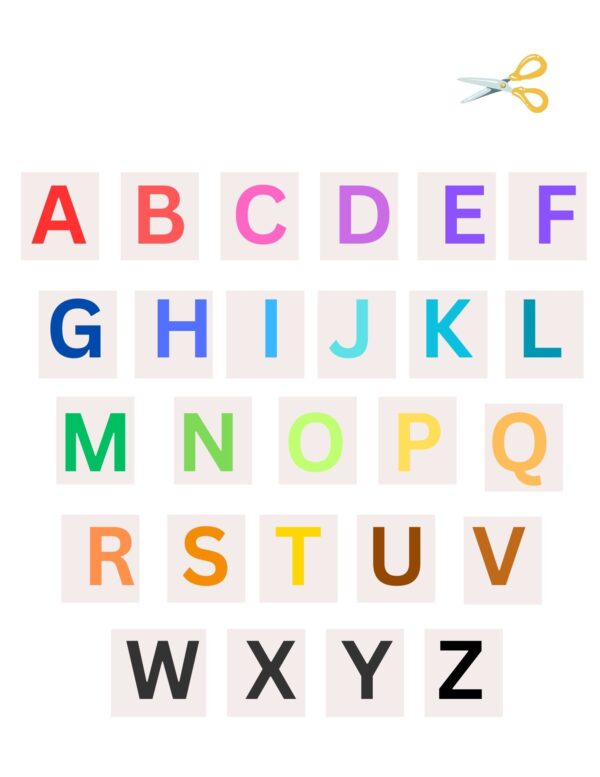
- One page of individual capital letters without boxes
- One page of alphabet matching wheel cards with light-colored square backgrounds
- All 26 alphabet letters from A through Z
- Bright colors that correspond across the different pages
The 2 wheels offer the same basic activity. Print the design you prefer, or prepare both versions for different children or learning centers.
The letter cards with square backgrounds are the easiest option to cut. The individual pieces provide more detailed cutting practice for children who are ready to work on their scissor skills.

Supplies Needed
You will need:
- The printable alphabet wheel (Get the free resource at the bottom of this post)
- White card stock paper or printer paper
- A color printer
- Child-safe scissors
- Laminator and laminating sheets, optional
- Reusable adhesive, hook-and-loop dots, or poster putty, optional
- A small container or resealable bag for storing the pieces
Card stock will make the activity sturdier, especially if you plan to use it more than once. You can print and laminate the wheel and matching pieces to help them last through repeated use at home or in a classroom.
An adult should be nearby to supervise whenever scissors or small pieces are being handled.
This post may contain affiliate links. As an Amazon Associate and a participant in other affiliate programs, I earn a commission on qualifying purchases. Read our disclosure policy here.




How to Prepare the Alphabet Matching Activity
1. Save and print the pages
Save the free PDF near the bottom of this post. Print the wheel you want to use and one of the two capital letter-piece pages.
Select “actual size” or “100%” in your printer settings so the pages maintain their intended proportions.

2. Cut out the letters
Cut around the individual letters or along the edges of the square cards.
Adults can prepare the pieces in advance for younger preschoolers. Older preschool and kindergarten children may be able to help cut apart the square cards with supervision, providing extra fine motor practice.
3. Protect the pieces
Adding a protective layer is optional but helpful if you plan to reuse the activity.
For easier cutting, first separate the letters roughly, seal them in laminating sheets, then complete the final trimming. Leave a narrow sealed edge around each piece so the layers remain secure.
4. Add reusable fasteners
Children can simply place the letters on top of the wheel. If you want the pieces to stay attached, add small hook-and-loop dots to the wheel and the back of each one.
Reusable adhesive or poster putty is another easy option that does not require fasteners to be permanently attached.

How to Use the Printable Alphabet Matching Wheel
Place the single wheel on a table or flat work surface. Put the letter pieces in a small pile or container beside it.
Have your child pick a letter, say its name if they know it, and look around the wheel for its match. The child then places the loose piece directly over its match.
Continue until all 26 letters have been matched.
You can say the name of each letter as your child works:
- “You picked the letter B. Can you find another B?”
- “What features stand out to you about this letter?”
- “Which letter comes after M?”
- “Can you find a letter that looks similar?”
- “What color is the letter T?”
Keep the literacy activity relaxed. The goal is to provide repeated, positive exposure to the alphabet rather than expecting a young child to complete the entire wheel immediately.

Start With Just a Few Letters
Twenty-six letter pieces can feel overwhelming to a child who is beginning to learn the alphabet. Begin with a small group of three to five pieces, using familiar ones from your child’s name when possible.
Good first choices include:
- The first letter in the child’s name
- Letters found in the child’s name
- A few letters with noticeably different shapes
- Letters the child already recognizes
- Letters recently introduced during letter of the week lessons
Place only those pieces beside the wheel. Once the child can confidently match them, introduce two or three additional letters.
Eventually, the activity can be completed with the entire alphabet.
Skills Practiced With This Letter Recognition Printable
Recognizing capital letters
Children compare the shapes of capital letters and locate identical matches. This letter recognition activity helps them become more familiar with the visual characteristics of each one.
Visual discrimination
To find a match, children must notice details such as straight lines, curves, angles, and the direction in which a letter faces.
Visual discrimination is particularly useful when working with letters that have similar features, such as E and F or M and W.
Alphabet order
Because the letters appear in alphabetical order around the wheel, children can begin noticing where each one belongs in the sequence.
Fine motor skills
Picking up and positioning small pieces requires controlled movements of the fingers and hands. Cutting the cards can provide additional fine motor skills development for children who are ready to use scissors.
Concentration
Children must look closely at each letter, scan the wheel, and remain focused long enough to locate its match. This also gives them an opportunity to practice identifying letters independently.
Ways to Use the Matching Game
Preschool literacy center
Place the prepared wheel and pieces in an alphabet or literacy center. Store everything in a labeled bag or small container so the set stays together.
Morning work
Set out five or six letters as morning work for when children arrive at school or when you prepare for the day at home.
Busy binder activity
Attach the wheel to the inside of a busy binder or learning binder and store the matching pieces in a zippered pouch. Hook-and-loop dots can help keep everything in place. This setup can also work well as a reusable busy book activity.
Homeschool alphabet lesson
Use the wheel during a homeschool lesson after introducing a new group of letters. It works well as a short review before moving on to alphabet tracing, beginning sounds, or letter formation.
Travel activity
Prepare the pages with a protective finish, then store them in a large resealable bag. Use only a few pieces at a time so they are easier to manage while traveling.
Additional Alphabet Matching Ideas
After your child becomes familiar with how the game works, introduce a few of these variations.
Match the colors
The letters appear in different colors. Younger children can use both letter shape and color as clues while searching for a match.
As they become more confident, encourage them to focus on the letter’s shape first.
Put the letters in alphabetical order
Instead of immediately placing the pieces on the wheel, ask your child to arrange a small group in alphabetical order.
Begin with three consecutive letters, such as A, B, and C. Gradually increase the number of letters for independent practice.
Go on a letter hunt
Choose one letter from the activity and search for that same capital letter in books, signs, toy packaging, or magazines. You might choose a less familiar example, such as letter X, to make the hunt more challenging.
Find the letter in a name
Select the capital letters found in your child’s name. Match the letter to the wheel, and then arrange the cards to spell the name.
Add beginning-sound practice
After matching a letter, say a simple word that begins with it. For example:
- A is for apple.
- B is for ball.
- C is for cat.
The activity does not include picture clues, so beginning sounds are best used as an optional extension after children can recognize several letters. This can introduce simple phonics and help connect each symbol with its letter sound.
Play a missing-letter game
Place several consecutive letters on the table and remove one. Ask your child to determine which letter is missing. This turns the resource into a simple letter recognition game.
Tips for Using the Activity With Preschoolers
Follow your child’s pace. Some children will enjoy matching the entire alphabet, while others may be ready for only a few letters at a time.
A few ways to keep this activity successful for preschoolers include:
- Begin with familiar letters.
- Limit the number of choices.
- Name each letter aloud.
- Demonstrate one match before asking the child to try.
- Offer hints without immediately giving the answer.
- Stop before the child becomes frustrated.
- Repeat the activity on another day.
Short, enjoyable sessions can make early literacy learning more approachable than requiring a child to finish all 26 letters at once.



Storing the Activity
Keep the wheel flat in a folder, binder, or large resealable bag. Store the small letter cards in a separate envelope or zippered pouch.
Label the storage container so the pieces do not become mixed with other alphabet printables.
If you use this activity in a classroom, consider preparing more than one copy. That allows several children to work independently or in a small group.
More Alphabet Activities for Kids
Keep the alphabet fun going with these simple learning activities. They give kids more ways to work on letter recognition, tracing, matching, and alphabetical order.
- Alphabet Find and Color Worksheets – A fun search-and-find activity where kids can spot specific letters and color them as they go.
- Alphabet Matching Worksheets for Preschoolers – Easy matching pages that help preschoolers become more familiar with letters through hands-on learning.
- Alphabet Trace and Color Worksheets – Simple worksheets that combine letter tracing with coloring for an engaging way to build early writing skills.
- Alphabet Line Tracing Worksheets – Pre-writing pages that encourage kids to follow different lines while building pencil control and fine motor skills.
- Alphabet ABC Order Worksheets – Helpful activities that let kids work on putting letters in the correct alphabetical order.
Download the Free Alphabet Wheel
This free PDF contains four pages. You may use all four pages or select the wheel-and-letter-piece style you want.
These free alphabet wheels are intended for personal use and classroom use. Please link to this blog post when sharing the activity rather than distributing the PDF file directly.
After saving the PDF to your computer, open it before printing. This can help prevent formatting or scaling problems that sometimes occur when printing directly from an internet browser.
What ages is this activity for?
The activity is designed primarily for preschool, pre-K, and kindergarten children. Readiness is more important than a specific age, so begin with only a few letters if the complete alphabet is too challenging.
Does the activity include lowercase letters?
No. The wheels and matching pieces use capital letters only.
It is intended as a same-case recognition exercise. Children can work on uppercase and lowercase letter matching once they are comfortable with capital letter shapes. Other alphabet activities can later introduce lowercase and uppercase letters together.
Do I need to print every page?
No. Choose one wheel and one page of letter pieces.
Use the cards with square backgrounds for pieces that are faster and easier to cut. Choose the individual letter page if you prefer pieces without a surrounding box.
Should I protect the wheel for repeated use?
Adding a protective finish is optional. It is recommended for classroom centers, learning binders, or other learning activities that will be used repeatedly.
Can children use clothespins with this activity?
This resource is designed for loose letter pieces to be placed directly on their matches. Standard clothespins could cover nearby letters because all 26 letters appear around one wheel.
If you want to use clothespins, an alphabet clip card or clip wheels format would be better suited to that method. A clothespin works especially well with clip card wheels for beginning sounds because children can attach it beside their chosen answer without covering nearby options.
Can this activity teach letter sounds?
Its primary purpose is visual matching and recognition. You can add beginning-sound exercises by naming a word that starts with each letter after it is matched.
As children progress, this can support the identification of beginning sounds in words and introduce basic phonics skills. Resources such as card wheels for beginning sounds can provide additional practice when they are ready for the next step.
How can I make the activity easier?
Start with three to five pieces, especially letters from your child’s name. Add more gradually as your child gains confidence.
How can I make it more challenging?
Ask your child to name each letter, arrange cards alphabetically, identify the letter that comes next, or say a word beginning with the matched letter. You can later introduce uppercase-lowercase matching, tracing cards, or ask them to trace the letter to provide additional practice.
