
Alphabet Find and Color Worksheets A-Z (Free PDF Printables)
These Alphabet Find and Color Worksheets turn every capital letter into a detailed picture search. Children use the word bank at the bottom of each page to find target pictures hidden among the other illustrations and color each one as they discover it.
The printable pack contains 26 worksheets, with one large uppercase letter for every letter from A to Z. Each word-bank item begins with the featured letter, helping children practice letter recognition, picture vocabulary, visual discrimination, and beginning-letter awareness.
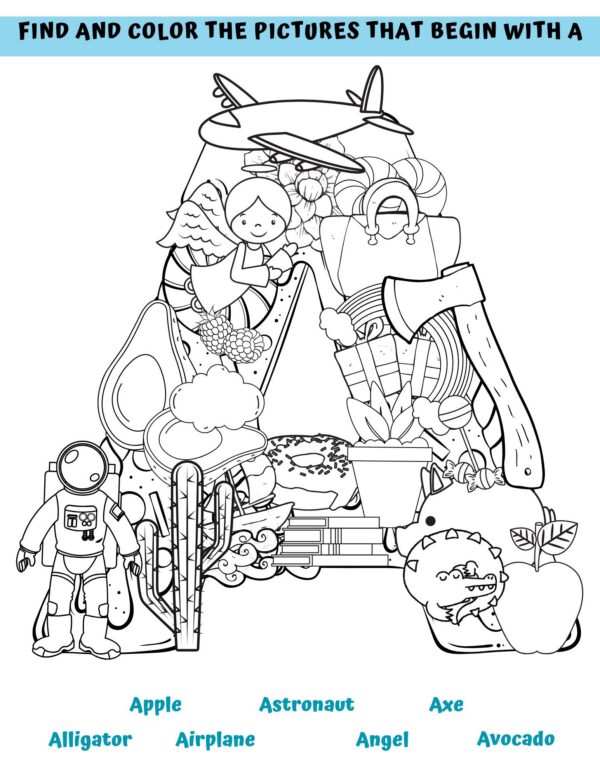
On the letter A worksheet, children search for an apple, astronaut, axe, alligator, airplane, angel, and avocado. By the time they reach Z, they will be looking for a zebra, zipper, zucchini, zero, and zeppelin.
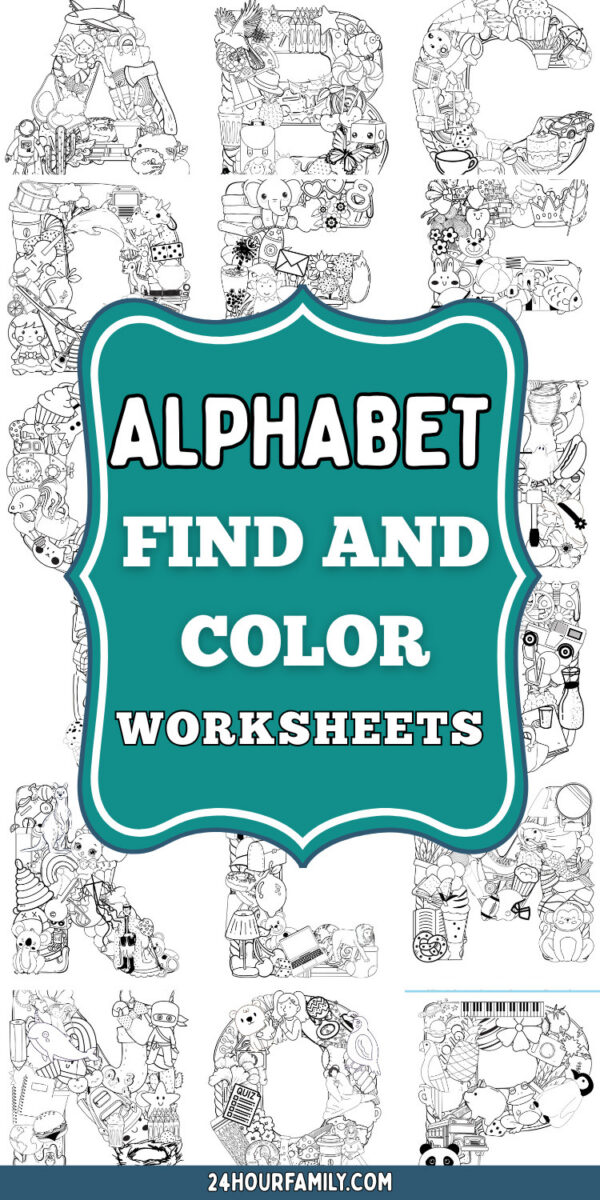
These pages are part coloring activity, part picture hunt, and part early literacy practice. They are best for preschoolers ages 4–5, pre-K, kindergarten, and early elementary learners.
Younger preschoolers can enjoy them with an adult who reads the word bank and presents two or three pictures at a time.
Alphabet Seek-and-Find Coloring Worksheets
Traditional alphabet worksheets often ask children to trace a letter repeatedly or circle it in a row of other letters. Those are valuable skills, but this printable takes a more imaginative approach.
Each capital letter is formed from an assortment of detailed pictures. Children use the word bank at the bottom of the page as a search list. They find each named object inside the letter and color it.
This gives children a reason to slow down and examine each illustration carefully.
The pages can be used for:
- Preschool alphabet lessons
- Pre-K literacy centers
- Kindergarten phonics practice
- Letter-of-the-week activities
- Homeschool language arts
- Early-finisher work
- Quiet-time activities
- Morning work
- Occupational therapy activities
- Summer learning
- Indoor travel activities
- ESL and ELL vocabulary practice
The designs are detailed enough to interest older preschoolers and early elementary children while still reinforcing foundational alphabet skills.
What Is Included?
The downloadable PDF contains 26 alphabet find-and-color worksheets.
Each page includes:
- One large capital letter
- A collage of black-and-white pictures
- Target pictures beginning with the featured letter
- A word bank identifying the objects
- Detailed illustrations to find and color
- A consistent A-Z worksheet format
- A blue title bar and blue vocabulary words
- Additional illustrations that make the picture search more challenging
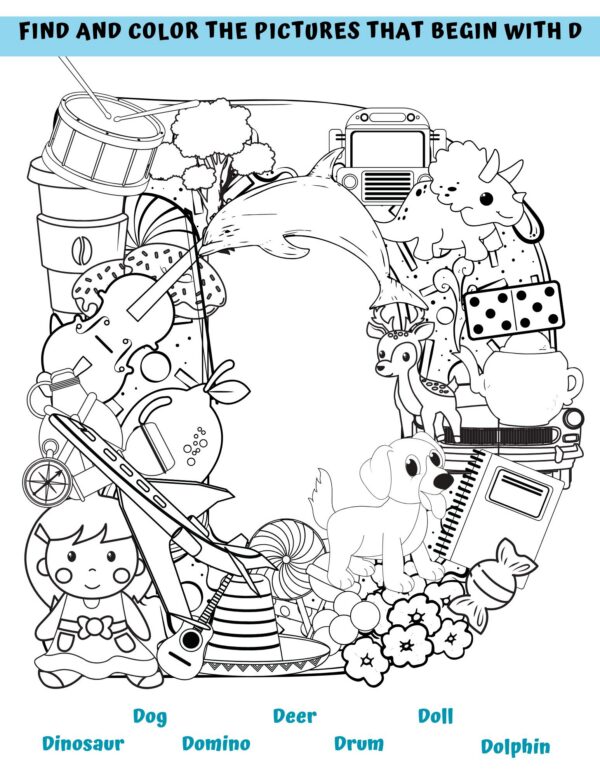
The worksheets are formatted for US Letter paper in portrait orientation.
Most of the page is black and white, allowing children to add their own colors. The blue header and word bank provide a small amount of color while keeping the worksheets relatively printer-friendly.
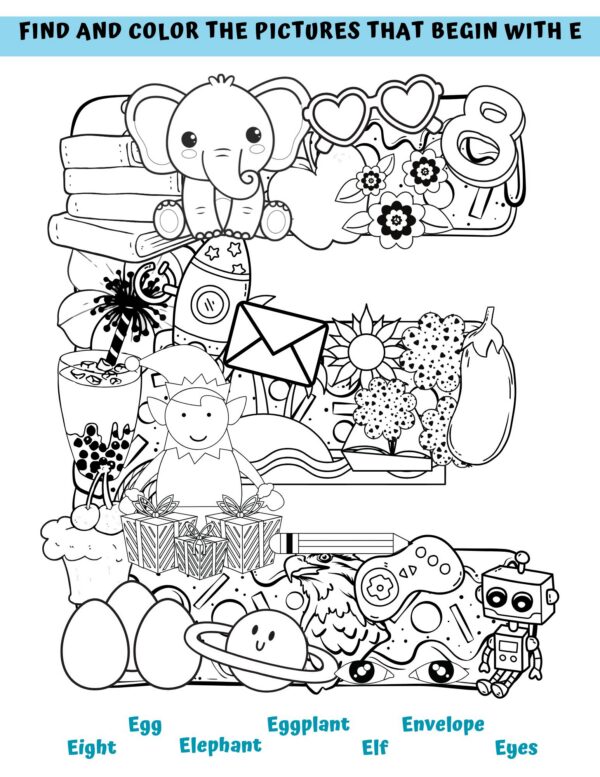
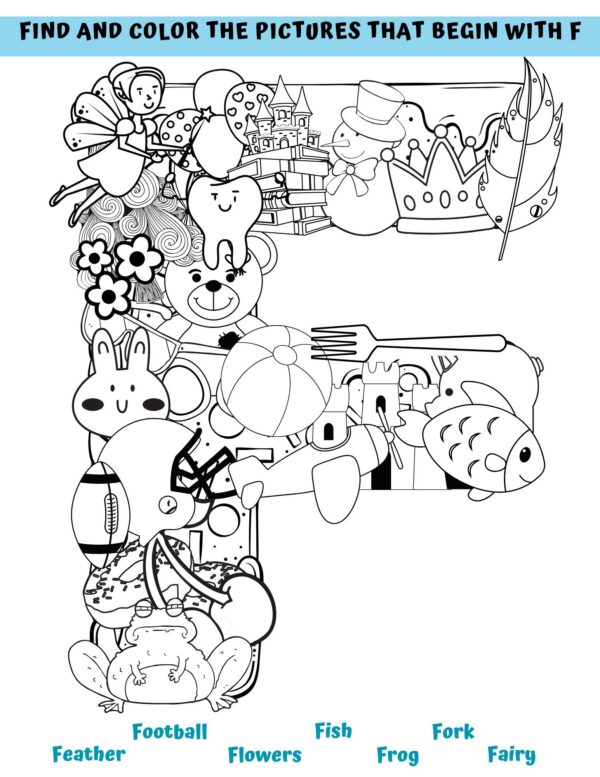
How the Alphabet Find and Color Activity Works
Using the worksheets is simple:
- Choose the letter your child is learning.
- Read the words at the bottom of the page together.
- Say the featured letter and its most common sound.
- Search the large letter collage for each listed object.
- Color an object after finding it.
- Check the word bank to see which pictures remain.
- Name each object again when the page is complete.
For the letter A, you might say:
“Listen for /ă/ at the beginning of apple, astronaut, axe, alligator, and avocado.”
Airplane and angel begin with the long A sound, /ā/. Having both sounds on the page gives older preschoolers and kindergarten students a simple introduction to the fact that one letter can represent more than one sound.
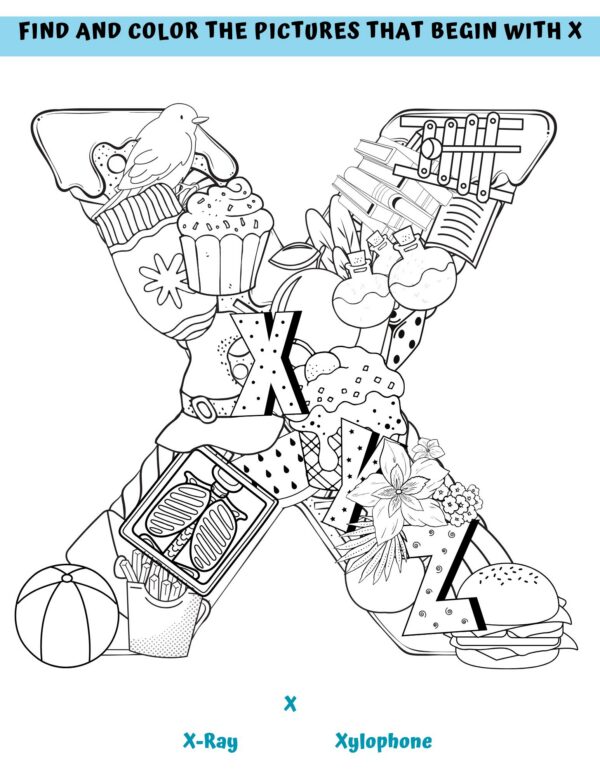
Some letters have more than one sound, and the picture words do not always begin with the letter’s most common phoneme. The X page is a good example: X-ray begins with the spoken letter name /ĕks/, while xylophone begins with a /z/ sound. For younger learners, focus first on recognizing the printed letter and naming the picture. Older children can compare the sounds they hear.
Alphabet Picture Words Included
The worksheets feature a wide variety of animals, foods, people, toys, household objects, and other familiar items.
Examples include:
- A: Apple, astronaut, axe, alligator, airplane, angel, and avocado
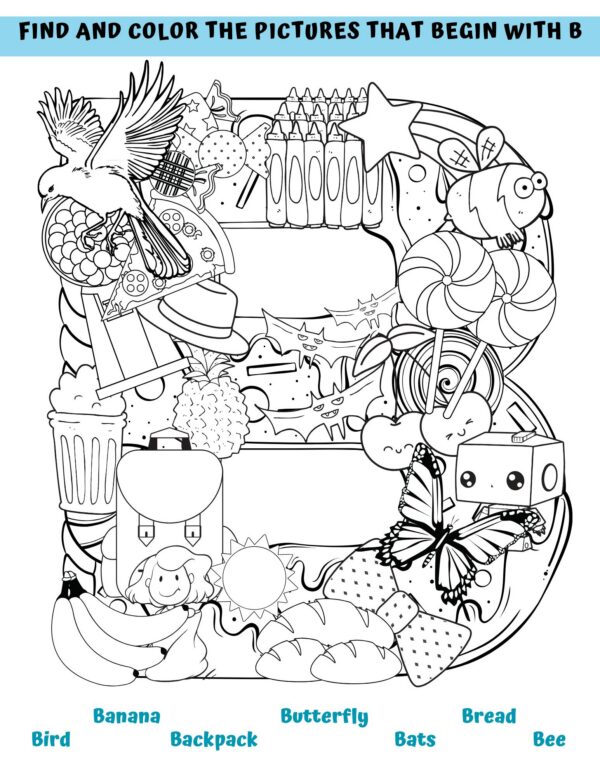
- B: Bird, banana, backpack, butterfly, bats, bread, and bee
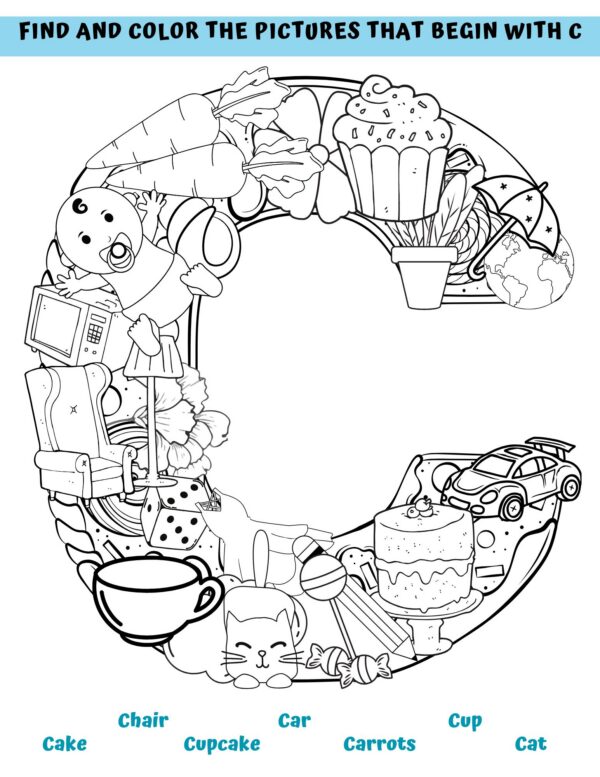
- C: Cake, chair, cupcake, car, carrots, cup, and cat
- D: Dog, dinosaur, domino, deer, drum, doll, and dolphin
- E: Eight, egg, elephant, eggplant, elf, envelope, and eyes
- F: Feather, football, flowers, fish, frog, fork, and fairy
- G: Guitar, golf, giraffe, grapes, gingerbread, glasses, and goldfish
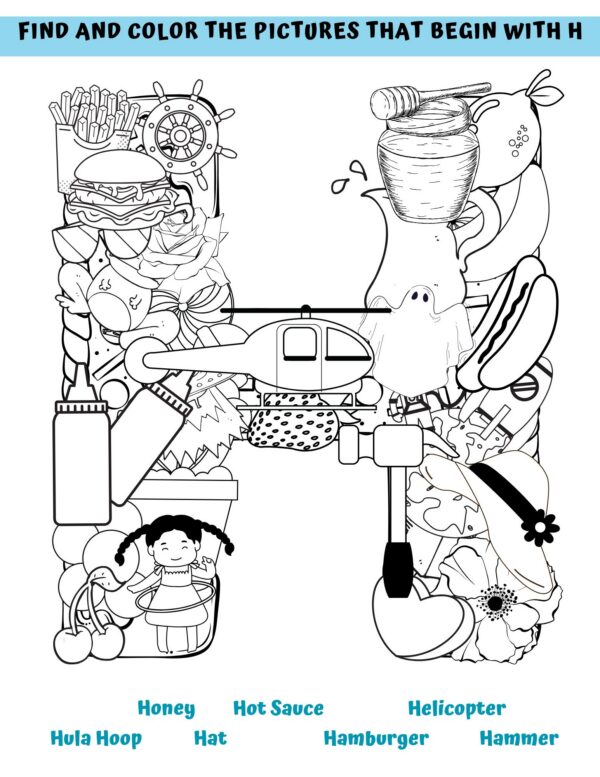
- H: Hula hoop, honey, hat, hot sauce, hamburger, helicopter, and hammer
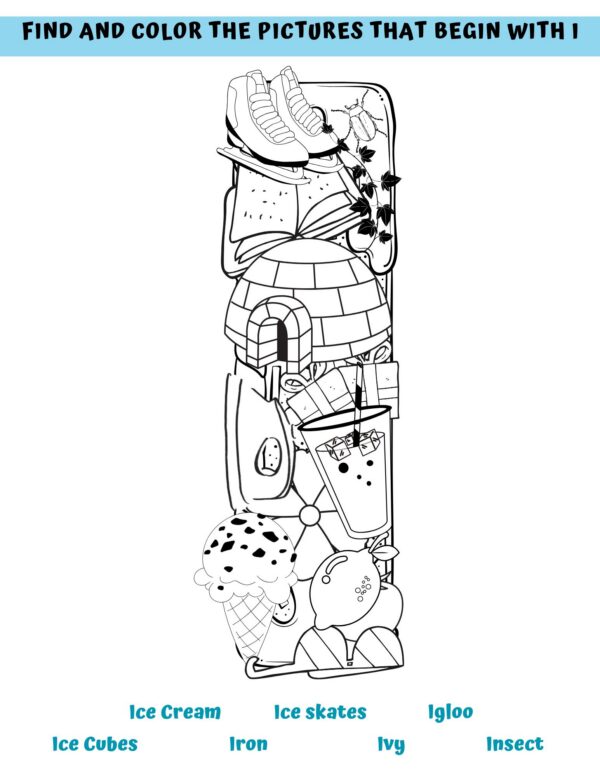
- I: Ice cubes, ice cream, ice skates, iron, igloo, ivy, and insect
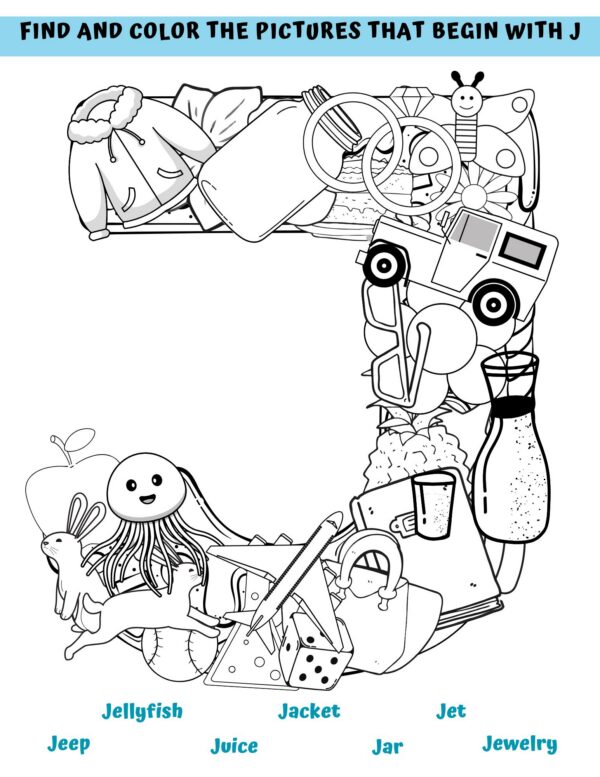
- J: Jeep, jellyfish, juice, jacket, jar, jet, and jewelry
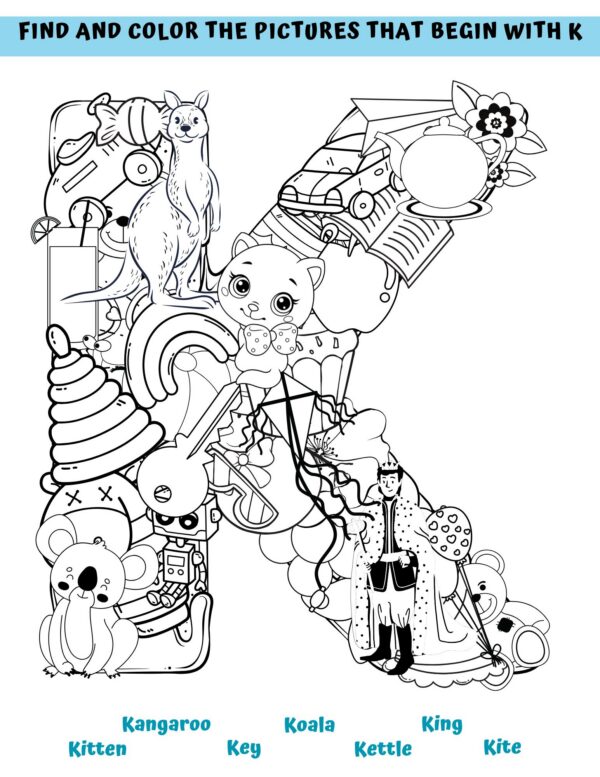
- K: Kangaroo, koala, key, kettle, king, kitten, and kite
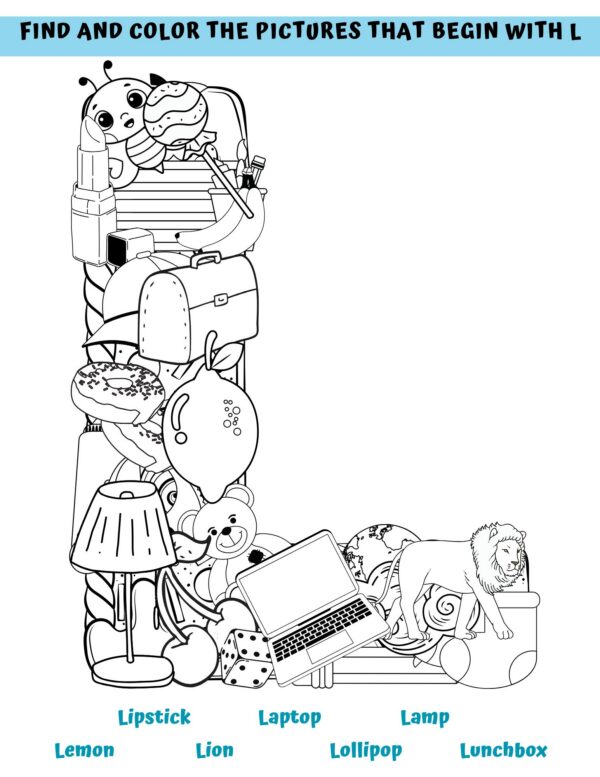
- L: Lipstick, laptop, lamp, lemon, lion, lollipop, and lunchbox
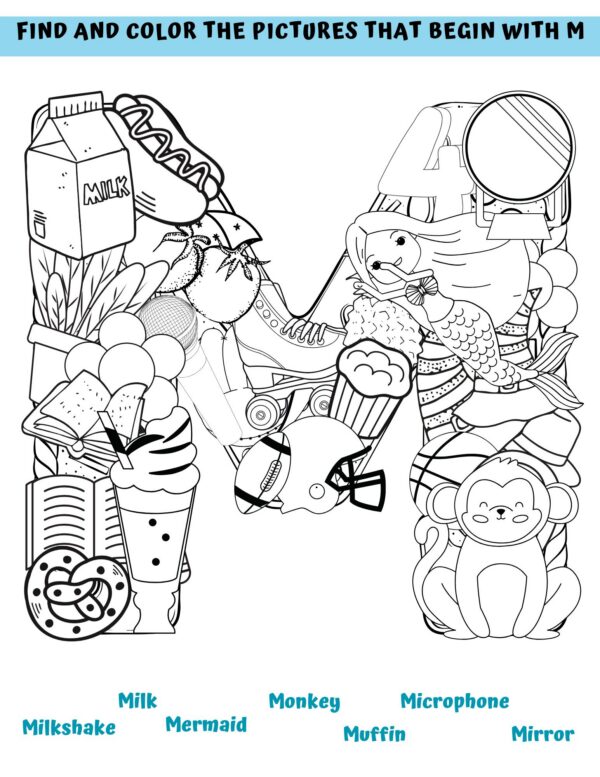
- M: Milk, milkshake, mermaid, monkey, muffin, microphone, and mirror
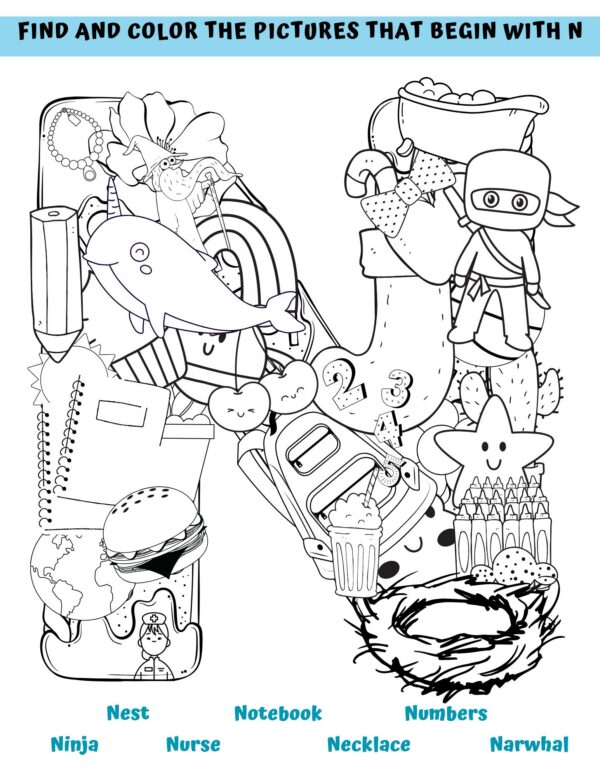
- N: Ninja, nurse, nest, notebook, necklace, numbers, and narwhal
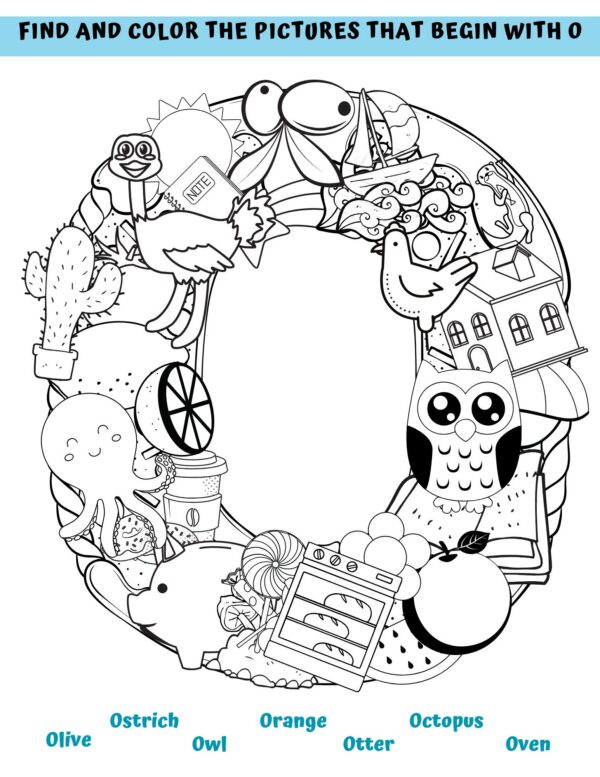
- O: Olive, ostrich, owl, orange, otter, octopus, and oven
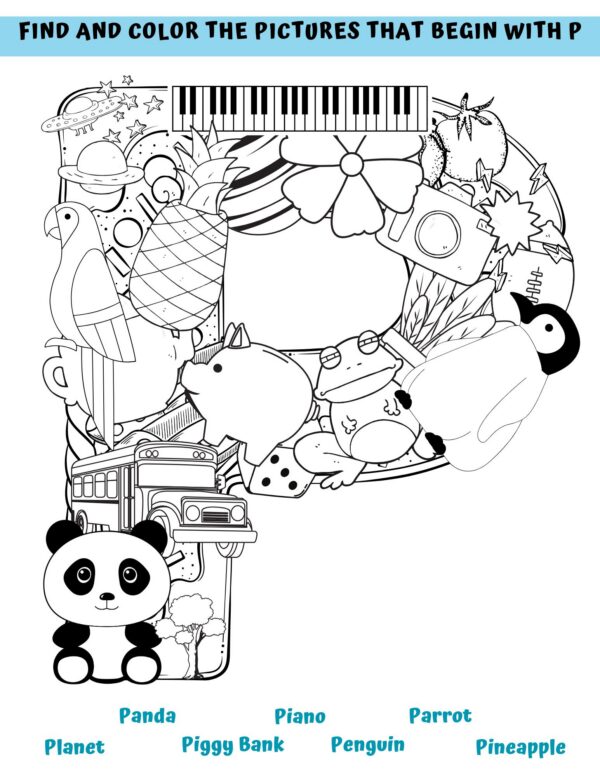
- P: Panda, piano, parrot, planet, piggy bank, penguin, and pineapple
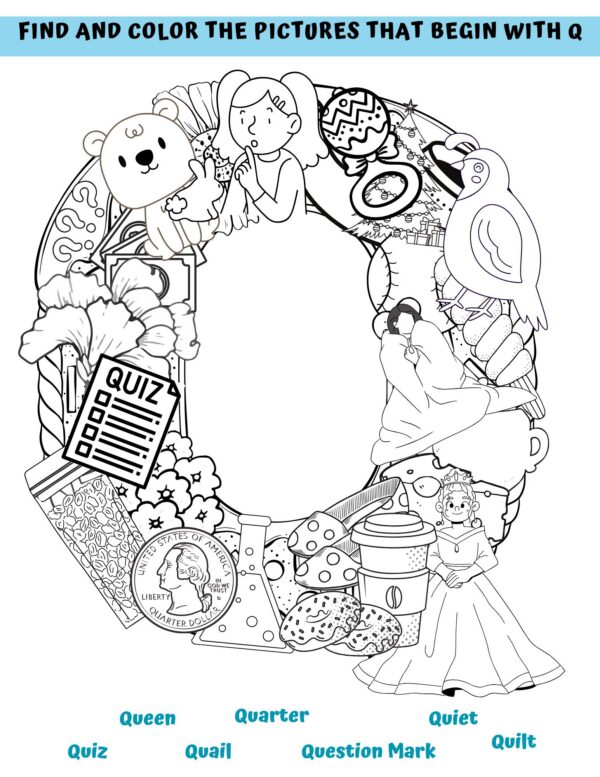
- Q: Queen, quarter, quiet, quilt, quiz, quail, and question mark
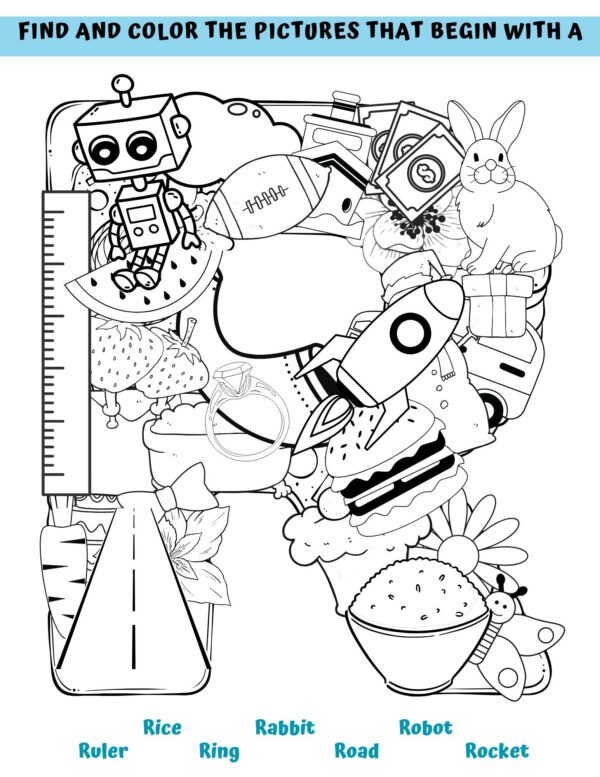
- R: Rice, rabbit, robot, ruler, ring, road, and rocket
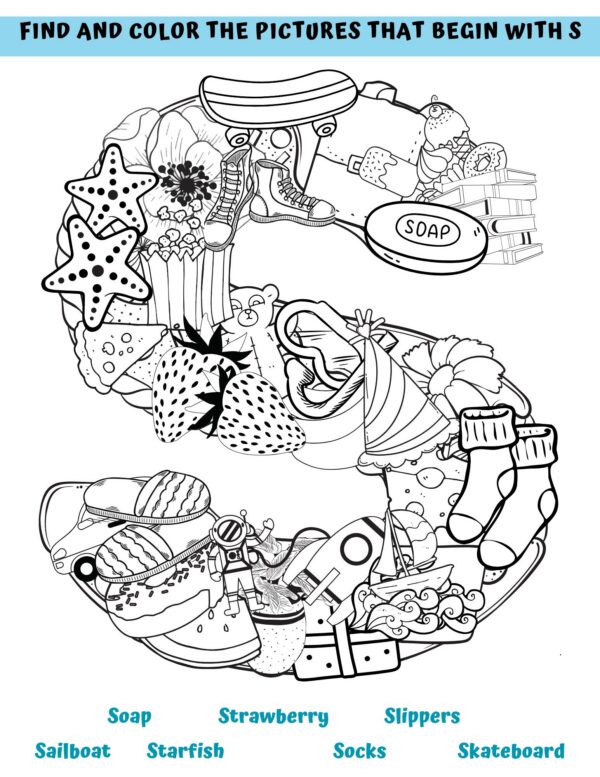
- S: Soap, strawberry, slippers, sailboat, starfish, socks, and skateboard
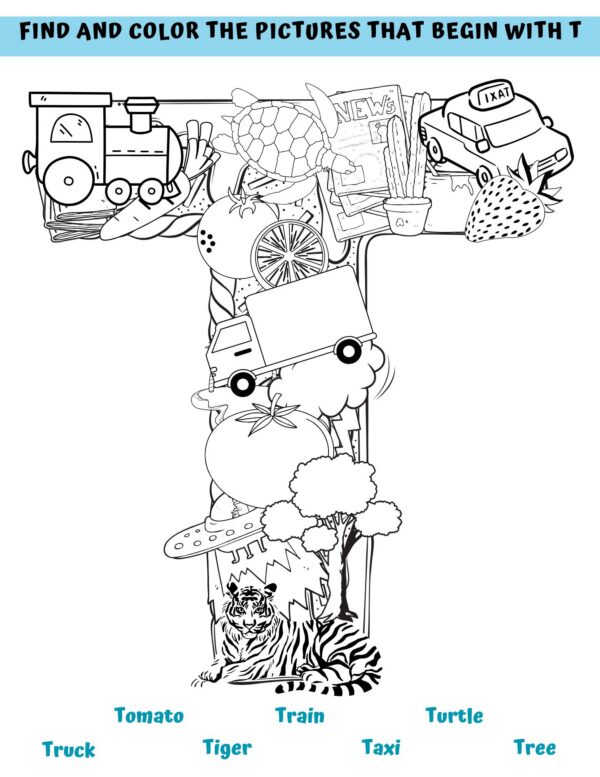
- T: Tomato, train, turtle, truck, tiger, taxi, and tree
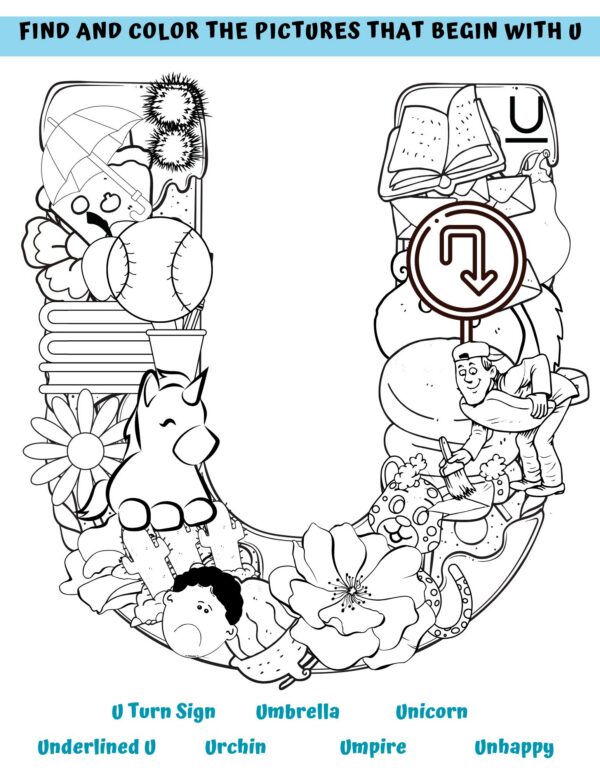
- U: U-turn sign, umbrella, unicorn, urchin, umpire, unhappy, and U underlined
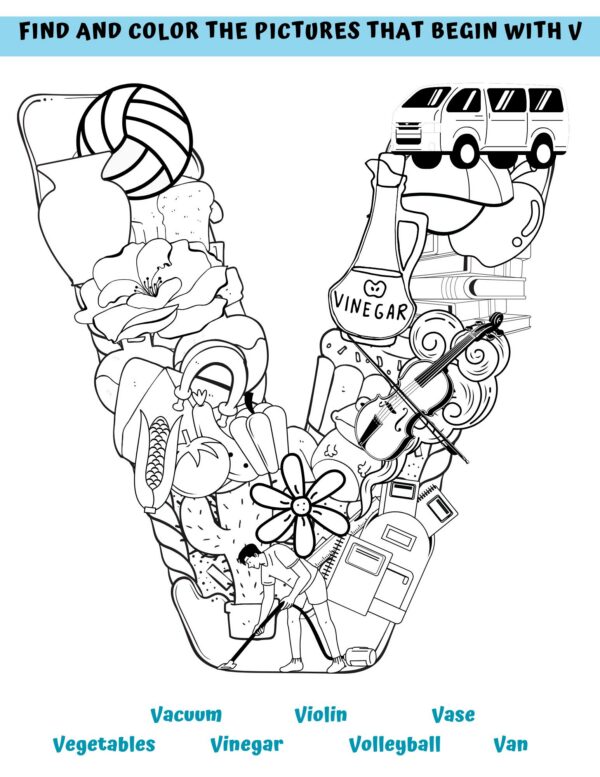
- V: Vacuum, violin, vase, vegetables, vinegar, volleyball, and van
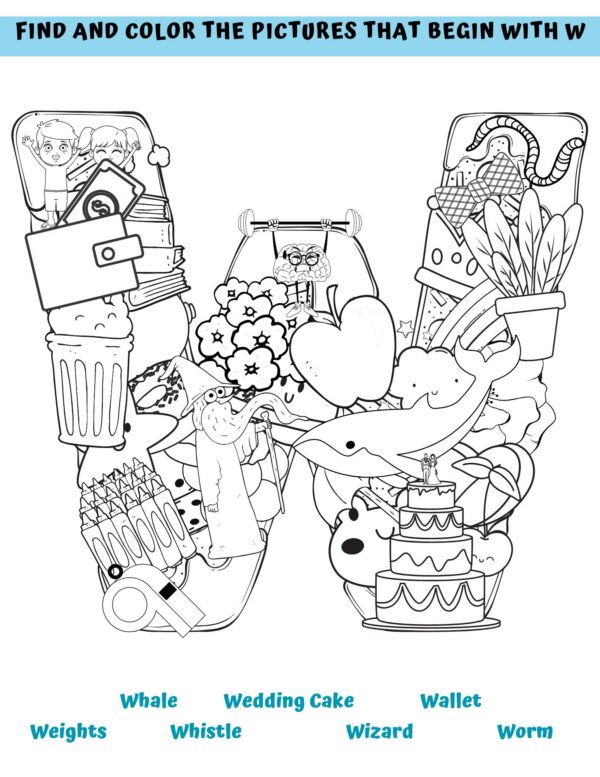
- W: Whale, wedding cake, wallet, weights, whistle, wizard, and worm
- X: X, X-ray, and xylophone
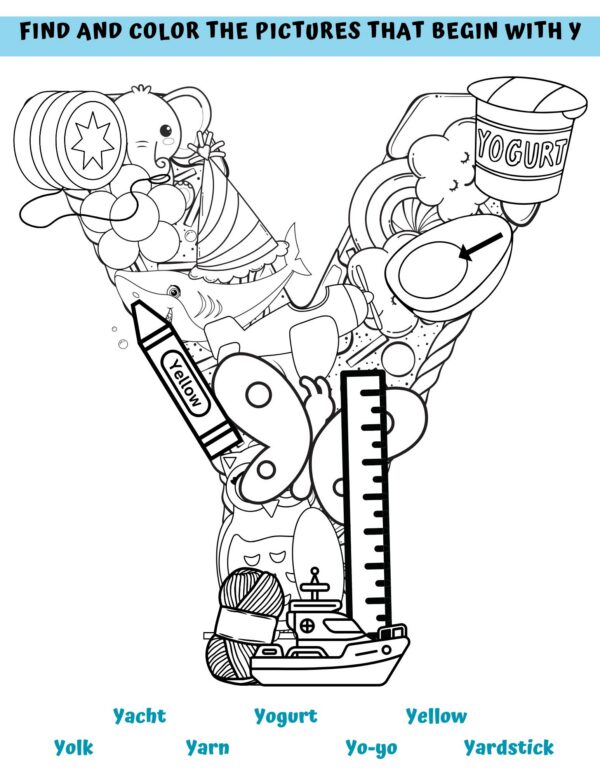
- Y: Yacht, yogurt, yellow, yolk, yarn, yo-yo, and yardstick
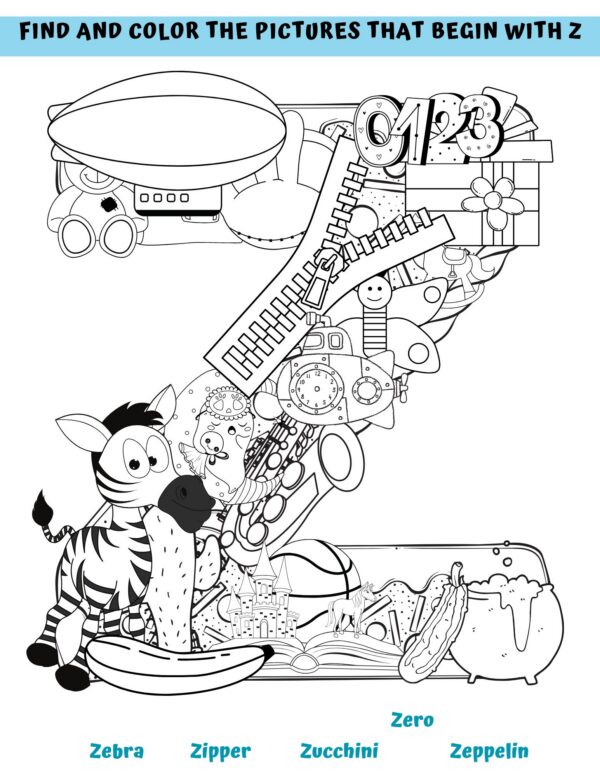
- Z: Zebra, zipper, zucchini, zero, and zeppelin
The less-common letters naturally have fewer familiar picture choices. The X worksheet, for example, focuses on X, X-ray, and xylophone rather than forcing unrelated vocabulary onto the page.
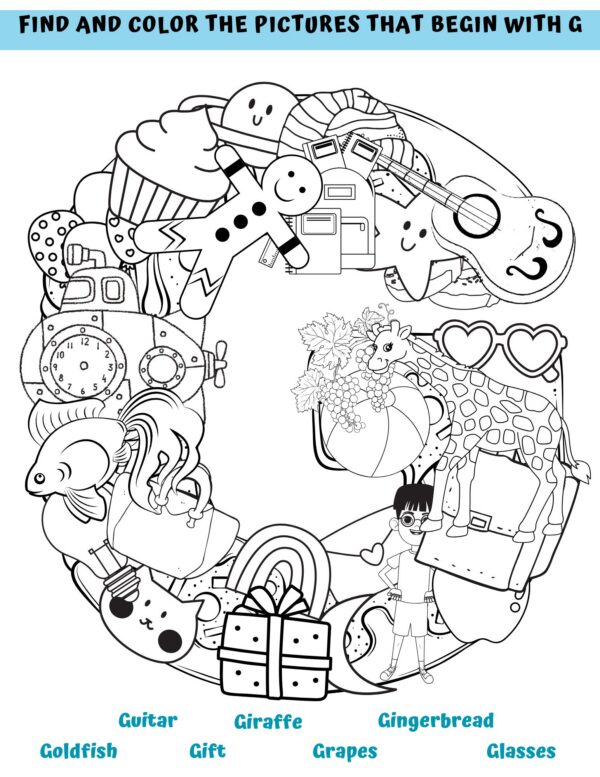
Skills Children Practice
These alphabet search-and-find worksheets support more than coloring.
Letter recognition
Each page is arranged in the shape of one large capital letter. This helps children study the overall form of the letter while exploring the individual pictures inside it.
Beginning sounds
Every object on a page begins with the featured letter. Naming the pictures aloud reinforces the connection between printed letters and spoken sounds.
Visual discrimination
Children must distinguish one detailed illustration from the others and match it with a word from the list. This encourages careful observation and attention to visual details.
Vocabulary development
The worksheets introduce a varied collection of words. Children may recognize familiar objects such as apples and cats while encountering less familiar words such as zeppelin, quail, narwhal, or urchin.
Fine-motor skills
Coloring small and large areas helps children practice pencil control, hand strength, coordination, and accuracy.
Focus and attention
The detailed collages require children to remain engaged long enough to find multiple objects on a page.
Early reading
The words beneath each page help children connect a printed word with a corresponding illustration.
Supplies for the Alphabet Worksheets
You only need a few basic supplies:
- Alphabet Find and Color A-Z printable PDF
- White printer paper
- Crayons
- Colored pencils
- Washable markers, optional
- Clipboard, optional
- Page protector or dry-erase pocket, optional
Colored pencils work especially well with the smaller details. Chunky crayons may be easier for preschoolers, while fine-tip markers provide more precision for older children.
How to Use the Alphabet Worksheets
Step 1: Download the PDF
Download the 26-page Alphabet Find and Color printable near the bottom of this post. Save the file to your computer before printing.
Step 2: Select a letter
You can print the entire pack or choose one page at a time. If you follow a letter-of-the-week curriculum, print only the current letter.
Step 3: Print the worksheet
Print on US Letter paper in portrait orientation. Choose “Fit” or “Fit to Printable Area” if your printer clips content close to the edges.
Step 4: Introduce the capital letter
Point to the shape of the letter and ask your child to name it. Trace around the outside of the letter with a finger.
Say the letter’s most common sound and invite your child to repeat it.
Step 5: Read the word bank
Read each picture word at the bottom of the page. Ask your child to listen for the sound at the beginning.
Emphasize the first sound without adding an extra “uh.” For example, pronounce the sound of T as /t/, not “tuh.”
Step 6: Find the pictures
Search inside the letter for one item at a time. Younger children may find it easier when an adult reads the words individually instead of giving them the entire list at once.
Step 7: Color each discovery
After finding an object, color it and mark the word in the word bank. Continue until every named picture has been located.
Step 8: Review the page
Name the objects one more time. Ask your child to think of another word beginning with the same letter.
Letter-of-the-Week Lesson Idea
These worksheets work naturally with a letter-of-the-week program.
Begin by introducing the capital and lowercase forms of the letter. The printable itself shows the large capital form, so display a lowercase letter card beside it for comparison.
Next, practice the letter sound and complete the find-and-color worksheet. Afterward, extend the lesson with one or two related activities:
- Read an alphabet book
- Build the letter with playdough
- Write the letter in a salt tray
- Find the letter on signs or packages
- Collect objects beginning with the sound
- Practice forming the letter with a pencil
- Make a simple letter craft
- Sort pictures by beginning sound
- Sing an alphabet song
- Create a page for an alphabet notebook
Using several types of activities allows children to see, hear, form, and use each letter.
Ways to Use the Printable Pack
These worksheets can be used in several settings:
- Literacy centers: Place the featured letter page beside uppercase and lowercase letter cards.
- Morning work: Offer one worksheet as a quiet activity at the beginning of the day.
- Early-finisher work: Keep several pages available for children who finish another assignment.
- Homeschool preschool: Use one worksheet each week as part of a letter-of-the-week study.
- Small groups: Assign each child a picture from the word bank to locate.
- Speech and language practice: Name the illustrations, describe them, and use the words in sentences.
- English-language learning: Use the pictures to connect new written vocabulary with recognizable images.
Turn It into an Alphabet Book
Children can collect their finished pages in a binder to create a personalized A-Z coloring book.
To make an alphabet book:
- Print all 26 worksheets.
- Complete one letter at a time.
- Place the finished pages in alphabetical order.
- Punch holes along the left edge.
- Store the pages in a three-ring binder.
- Add a child-designed cover.
Children can revisit the book to name the letters, identify the pictures, and review beginning sounds.
A completed book also makes a fun record of a child’s progress through the alphabet.
Make the Pages Reusable
Place a worksheet inside a dry-erase pocket or laminate it to create a reusable search activity.
Instead of coloring the pictures, children can:
- Circle each object with a dry-erase marker
- Place a small counter over each discovery
- Check off the words at the bottom
- Use a pointer to identify each item
- Race against a sand timer
- Complete the search with a partner
Laminating the pages is especially useful for classroom literacy centers or families with multiple children.
Small counters can present a choking hazard and should only be used with appropriate adult supervision.
Alphabet Games to Play
I Spy
Choose one word from the bottom of the page and say, “I spy something beginning with…” Give clues until your child identifies the object.
Beginning-sound challenge
After finding an object, ask your child to think of one more word beginning with the same sound.
Find it first
Give two children copies of the same worksheet. Call out an item and see who can point to it first. Keep the activity cooperative by allowing both children to color it after it is found.
Describe and discover
Describe an object without naming it. For example, say, “Find something that flies and carries passengers” for an airplane.
Memory check
Study the completed page, cover it, and ask your child to remember as many pictured objects as possible.
Color by category
Assign colors to different categories. Children might color animals green, foods red, people blue, and objects yellow.
Count the pictures
After the search, count the listed objects. Compare pages and determine which contains more or fewer vocabulary words.
Questions to Ask While Children Work
Conversation turns the worksheet into a richer language activity. Try questions such as:
- What letter is this?
- What sound does it usually make?
- Which picture did you find first?
- Which object was hardest to locate?
- Which word is new to you?
- Can you describe that object?
- Is it an animal, food, person, place, or thing?
- What color should we use?
- Can you think of another word beginning with this letter?
- Can you use one of the words in a sentence?
Avoid correcting every response immediately. Give children time to observe, think, and explain what they see.
Adjusting the Activity for Different Ages
Younger preschoolers
Read the word list aloud and ask the child to find only two or three objects at a time. Allow free coloring rather than expecting children to remain inside every line.
Older preschoolers
Ask children to find every picture, repeat the beginning sound, and mark each completed word.
Kindergarten students
Have children identify the first letter in each printed word and write the capital and lowercase letter on the back of the page.
First-grade students
Invite children to alphabetize several words from the page, write sentences, or sort the vocabulary into categories.
More Alphabet Activities for Kids
Continue learning letters with these hands-on activities and printables:
- Alphabet Do-a-Dot Printables
- Alphabet Coloring Pages for Kids
- Free Printable Number Playdough Mats
- A Is for Alligator Worksheets
- ABC Animals Coloring Pages
- Printable Alphabet Worksheets
Combining picture searches with dot markers, coloring, tracing, playdough, and letter-building activities gives children varied ways to master the alphabet.
Download the Alphabet Find and Color Printable Worksheets
The complete printable contains 26 letter-shaped picture searches from A through Z.
How many worksheets are included?
The PDF contains 26 pages, with one detailed find-and-color worksheet for every letter from A to Z.
Do the worksheets include uppercase or lowercase letters?
Each picture collage forms a large uppercase letter. The word bank contains ordinary written words with capitalized first letters. For complete letter-form practice, pair the worksheet with a separate lowercase letter card or handwriting page.
Are these traditional hidden-picture worksheets?
The pictures are arranged together inside the shape of a large capital letter. Children use the word bank to locate the named objects and color them. The objects are not concealed to the point of being unrecognizable, but the detailed arrangement creates a picture-search challenge.
What ages are these worksheets for?
They are best suited for older preschoolers, kindergarten students, and early elementary children. Younger children may need an adult to read the word bank and help them search.
Are the worksheets printer-friendly?
The detailed illustrations are black and white. Each page also contains a light blue header and blue vocabulary words. Families who need grayscale pages can select a black-and-white printing option.
What type of paper should I use?
Regular white printer paper is suitable for crayons and colored pencils. Use slightly heavier paper if children will color with markers.
Can I use these worksheets in a classroom?
The printable may be used for personal, homeschool, or individual classroom use. It may not be resold, redistributed, or uploaded to another website.
Download the PDF below, print the letters your child is learning, and begin searching and coloring!
This printable is intended for personal, homeschool, and individual classroom use. Please do not sell, redistribute, alter, or upload the PDF to another website.
