
50 Best Math Movies for High School (Rated + Classroom-Ready)
A great math movie does something a textbook can’t — it makes you care about the answer.
These 50 best math movies for high school students have been chosen because they treat math seriously, not as a backdrop, but as the thing characters live and breathe. Each entry includes the specific math concepts covered, a discussion question, and an honest content note so you know exactly what you’re getting before you press play.
Whether you’re a high school math teacher looking for a film that actually connects to your curriculum, a homeschool parent who wants to make algebra feel less abstract, or a student who just wants to see what math looks like in the real world, this list has you covered.
What Makes a Math Movie Worth Showing in High School?
High schoolers are harder to impress than younger students. A film earns its place in a high school math class — or on a family movie night for a teenager — when it does at least one of these things:
It shows math being used to solve a real problem. Not equations on a chalkboard, but math as the actual tool a character uses to survive, win, build something, or prove someone wrong. The Martian is calculating how long potatoes will last. Moneyball runs regression analysis on player statistics. Hidden Figures computing a rocket trajectory by hand.
This post may contain affiliate links. As an Amazon Associate and a participant in other affiliate programs, I earn a commission on qualifying purchases. Read our disclosure policy here.





It puts a human face on mathematical thinking. Students who believe math is for other people — people smarter than them, people who don’t look like them — need to see mathematicians who are flawed, driven, funny, and recognizable. These films deliver that.
It’s genuinely good. Several films on this list have won Academy Awards. These aren’t educational videos dressed up as movies. They’re films worth watching on their own merits, and they happen to be rich in mathematical content.
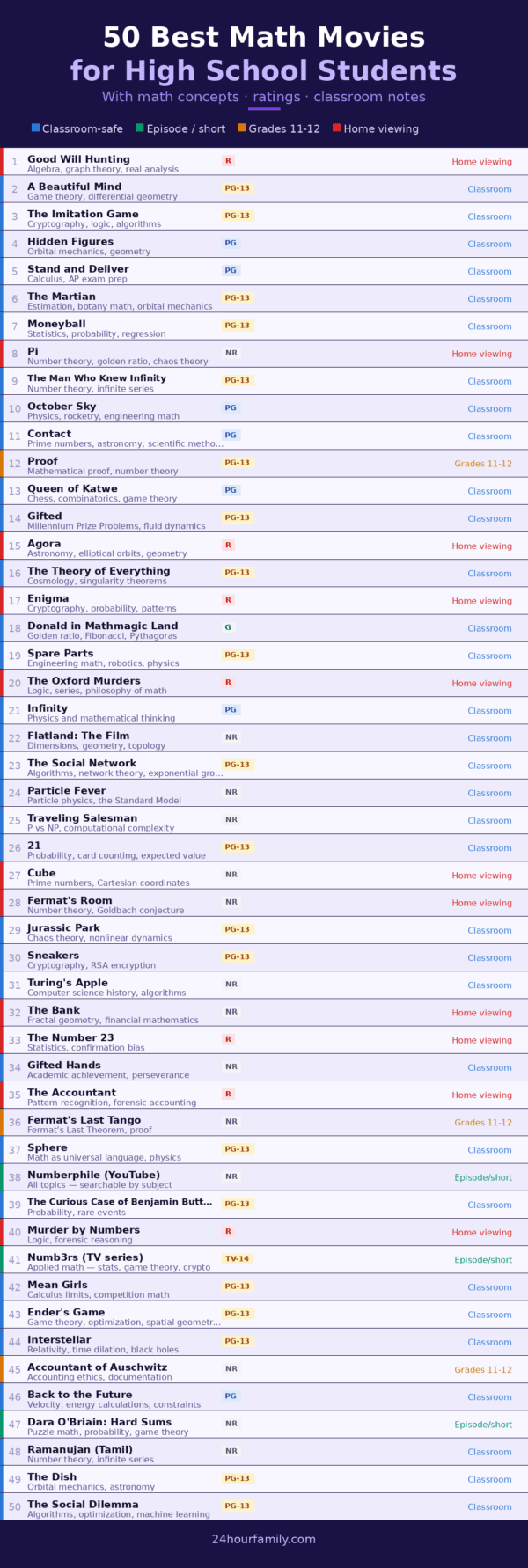
The 50 Best Math Movies for High School Students
1. Good Will Hunting (1997) — Rated R
Math concepts: Advanced algebra, combinatorics, graph theory, real analysis
Will Hunting is a janitor at MIT who anonymously solves a graduate-level math problem posted on a hallway chalkboard — a problem that had stumped the department’s best students for two years. When a professor tracks him down, Will must decide whether his gift is something he owes the world or something he gets to walk away from.
This is the most emotionally powerful film on this list. The math is real — screenwriters Matt Damon and Ben Affleck consulted with mathematicians, and the problems shown on the chalkboard are genuine. But the film is ultimately about whether intelligence alone is enough, and what happens when someone who could do anything chooses to do nothing.
Math discussion question: The professor says Will’s ability is a gift that comes with a responsibility. Do you agree that exceptional talent creates an obligation? What would you do in Will’s position?
Curriculum connection: Graph theory, the nature of mathematical proof, mathematical genius, and motivation
Content note: Rated R for strong language throughout and some mature thematic content. Not appropriate for classroom use without parental permission and administrative approval. Best for mature 11th–12th graders or for homeschool families to view. Absolutely worth the effort for the right group.

2. A Beautiful Mind (2001) — Rated PG-13
Math concepts: Game theory, differential geometry, governing dynamics
John Nash (Russell Crowe) is one of the most brilliant mathematicians of the 20th century — and one of the most troubled. The film follows his revolutionary work in game theory at Princeton, his marriage, his decades-long battle with paranoid schizophrenia, and his eventual Nobel Prize in Economics.
The film is beautifully crafted and handles mental illness with unusual sensitivity for a mainstream Hollywood production. Nash’s insight about “governing dynamics” — the idea that the best outcome for a group comes not from everyone acting in their own self-interest but from what’s best for the individual and the group — changed economics and mathematics permanently.
Math discussion question: Nash’s “governing dynamics” theory challenged Adam Smith’s idea that individual self-interest leads to the best outcome for all. Can you think of a real-world example where acting in your own self-interest actually makes things worse for everyone?
Curriculum connection: Game theory, Nash equilibrium, the relationship between mathematical genius and mental health
Content note: PG-13 for mature thematic content and some disturbing sequences related to mental illness. Appropriate for grades 10–12 with framing. One scene contains brief suggestive content — preview before showing to a class.
3. The Imitation Game (2014) — Rated PG-13
Math concepts: Cryptography, logic, algorithms, and the foundations of computer science
Alan Turing (Benedict Cumberbatch) leads a team of mathematicians and codebreakers at Bletchley Park during World War II, racing to crack the German Enigma machine before millions more die. The mathematical machine he builds to do it — which he calls Christopher — becomes the conceptual foundation for the modern computer.
The film is a masterclass in showing mathematical thinking as a form of creativity, not just calculation. Turing’s key insight — that you can’t beat Enigma by finding one message; you have to find a pattern that reveals the system — is one of the most elegant problem-solving moments in any film on this list.
Math discussion question: Turing’s machine worked by searching for patterns rather than individual answers. How does this approach to problem-solving apply outside of cryptography? Can you think of a problem in your own life where looking for a pattern would work better than trying to solve one instance at a time?
Curriculum connection: Logic, algorithms, cryptography, the birth of computer science, and the ethics of mathematical discovery
Content note: PG-13 for thematic elements, including Turing’s persecution for being gay — handled with restraint. Some wartime intensity. Appropriate for grades 9–12.
4. Hidden Figures (2016) — Rated PG
Math concepts: Orbital mechanics, analytic geometry, Euler’s method, numerical analysis
Katherine Johnson, Dorothy Vaughan, and Mary Jackson are Black women mathematicians at NASA in 1961. Katherine’s calculations are essential to John Glenn’s orbital flight — and the film doesn’t shy away from showing the actual math, including the moment Katherine corrects a senior engineer’s orbital mechanics calculation on a chalkboard in a roomful of men who don’t want her there.
This is the film on this list most likely to make a student who thinks math isn’t for them change their mind. The mathematics is authentic — Katherine Johnson’s real calculations have been published and are available for advanced students to examine.
Math discussion question: Dorothy Vaughan taught herself FORTRAN from a library book because she could see that human computers were about to be replaced by machines. What subject or skill would you teach yourself right now if you could see what was coming?
Curriculum connection: Geometry, orbital mechanics, numerical methods, computer programming history, and the role of mathematics in space exploration
Content note: Rated PG. Deals with racial segregation and gender discrimination — historically accurate and essential context, not gratuitous. Appropriate for all high school grades.
5. Stand and Deliver (1988) — Rated PG
Math concepts: Calculus (limits, derivatives, integrals), AP exam preparation
Jaime Escalante (Edward James Olmos) is a math teacher at Garfield High School in East Los Angeles who decides his students — largely written off by the education system — are going to pass the AP Calculus exam. They do. The College Board accuses them of cheating. They take the test again.
This is the definitive math-teacher movie and one of the most powerful films ever made about what education can accomplish. The scene where Escalante explains calculus using an apple is one of the great teaching moments in cinema. For students who feel like math isn’t for people like them, this film is essential viewing.
Math discussion question: Escalante’s students were accused of cheating partly because no one believed students from their school could achieve what they achieved. What assumptions do people make about who is and isn’t capable of doing advanced math — and where do those assumptions come from?
Curriculum connection: Calculus, the AP exam, equity in mathematics education, the history of mathematics education in the US
Content note: Rated PG. A few mild instances of language. Appropriate for all high school grades. Ideal to show before AP exam season.
6. The Martian (2015) — Rated PG-13
Math concepts: Arithmetic, estimation, botany calculations, orbital mechanics, problem-solving under constraints
Astronaut Mark Watney (Matt Damon) is left for dead on Mars after a mission gone wrong. He has limited food, limited power, and no way to contact Earth. His survival depends entirely on math — calculating how long his food supply will last, how many calories he needs to grow in the soil of an alien planet, and whether two spacecraft can intercept each other in orbit.
Watney narrates his problem-solving out loud throughout the film, making it one of the best natural demonstrations of applied mathematics ever filmed. The math is real and checkable. Students who see this film often come to class the next day having verified his calculations.
Math discussion question: Watney says, “I’m going to science the s*** out of this.” What he actually means is that he’s going to apply the mathematical method to every constraint he faces. Pick one of his survival problems and walk through the math yourself. Does his answer hold up?
Curriculum connection: Arithmetic, unit conversion, estimation, basic chemistry, orbital mechanics, and the scientific method
Content note: PG-13 for language, including one use of a stronger expletive (the MPAA allows one per PG-13 rating). Otherwise appropriate for grades 9–12. Many teachers show this in class without issue.
7. Moneyball (2011) — Rated PG-13
Math concepts: Statistics, sabermetrics, probability, regression analysis, data-driven decision making
Billy Beane (Brad Pitt), general manager of the Oakland A’s, can’t compete financially with the New York Yankees. So he hires a Yale economics grad (Jonah Hill) and rebuilds his team using statistical analysis instead of traditional scouting. The result changes baseball — and every other professional sport — permanently.
This is the best film ever made about applied statistics. It shows, in completely accessible terms, how data analysis works, why it works, and what happens when people who are emotionally invested in old methods resist it. For students who wonder what statistics is actually for, this film answers the question definitively.
Math discussion question: The traditional scouts in the film reject the statistical approach because it conflicts with their decades of personal observations. Why do you think people resist data when it contradicts their experience? When should you trust data over intuition?
Curriculum connection: Statistics, probability, data analysis, regression, the history of sabermetrics
Content note: PG-13 for some language. Appropriate for grades 9–12.
8. Pi (1998) — Not Rated
Math concepts: Number theory, the golden ratio, chaos theory, pattern recognition
Max Cohen (Sean Gullette) is a mathematician who believes everything in nature can be understood through numbers. He becomes obsessed with finding a 216-digit number he believes contains the pattern underlying the stock market — and possibly the universe. Shot in black and white on a budget of $60,000, this film is unlike anything else on this list.
This is a challenging, unconventional film better suited for advanced students or homeschool families than for a general classroom. But for students who are genuinely captivated by mathematics as a way of understanding reality, it’s extraordinary. The mathematical ideas it explores — the golden ratio, the Fibonacci sequence, the possibility of finding order in apparent chaos — are real and fascinating.
Math discussion question: Max believes the universe can be understood through mathematics. Physicist Eugene Wigner called this “the unreasonable effectiveness of mathematics” — the strange fact that math developed for purely abstract reasons keeps turning out to describe the physical world perfectly. Why do you think that is?
Curriculum connection: Number theory, the golden ratio, Fibonacci sequence, chaos theory, mathematical obsession, and mental health
Content note: Not rated (equivalent to R). Intense, disturbing psychological content. Not for classroom use. Appropriate for mature high school students watching at home.
9. The Man Who Knew Infinity (2015) — Rated PG-13
Math concepts: Number theory, infinite series, partition theory, mathematical proof
Srinivasa Ramanujan (Dev Patel) is a self-taught mathematical genius from Madras, India, who writes to Cambridge mathematician G.H. Hardy (Jeremy Irons) with theorems that Hardy says are unlike anything he has ever seen. Hardy brings him to Cambridge — and the culture clash, the racism, the English weather, and the demand that Ramanujan prove his intuitions formally nearly destroy him.
The central tension of this film is one of the most interesting in any math movie: Ramanujan’s mind produced results that were true, but he couldn’t explain how he knew they were true. Hardy insisted on formal proof. The question of whether intuition or proof is more important in mathematics is one that students can debate for an entire class period.
Math discussion question: Ramanujan said his formulas came to him in dreams from a Hindu goddess. Hardy said that without proof, they were worthless regardless of whether they were true. Who do you think was right? What is mathematical proof actually for?
Curriculum connection: Number theory, the nature of mathematical proof, infinite series, and the history of mathematics
Content note: PG-13 for thematic elements and some historical racism. Appropriate for grades 9–12.
10. October Sky (1999) — Rated PG
Math concepts: Physics, rocketry calculations, trajectory, basic engineering math
Homer Hickam (Jake Gyllenhaal) is a coal miner’s son in Coalwood, West Virginia, who watches Sputnik cross the sky in 1957 and decides he’s going to build a rocket. His father thinks it’s a waste of time. His math teacher believes in him. The rockets keep blowing up. He keeps doing the math until they don’t.
This film is especially powerful for students who feel that STEM isn’t for people from where they come. Homer isn’t a prodigy. He’s a persistent, curious kid who gets the work done. The moment when his math teacher tells him his calculations are the key to everything is one of the best scenes in any film on this list.
Math discussion question: Homer’s math teacher tells him, “You’re gonna take this thing all the way to the national science fair.” She saw something in his calculations before he did. Has a teacher ever seen something in you before you saw it in yourself? What did that feel like?
Curriculum connection: Physics, rocketry, engineering design, the Cold War space race
Content note: Rated PG. Appropriate for all high school grades.
11. Contact (1997) — Rated PG
Math concepts: Radio astronomy, prime numbers, mathematical communication, physics
SETI scientist Ellie Arroway (Jodie Foster) discovers what appears to be a signal from an extraterrestrial civilization. The signal is decoded using prime numbers — the mathematical choice of a civilization trying to prove its intelligence to another. The film then explores how humanity responds to that discovery.
Based on Carl Sagan’s novel, this film is exceptional in its discussion of the nature of evidence, the scientific method, and the relationship between mathematics and communication. Prime numbers as a universal language is a concept that genuinely stops students in their tracks.
Math discussion question: The aliens chose prime numbers to communicate because they believed prime numbers would be recognizable to any intelligent species anywhere in the universe. Do you agree that mathematics is truly universal? Could there be intelligent life that doesn’t think mathematically?
Curriculum connection: Prime numbers, the scientific method, astronomy, and mathematical communication
Content note: Rated PG. Appropriate for all high school grades.
12. Proof (2005) — Rated PG-13
Math concepts: Advanced mathematical proof, number theory, the psychology of mathematical genius
Catherine (Gwyneth Paltrow) is the daughter of a legendary but now mentally ill mathematician (Anthony Hopkins). After her father’s death, a notebook is found in his desk containing a groundbreaking mathematical proof. The question is whether her father wrote it — or Catherine did. And whether Catherine herself is beginning to lose her mind.
This film explores something rarely addressed in math movies: the psychological cost of exceptional mathematical ability, and the specific way mathematical genius intersects with mental illness. The proof at the center of the story involves number theory and is described with enough detail to feel genuine.
Math discussion question: Catherine fears she’s inherited her father’s madness along with his talent. Is there a relationship between mathematical genius and mental illness — or is that a myth we’ve constructed? What evidence can you find on either side?
Curriculum connection: Mathematical proof, number theory, the psychology of mathematics, and the ethics of intellectual credit
Content note: PG-13 for thematic elements and brief language. Appropriate for grades 10–12.
13. Queen of Katwe (2016) — Rated PG
Math concepts: Chess strategy (combinatorics, pattern recognition, strategic thinking)
Phiona Mutesi (Madina Nalwanga) grows up in the Katwe slum of Kampala, Uganda, selling corn on the street at age nine. She discovers chess through a missionary program — and turns out to be extraordinarily gifted. Her coach (David Oyelowo) believes she can become a chess master. Her mother (Lupita Nyong’o) isn’t sure chess can put food on the table.
Chess is mathematics — combinatorics, pattern recognition, game theory, strategic thinking under uncertainty. This film is also one of the most honest portrayals of what it’s like to be talented and poor, and what happens when opportunity finds someone who wasn’t supposed to have it.
Math discussion question: Chess grandmasters say they don’t calculate every possible move — they recognize patterns they’ve seen before. How does this compare to how you approach math problems? Do you calculate from scratch each time, or do you recognize patterns?
Curriculum connection: Combinatorics, game theory, strategic thinking, and chess as mathematical thinking
Content note: Rated PG. Appropriate for all high school grades.
14. Gifted (2017) — Rated PG-13
Math concepts: The Navier-Stokes existence and smoothness problem (one of the Millennium Prize Problems), prodigy education
Seven-year-old Mary (McKenna Grace) is a mathematical prodigy who can do college-level calculus. Her uncle Frank (Chris Evans) is raising her and wants her to have a normal childhood. Her grandmother wants her in a school for gifted students. The mathematical problem at the center of the story — Navier-Stokes — is one of the seven Millennium Prize Problems, each with a $1 million prize for a correct solution.
This film works especially well for high school math students because it raises questions they may be starting to ask themselves: What do I owe my talent? What do I owe myself?
Math discussion question: The Navier-Stokes problem has been unsolved for over 150 years. What does it mean for a mathematical problem to be “unsolved”? How is that different from a problem that’s just very hard?
Curriculum connection: The Millennium Prize Problems, the nature of unsolved mathematics, and fluid dynamics
Content note: PG-13 for thematic elements and brief language. Appropriate for grades 9–12.
15. Agora (2009) — Rated R
Math concepts: Astronomy, the heliocentric model, elliptical orbits, Euclidean geometry
Hypatia of Alexandria (Rachel Weisz) is a mathematician and philosopher in 4th-century Alexandria who is developing a new model of the solar system — the elliptical orbit — while the city descends into religious violence around her. She is eventually killed by a Christian mob.
This film covers some of the most important mathematical and astronomical discoveries in history and raises profound questions about the relationship between knowledge, religion, and power. For advanced students interested in the history of mathematics and science, it’s extraordinary.
Math discussion question: Hypatia’s discoveries were lost for over a thousand years after her death. How does history decide whose mathematical work gets preserved and whose gets destroyed? What mathematical knowledge might we have lost throughout history?
Curriculum connection: Astronomy, elliptical orbits, Euclidean geometry, the history of mathematics, women in mathematics
Content note: Rated R for some violence and disturbing historical content. Not for classroom use. Appropriate for mature high school students at home with parental guidance.
16. The Theory of Everything (2014) — Rated PG-13
Math concepts: Theoretical physics, cosmology, black holes, singularity theorems
Stephen Hawking (Eddie Redmayne) arrives at Cambridge as a PhD student and begins developing a theory of black holes and the origins of the universe — while also falling in love, getting married, and receiving a diagnosis of motor neuron disease that will eventually leave him paralyzed. The mathematics at the center of the film involves singularity theorems: the proof that the universe must have had a beginning.
The film is primarily about the relationship between Hawking and his first wife, Jane, but it takes the mathematics seriously, and the physics is largely accurate.
Math discussion question: Hawking’s early work proved mathematically that the universe had to have a beginning — a singularity. He later tried to find a way around that conclusion because he wasn’t comfortable with its implications. Is it ever appropriate to be motivated by what you want the math to say?
Curriculum connection: Theoretical physics, cosmology, singularity, the nature of mathematical proof in physics
Content note: PG-13 for some thematic elements and brief sensuality. Appropriate for grades 9–12.
17. Enigma (2001) — Rated R
Math concepts: Cryptography, probability, statistics, pattern recognition
A fictionalized account of Bletchley Park codebreakers during World War II (a companion piece of sorts to The Imitation Game, though fictional). A mathematician (Dougray Scott) returns to the codebreaking operation after a breakdown to find that Enigma has been changed just as the Allies need it most.
Less well-known than The Imitation Game but rich in the actual mathematics of codebreaking. Good for students who want more detail on how Enigma actually worked.
Math discussion question: The codebreakers at Bletchley used statistical patterns in German military language (words like “Heil Hitler” always appearing at the end of messages) to find entry points into Enigma. How does knowing something about the structure of a message help you decode it mathematically?
Curriculum connection: Cryptography, statistics, probability, World War II history
Content note: Rated R for some sensuality and language. Best for home viewing for mature students.
18. Donald in Mathmagic Land (1959) — Not Rated
Math concepts: The golden ratio, Fibonacci sequence, geometry, musical ratios, the Pythagorean theorem
Donald Duck explores a magical land where mathematics underlies everything — music, architecture, nature, and games. A Disney animated short (27 minutes) that introduced millions of children to the beauty of mathematical relationships.
Important note for high school: This is a wonderful film, but it is made for elementary-age children and should be positioned that way. For high school, use it as a conversation starter: “You probably saw this when you were younger. Let’s look at the actual mathematics it’s pointing to.” Then go deeper into the golden ratio and the Fibonacci sequence as a class activity.
Math discussion question: The film shows the golden ratio appearing in nature, art, and architecture. Does the golden ratio actually appear in nature as often as people claim — or is this one of those math myths that spreads because it’s beautiful? How would you test it?
Curriculum connection: Golden ratio, Fibonacci sequence, geometry, mathematical patterns in nature
Content note: G equivalent. Appropriate for all ages — but frame it correctly for high school.
19. Spare Parts (2015) — Rated PG-13
Math concepts: Engineering math, physics, robotics, problem-solving under constraints
Four undocumented high school students build an underwater robot from spare parts and compete against MIT. Already covered in detail in our science movies for middle school post, but worth including here for high school — especially for AP Physics and engineering classes.
Math discussion question: The students couldn’t afford the sensors the MIT team used, so they improvised mechanical solutions. How does constraint force creativity in mathematics and engineering?
Curriculum connection: Engineering, physics, robotics, problem-solving
Content note: PG-13 for thematic elements. Appropriate for all high school grades.
20. The Oxford Murders (2008) — Rated R
Math concepts: Mathematical logic, Wittgenstein’s philosophy of mathematics, series and sequences, the Goldbach conjecture
An American math student (Elijah Wood) in Oxford teams up with a legendary logician (John Hurt) to solve a series of murders connected by mathematical symbols. A thriller built around genuine mathematical ideas — the nature of proof, the relationship between mathematics and truth, and whether the universe follows logical rules.
Best for students who are interested in the philosophy of mathematics, not just its applications.
Math discussion question: One character argues that mathematical proof is ultimately just consensus — that we believe something is proven because enough smart people agree it’s proven, not because we’ve accessed some objective mathematical truth. Do you agree?
Curriculum connection: Mathematical logic, philosophy of mathematics, series and sequences
Content note: Rated R for violence and language. Home viewing only for mature students.
21. Infinity (1996) — Rated PG
Math concepts: Physics, mathematical thinking, the life of Richard Feynman
A biographical film about physicist and mathematician Richard Feynman (Matthew Broderick) and his first wife, Arline, focusing on his early career and her death from tuberculosis. Feynman is one of the most charismatic figures in the history of mathematics and physics, and his approach to problem-solving — playful, unconventional, always looking for a simpler way — is something every math student can learn from.
Math discussion question: Feynman said the best way to understand something was to try to explain it simply. If you can’t explain it simply, you don’t understand it yet. Pick a math concept you’ve studied this year and try to explain it in plain language to someone who has never taken a math class.
Curriculum connection: Physics, the nature of mathematical thinking, the history of theoretical physics
Content note: PG for mild thematic elements. Appropriate for all high school grades.
22. Flatland: The Film (2007) — Not Rated
Math concepts: Dimensions, geometry, topology, the nature of mathematical space
Based on Edwin Abbott’s 1884 novella, this animated film follows a square living in a two-dimensional world who is visited by a sphere from the third dimension — and cannot comprehend what he’s being shown.
This is a 34-minute film perfect for a single class period and one of the best visual introductions to the concept of dimensions ever created. It directly connects to high school geometry and makes abstract concepts like the fourth dimension viscerally imaginable.
Math discussion question: The square in Flatland can’t perceive the sphere as a sphere — he can only see a circle that appears and disappears. How does our own three-dimensional perspective limit what we can perceive mathematically? What would a fourth-dimensional object look like to us?
Curriculum connection: Geometry, dimensions, topology, abstract mathematical thinking
Content note: Not rated. Completely appropriate for all grades. Ideal for a geometry unit.
23. The Social Network (2010) — Rated PG-13
Math concepts: Algorithms, network theory, exponential growth, programming
Mark Zuckerberg (Jesse Eisenberg) builds Facebook from a Harvard dorm room. The mathematical ideas underlying the film — algorithms, network effects, exponential user growth — are central to how the story unfolds, even if the film itself focuses on the human drama of betrayal and intellectual property.
Best for students interested in computer science and the mathematics of networks and algorithms.
Math discussion question: Facebook’s growth was exponential — doubling repeatedly in short periods. What does exponential growth actually mean mathematically, and why is it so hard for humans to intuitively grasp?
Curriculum connection: Algorithms, exponential functions, network theory, computer science
Content note: PG-13 for language, some sexual content, and substance use. Preview before showing in class. Best for grades 10–12.
24. Particle Fever (2013) — Not Rated
Math concepts: Particle physics, theoretical mathematics, the Standard Model, the Higgs boson
Six scientists at CERN work toward the 2012 discovery of the Higgs boson — the particle that explains why matter has mass. The film follows both the experimental physicists (who build the Large Hadron Collider) and the theoretical physicists (who predicted what they’d find using mathematics alone). The tension between theory and experiment is one of the most honest portrayals of how mathematics and physics actually work together.
Math discussion question: Theoretical physicists predicted the Higgs boson using mathematics decades before it was experimentally confirmed. How can mathematics predict something physical before anyone has observed it? What does that tell us about the relationship between math and reality?
Curriculum connection: Particle physics, theoretical mathematics, the scientific method, the Standard Model
Content note: Not rated (G equivalent). Appropriate for all high school grades. Best for AP Physics and mathematically advanced students.

25. Traveling Salesman (2012) — Not Rated
Math concepts: The P vs NP problem, computational complexity, algorithm theory
A group of four mathematicians meets in a hotel room after being paid by the US government to solve the most famous unsolved problem in computer science: P vs NP. The entire film is essentially one long mathematical conversation. There are no explosions, no love stories, no car chases — just four people arguing about mathematics and what it means to solve it.
This is a niche recommendation for students who are genuinely passionate about theoretical mathematics. For those students, it’s one of the most gripping films on this list.
Math discussion question: P vs NP asks whether every problem whose solution can be quickly verified can also be quickly solved. If P=NP were proven true, encryption as we know it would collapse overnight. Why does a theoretical mathematics question have such enormous real-world consequences?
Curriculum connection: Computational complexity, the P vs NP problem, algorithm theory, the Millennium Prize Problems
Content note: Not rated (G equivalent). Appropriate for all ages, but will only engage students with a strong existing interest in mathematics.
26. 21 (2008) — Rated PG-13
Math concepts: Probability, card counting, statistical advantage, expected value
Six MIT students — led by a brilliant but cash-strapped scholarship applicant (Jim Sturgess) — are trained by their math professor (Kevin Spacey) to count cards at Las Vegas blackjack tables. They make millions. Then the casino security catches on.
Card counting isn’t cheating — it’s applied probability. The film is an excellent hook for teaching expected value and how statistical advantage works in practice. Real students who watch this tend to want to learn the Hi-Lo counting system immediately, which makes for an unusually engaging probability lesson.
Math discussion question: Card counting is legal, but casinos ban players who do it. If you’re simply using mathematics to make better decisions, why is that considered unsportsmanlike? Where else in life do people get penalized for being statistically too good?
Curriculum connection: Probability, expected value, statistical advantage, the mathematics of gambling
Content note: PG-13 for language and some brief sexual content. Best for grades 10–12. Preview before classroom use.
27. Cube (1997) — Not Rated
Math concepts: Prime numbers, Cartesian coordinates, factoring, spatial geometry
Six strangers wake up trapped inside a massive structure made of cubic rooms. Some rooms contain deadly traps. Some don’t. The only way to know the difference is mathematics — specifically, a young math student who realizes the room numbers can be factored to determine whether they’re safe. Survival depends entirely on doing math correctly under pressure.
Unusual, tense, and genuinely mathematical — the prime number factoring sequences that the character Leaven works through are real and follow actual mathematical rules. Best for students who enjoy math as puzzle-solving rather than as biography.
Math discussion question: Leaven discovers that rooms with prime-factor coordinates are dangerous. Why might a system designer use prime numbers as a signal? What properties of prime numbers make them useful for encoding information?
Curriculum connection: Prime numbers, factoring, Cartesian coordinates, spatial geometry
Content note: Not rated but equivalent to R for violence and gore. Absolutely not for classroom use. Home viewing only for mature students with parental guidance.
28. Fermat’s Room (La Habitación de Fermat) (2007) — Not Rated
Math concepts: Mathematical puzzles and logic, the Goldbach conjecture, number theory
Four mathematicians — each given a pseudonym of a famous historical mathematician — are invited to a house under the premise of solving a great mathematical enigma. They find themselves trapped in a room that shrinks unless they continuously solve puzzles. The Goldbach conjecture (every even integer greater than 2 is the sum of two primes) is central to the plot.
A Spanish-language thriller that is one of the most purely mathematical films ever made. For students interested in number theory and mathematical puzzles, it’s gripping. It’s also an excellent introduction to the Goldbach conjecture — one of the oldest unsolved problems in mathematics.
Math discussion question: The Goldbach conjecture has been verified for every even number up to 4 × 10¹⁸ — but it’s never been proven. How can mathematicians be almost certain something is true without being able to prove it? What would a proof even need to look like?
Curriculum connection: Number theory, the Goldbach conjecture, mathematical puzzles, and logic
Content note: Not rated (Spanish with subtitles). Some violence and tension. Home viewing for mature students. Worth the effort for math-passionate students.
29. Jurassic Park (1993) — Rated PG-13
Math concepts: Chaos theory, nonlinear dynamics, the butterfly effect, fractal geometry
Ian Malcolm (Jeff Goldblum) is a mathematician specializing in chaos theory who is brought in to assess a theme park of cloned dinosaurs. His argument — that the park cannot be controlled because complex systems are inherently unpredictable — turns out to be correct in the most spectacular possible way.
Most students don’t know that Jurassic Park is fundamentally a movie about mathematics. Malcolm’s chaos theory speeches are the film’s moral and intellectual center, not just comic relief. The scene where he demonstrates chaos theory using a drop of water on a hand is one of the best introductions to nonlinear dynamics in any film.
Math discussion question: Malcolm says “life finds a way” as an expression of chaos theory — that complex systems resist human attempts to control them. Can you think of a real-world example where human attempts to control a complex system produced unexpected and opposite results?
Curriculum connection: Chaos theory, nonlinear dynamics, the butterfly effect, fractal geometry
Content note: PG-13 for intense sequences and some language. Appropriate for grades 9–12.
30. Sneakers (1992) — Rated PG-13
Math concepts: Cryptography, prime number factorization, RSA encryption, number theory
A team of security experts (Robert Redford, Sydney Poitier, River Phoenix) is blackmailed into stealing a mysterious black box that turns out to be a device capable of breaking any encryption in the world by factoring very large numbers. The mathematics underlying RSA encryption — the idea that multiplying two large primes together is easy but factoring the result is computationally almost impossible — is central to the entire plot.
This is one of the few mainstream Hollywood films that accurately depict the actual mathematics of cryptography. The conversation about why factoring large numbers is hard — and what would happen if someone could do it quickly — is more relevant than ever in an era of quantum computing.
Math discussion question: RSA encryption works because factoring large numbers takes too long, even for powerful computers. Quantum computers may soon be able to factor these numbers quickly. What would it mean for internet security if RSA encryption broke down?
Curriculum connection: Cryptography, prime numbers, RSA encryption, number theory, computational complexity
Content note: PG-13 for language and mild violence. Appropriate for grades 9–12. Excellent for a computer science or number theory unit.
31. Turing’s Apple (2011 documentary) — Not Rated
Math concepts: Computer science foundations, algorithm theory, the Turing machine, artificial intelligence
A documentary about Alan Turing’s life, work, and legacy — covering his wartime codebreaking, his foundational papers on computation and artificial intelligence, and his tragic death. More mathematically detailed than The Imitation Game, which takes dramatic liberties, this documentary is closer to the historical record.
For students who want to go deeper after watching The Imitation Game, this is the natural next step. The explanation of how the Turing machine works is one of the clearest available for a general audience.
Math discussion question: Turing asked, “Can machines think?” and proposed a test to answer it. Seventy years later, we still argue about whether any machine has passed his test. What would it take to convince you that a machine was genuinely thinking — not just simulating thought?
Curriculum connection: Computer science history, algorithm theory, artificial intelligence, mathematical logic
Content note: Not rated. Documentary format. Appropriate for all high school grades.
32. The Bank (2001) — Not Rated
Math concepts: Fractal geometry, chaos theory, financial mathematics, predicting market behavior
A young mathematician (David Wenham) discovers a fractal-based formula he believes can predict stock market fluctuations. A powerful banker funds his research — with motives that turn out to be far from pure. An Australian thriller that takes the mathematics of financial prediction seriously.
Less well-known than most films on this list, but genuinely interesting for students studying chaos theory, fractals, or financial mathematics. The film asks a real question: if you could predict the market mathematically, who would that power belong to?
Math discussion question: The film suggests that predicting the stock market with mathematics would be both possible and dangerous. If a mathematical model could reliably predict market crashes, who should own that model — and what should be done with it?
Curriculum connection: Fractal geometry, chaos theory, financial mathematics, the limits of mathematical prediction
Content note: Not rated (Australian; equivalent to R for some language and mature themes). Home viewing for mature students.
33. The Number 23 (2007) — Rated R
Math concepts: Numerology, apophenia (pattern-seeking behavior), coincidence vs. mathematical significance
Walter Sparrow (Jim Carrey) becomes obsessed with a novel whose main character shares his name, birthday, and life experiences — and whose every significant event connects to the number 23. A psychological thriller about the dangerous human tendency to find mathematical patterns where none exist.
Use this as a counterpoint to films that celebrate mathematical pattern-finding. The film is a useful illustration of apophenia — the tendency to perceive meaningful patterns in random data — which is one of the most important concepts in statistics and scientific reasoning.
Math discussion question: Is there anything special about the number 23? How would you actually test whether 23 appears in your life more often than other numbers — and what would a statistically significant result look like?
Curriculum connection: Statistics, probability, confirmation bias, apophenia, the difference between pattern and coincidence
Content note: Rated R for violence and some disturbing content. Home viewing only for mature students. Best used as a critical thinking discussion prompt.
34. Gifted Hands: The Ben Carson Story (2009) — Not Rated (TV Movie)
Math concepts: General mathematical achievement, problem-solving, and the role of education in overcoming adversity
Cuba Gooding Jr. plays neurosurgeon Ben Carson, who grew up in poverty in Detroit with a mother who could barely read, and became one of the world’s leading pediatric neurosurgeons. While not a film about mathematics specifically, it’s a powerful story about academic achievement against the odds that resonates with students who feel like their circumstances have already decided their futures.
Math discussion question: Carson’s mother made him and his brother read two books per week and write reports on them — even though she couldn’t read the reports herself. How did a commitment to learning change the trajectory of his life? What’s one educational commitment you could make right now?
Curriculum connection: General academic achievement, persistence, the role of education, and neuroscience
Content note: Not rated (TV movie). Appropriate for all high school grades.
35. The Accountant (2016) — Rated R
Math concepts: Advanced arithmetic, forensic accounting, pattern recognition, number theory
Christian Wolff (Ben Affleck) is a math savant who works as an accountant for criminal organizations — using his extraordinary numerical abilities to uncover financial discrepancies worth billions. A thriller that, unusually for Hollywood, shows mathematics as something a person can do physically, compulsively, and brilliantly.
Best used not as a classroom film but as a conversation starter about mathematical thinking styles, neurodiversity, and the way mathematical ability manifests differently in different people.
Math discussion question: Christian processes numbers and patterns in ways that set him apart from neurotypical mathematicians. What does this film suggest about the relationship between neurodiversity and mathematical talent? Is the way it’s portrayed accurate?
Curriculum connection: Arithmetic, forensic accounting, pattern recognition, neurodiversity, and mathematics
Content note: Rated R for strong violence and language. Home viewing only for mature students.
36. Fermat’s Last Tango (2001) — Not Rated
Math concepts: Fermat’s Last Theorem, number theory, the history of mathematical proof, Andrew Wiles’s proof
A musical (yes, a musical) based on the true story of Andrew Wiles, who spent seven years in secret working on a proof of Fermat’s Last Theorem — one of the most famous unsolved problems in mathematical history, first posed by Pierre de Fermat in 1637. In the film, a fictionalized “Daniel Keane” solves the theorem and is visited by the ghosts of historical mathematicians, including Pythagoras, Newton, Euclid, and Gauss, who are skeptical of his proof.
Unusual and genuinely fun for mathematically inclined students. Fermat’s Last Theorem itself — that no three positive integers can satisfy aⁿ + bⁿ = cⁿ for n greater than 2 — is accessible to high school students even if the 200-page proof is not.
Math discussion question: Fermat wrote in the margin of a book that he had “a truly marvelous proof” of his theorem, but that the margin was too small to contain it. Do you think he actually had proof? What does this story tell us about how mathematical results get established and verified?
Curriculum connection: Fermat’s Last Theorem, number theory, the history of proof, and mathematical history
Content note: Not rated. Some adult humor and brief suggestive content. Best for mature grades 11–12 or home viewing.
37. Sphere (1998) — Rated PG-13
Math concepts: Mathematics and extraterrestrial communication, theoretical physics, the nature of mathematical reality
A team of scientists — including a mathematician (Samuel L. Jackson) — investigates a spacecraft discovered on the ocean floor that appears to have been there for 300 years. The mathematician’s role is to decode the mathematical language the craft uses to communicate. Based on Michael Crichton’s novel.
Good for discussing mathematics as a universal language and the question of whether mathematics is discovered or invented — ideas that appear in Contact and are treated differently here.
Math discussion question: Both Sphere and Contact use mathematics as the medium of first contact with another intelligence. Why do scientists assume that mathematics would be universally understood? Could there be intelligence that doesn’t share our mathematics?
Curriculum connection: Mathematics as language, theoretical physics, the nature of mathematical reality
Content note: PG-13 for some language and intense sequences. Appropriate for grades 9–12.
38. Good Math / Numberphile — Various Short Documentaries (YouTube)
Math concepts: All areas — prime numbers, infinity, pi, topology, number theory, and more
Not a film, but the YouTube channel Numberphile deserves a place on any high school math movie list. Individual videos run 5–15 minutes and cover specific mathematical topics with remarkable clarity and genuine enthusiasm. Videos on Fermat’s Last Theorem, the Riemann Hypothesis, and why -1/12 might equal the sum of all positive integers have each been viewed tens of millions of times.
For a class period when you want to spark a specific mathematical discussion rather than commit to a full film, a Numberphile video is often the best option.
Math discussion question: (Depends on which video you show — every Numberphile video ends with an implicit question. The -1/12 video, for example, naturally raises: “How can an infinite sum equal a negative fraction?”)
Curriculum connection: Any area of mathematics — searchable by topic
Content note: Completely appropriate for all grades. Free on YouTube.
39. The Curious Case of Benjamin Button (2008) — Rated PG-13
Math concepts: Probability, the statistics of rare events, exponential decay/growth as a metaphor
Benjamin Button (Brad Pitt) is born old and ages backward — growing younger as everyone around him grows older. While not a math film in the traditional sense, it opens with a meditation on probability: what are the odds that any of us exists at all? The clock that runs backward, the hummingbird that shouldn’t be there — the film is structured around the mathematics of impossibility.
Best used as a creative entry point for discussing probability, the statistics of rare events, and what it means for something to be mathematically impossible vs. merely improbable.
Math discussion question: The clockmaker in the film builds a clock that runs backward, hoping it will bring the soldiers lost in World War I back to life. What would it mean mathematically for time to run backward? Is time reversal physically possible?
Curriculum connection: Probability, statistics of rare events, entropy, and the arrow of time
Content note: PG-13 for brief sexual content, language, and war imagery. Appropriate for grades 10–12.
40. Murder by Numbers (2002) — Rated R
Math concepts: Statistical analysis, forensic logic, and mathematical reasoning in criminal investigation
Two high school students (Ryan Gosling and Michael Pitt) plan what they believe to be the perfect murder — one so methodically designed that it cannot be traced back to them. A detective (Sandra Bullock) has to unravel their logic. Loosely inspired by the Leopold and Loeb case.
The film is an interesting case study in the limits of mathematical planning — the idea that human behavior is ultimately messier than any formula. Best for mature students interested in logic and forensic reasoning.
Math discussion question: The students believe their crime is mathematically perfect — that they’ve anticipated every variable. What does this film suggest about the limits of mathematical modeling when applied to human behavior?
Curriculum connection: Logic, statistical reasoning, forensic mathematics, and the limits of mathematical planning
Content note: Rated R for disturbing content, violence, and language. Home viewing only for mature students.
41. Numb3rs (TV Series, 2005–2010) — Rated TV-14
Math concepts: Cryptography, game theory, probability, statistical analysis, network theory, geometric modeling
An FBI agent (Rob Morrow) teams up with his mathematician brother, Charlie (David Krumholtz), to solve crimes using mathematics. Each episode features a different mathematical concept applied to a real criminal investigation. The show ran six seasons and was developed in consultation with mathematicians at Caltech.
Individual episodes work perfectly as class-period fillers — 43 minutes, self-contained, and each focused on a specific mathematical idea. The Wolfram Research website maintains a companion page explaining the mathematics behind each episode.
Best episodes for class:
- “Uncertainty Principle” (Season 1) — Heisenberg uncertainty and prediction
- “Prime Suspect” (Season 1) — prime numbers and cryptography
- “Rampage” (Season 2) — game theory
- “Toxin” (Season 2) — epidemic modeling and statistics
Math discussion question: Charlie frequently uses a mathematical model to predict criminal behavior. What assumptions does he have to make for the model to work? What happens when those assumptions are wrong?
Curriculum connection: Applied mathematics across all areas — searchable by episode and topic
Content note: TV-14 for crime-related content. Appropriate for grades 9–12.
42. Mean Girls (2004) — Rated PG-13
Math concepts: Calculus limits, competition mathematics, the Mathletes
Cady Heron (Lindsay Lohan) was homeschooled in Africa and arrives at a suburban American high school for the first time, where she joins the Mathletes and eventually competes in a state mathematics competition. The climactic scene involves a calculus limit problem solved under pressure.
Yes, Mean Girls. The mathematical content is real — the limit problem Cady solves is a genuine calculus question — and the film’s portrayal of a girl who is genuinely good at math and not embarrassed by it is more significant than it might seem. For students who feel that being good at math makes them weird, this film says otherwise.
Math discussion question: Cady pretends to be bad at math to impress a boy and fit in. Why do some students hide their mathematical ability? What does this say about how our culture treats intelligence — and mathematical intelligence specifically?
Curriculum connection: Calculus (limits), competition mathematics, social dynamics around academic achievement
Content note: PG-13 for language and teen social content. Appropriate for grades 9–12. Works well as a light introduction to limits.
43. Ender’s Game (2013) — Rated PG-13
Math concepts: Game theory, strategic optimization, spatial geometry, military mathematics
Ender Wiggin (Asa Butterfield) is a child genius trained at a military school in space to fight an alien war. The training consists of increasingly complex tactical simulations that require geometric spatial reasoning, game theory, and strategic optimization under constraints.
The mathematics underlying military strategy — how to optimally position forces, model enemy behavior, and optimize resource use — is genuinely interesting and directly connects to game theory and operations research.
Math discussion question: Ender wins by finding solutions his commanders consider “cheating” — solutions outside the assumed constraints of the problem. Is redefining the constraints of a problem a legitimate mathematical strategy? Can you think of a real mathematical problem where someone solved it by changing the question?
Curriculum connection: Game theory, spatial geometry, optimization, strategic mathematics
Content note: PG-13 for action and some intense sequences. Appropriate for grades 9–12.
44. Interstellar (2014) — Rated PG-13
See our Science Movies for Middle School post for a full breakdown of Interstellar’s physics and math content.
Math concepts: Relativity, time dilation, higher dimensions, black hole mathematics, gravitational equations
A team of astronauts travels through a wormhole near Saturn to find a new home for humanity. The physics — black holes, time dilation, the fifth dimension — was developed in consultation with physicist Kip Thorne, who later won the Nobel Prize, in part, for work related to the film. The visualization of the black hole Gargantua was so mathematically accurate it contributed to a published scientific paper.
Math discussion question: Near the black hole, one hour on the planet equals seven years on Earth due to gravitational time dilation. If you could travel to a place where time moved differently, what are the ethical implications of choosing to do so?
Curriculum connection: Relativity, time dilation, gravitational mathematics, higher-dimensional geometry
Content note: PG-13 for intense sequences and thematic complexity. Long runtime (2h 49min). Best shown in segments. Grades 10–12.
45. The Accountant of Auschwitz (2018 documentary) — Not Rated
Math concepts: Statistical accounting, the use of mathematics in documenting atrocity, and forensic record-keeping
A documentary about Oskar Gröning, an SS officer who kept financial records at Auschwitz and was tried for war crimes at age 93. Raises profound questions about mathematical complicity — can keeping the accounts of a murder operation make you responsible for the murders?
Mathematically, the film is about the role of record-keeping, accounting, and statistical documentation in systems of organized violence. It is one of the most ethically serious films on this list and demands a careful teacher setup.
Math discussion question: Gröning’s defense was that he only kept records — he never personally harmed anyone. Does mathematical and administrative work carry moral responsibility? Can numbers be complicit?
Curriculum connection: Accounting, statistical documentation, the ethics of mathematical work, and Holocaust history
Content note: Not rated. Documentary. Contains testimony about atrocities. For mature grades 11–12 only with significant teacher framing. Parental notification recommended.
46. Back to the Future (1985) — Rated PG
Math concepts: Time travel mathematics, velocity calculations (88 mph), energy requirements (1.21 gigawatts), exponential functions
Marty McFly (Michael J. Fox) is accidentally sent back to 1955 in a time machine built from a DeLorean. Getting back to 1985 requires hitting exactly 88 miles per hour at precisely the right moment to intercept a lightning bolt providing 1.21 gigawatts of power. The film is full of numerical specificity that invites students to check the math.
While the science is fictional, the mathematical thinking — working backward from a required outcome to determine necessary conditions — is real and teachable. The scene where Doc Brown calculates the exact second of the lightning strike is a surprisingly good introduction to working with constraints.
Math discussion question: Doc Brown calculates that the lightning will strike at exactly 10:04 PM. What information would he need to make that calculation? Work backward from the strike to figure out what Doc must have known.
Curriculum connection: Velocity, energy calculations, exponential functions, working backward from constraints
Content note: Rated PG (older PG — equivalent to modern PG-13 for language). Appropriate for grades 9–12.
47. Maths or Magic (Various episodes of Dara O’Briain: School of Hard Sums) — Not Rated
Math concepts: Puzzle mathematics, probability, game theory, estimation, number theory
A British comedy panel show where comedian Dara O’Briain and mathematician Marcus du Sautoy pose mathematical problems to celebrity guests and the audience. Individual 30-minute episodes cover specific mathematical topics with humor and genuine depth.
Less well-known in the US but widely used in UK classrooms. Du Sautoy is one of the best mathematics communicators working today, and the format makes mathematics feel like a game rather than a chore. Individual episodes are available online.
Math discussion question: (Depends on episode — each poses a specific puzzle with a mathematical answer. The probability episodes work especially well as class starters.)
Curriculum connection: Puzzle mathematics, probability, game theory, and mathematical communication
Content note: Not rated. Appropriate for all grades.
48. Ramanujan (2014) — Not Rated (Indian biographical film)
Math concepts: Number theory, infinite series, partition theory, modular forms
An Indian biographical film about Srinivasa Ramanujan that predates and covers different aspects of his story than The Man Who Knew Infinity (2015). Made in Tamil with subtitles, it focuses more on his early life in India and the mathematical community’s initial rejection of his work.
For students interested in the history of mathematics and the global story of mathematical discovery, seeing two films about the same mathematician from different cultural perspectives is a rich exercise. The mathematics itself — particularly the partition function work — is treated with more detail here than in the Hollywood version.
Math discussion question: Ramanujan had almost no formal mathematical training, yet produced results that stunned Cambridge’s best mathematicians. What does his story tell us about the relationship between formal education and mathematical genius?
Curriculum connection: Number theory, infinite series, partition theory, the history of mathematics in India
Content note: Not rated (Tamil language with subtitles). Appropriate for all high school grades.
49. The Dish (2000) — Rated PG-13
Math concepts: Radio astronomy calculations, orbital mechanics, signal processing, engineering mathematics
The true story of the Parkes Observatory in Australia, which tracked the Apollo 11 mission and received the television signal of the first moon landing, after losing the signal during a windstorm and having to recalculate the moon’s position from scratch using mathematics.
A warm, funny, and underrated film that shows working mathematicians and engineers doing real calculations under genuine pressure. The scene where the team recalculates the moon’s position is one of the most quietly thrilling moments of applied mathematics in any film.
Math discussion question: The team had to recalculate the moon’s position from basic orbital mechanics when their computer system failed. What does this tell us about the relationship between mathematical understanding and technological tools? Should scientists always be able to do the math without the tools?
Curriculum connection: Orbital mechanics, signal processing, astronomy, applied mathematics
Content note: PG-13 for mild language. Appropriate for all high school grades. Excellent companion to Apollo 13 and Hidden Figures.
50. The Social Dilemma (2020) — Rated PG-13
Math concepts: Algorithms, exponential growth, machine learning mathematics, network effects, behavioral prediction models
A Netflix documentary in which former tech executives from Facebook, Google, Twitter, and others explain how the algorithms they built — designed using mathematics to maximize engagement — have contributed to addiction, polarization, and mental health crises.
The mathematics here is the mathematics of recommendation systems, engagement optimization, and behavioral prediction. For high school students who use these platforms daily, understanding the mathematical machinery behind them is one of the most important things they can learn.
Math discussion question: The documentary explains that these algorithms are optimized mathematically to maximize engagement. Who decides what “engagement” means as a mathematical target — and what gets lost when you reduce human behavior to an optimization problem?
Curriculum connection: Algorithms, machine learning, exponential functions, optimization mathematics, and the ethics of applied mathematics
Content note: PG-13 for thematic content about mental health and teen social media use. Appropriate for grades 9–12. Especially powerful for students who use social media.
Math Movies by Concept — Quick Reference for Teachers
Use this to find a film that matches your current unit:
Calculus: Stand and Deliver, Good Will Hunting
Statistics and Probability: Moneyball, The Imitation Game, Enigma
Number Theory: The Man Who Knew Infinity, Pi, Proof
Geometry and Dimensions: Flatland, Agora, Contact
Game Theory: A Beautiful Mind, Queen of Katwe
Algorithms and Computer Science: The Imitation Game, The Social Network, Traveling Salesman, Particle Fever
Applied Math / Problem Solving: The Martian, October Sky, Spare Parts
Mathematical History: Hidden Figures, Stand and Deliver, Agora, The Man Who Knew Infinity
Philosophy of Mathematics: Pi, Proof, Traveling Salesman, The Oxford Murders
More Movie Lists You Might Like:
What are the Top Math Movies for Middle School? – This can help students understand mathematical concepts creatively and entertainingly.
Best Math Movies for Adults, Teens, and Kids – This can help kids and adults develop a love for math and see its real-world applications.
Top STEM Movies For Kids – These are a fun way to learn and a gateway to expanding young minds.
The Top Computer Science Movies
Best Math Movies About Science
What is a good math movie to show during a statistics unit?
Moneyball (PG-13) is the best film ever made about applied statistics and is appropriate for classroom use. 21 (PG-13) covers probability and expected value in an engaging way. The Number 23 works as a counterpoint — showing what happens when someone finds patterns that aren’t there.
What math movies cover calculus?
Stand and Deliver is specifically about teaching AP Calculus. Mean Girls includes a calculus limit problem in its climactic scene. Good Will Hunting features graduate-level mathematics, including real analysis.
What math movies are appropriate to show in a high school classroom?
The most classroom-safe picks (PG or PG-13 with straightforward content): Hidden Figures, Stand and Deliver, October Sky, Queen of Katwe, The Martian, Moneyball, The Imitation Game, Contact, Jurassic Park, Sneakers, Mean Girls, Ender’s Game, Back to the Future, The Dish, The Social Dilemma.
