
10 Free “Blessed are the Poor in Spirit” Beatitudes Coloring Pages
“Blessed are the poor in spirit, for theirs is the kingdom of heaven.” — Matthew 5:3
The first Beatitude can be difficult for children to understand. Jesus was not saying that being sad, weak, or financially poor automatically earns someone a place in heaven. He was describing people who humbly recognize their need for God.
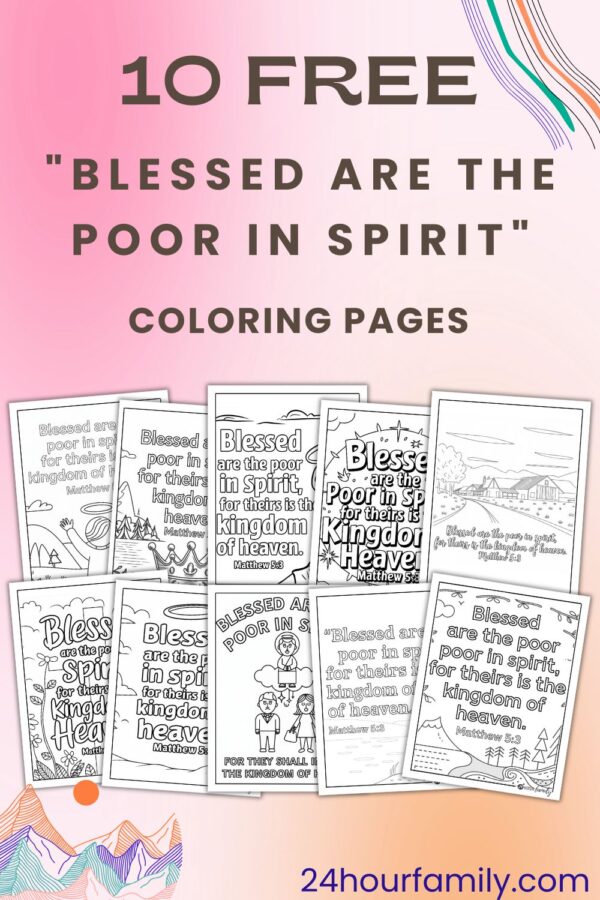
These free Blessed Are the Poor in Spirit coloring pages give children a creative way to become familiar with Matthew 5:3 while learning about humility, dependence on God, prayer, and the kingdom of heaven.
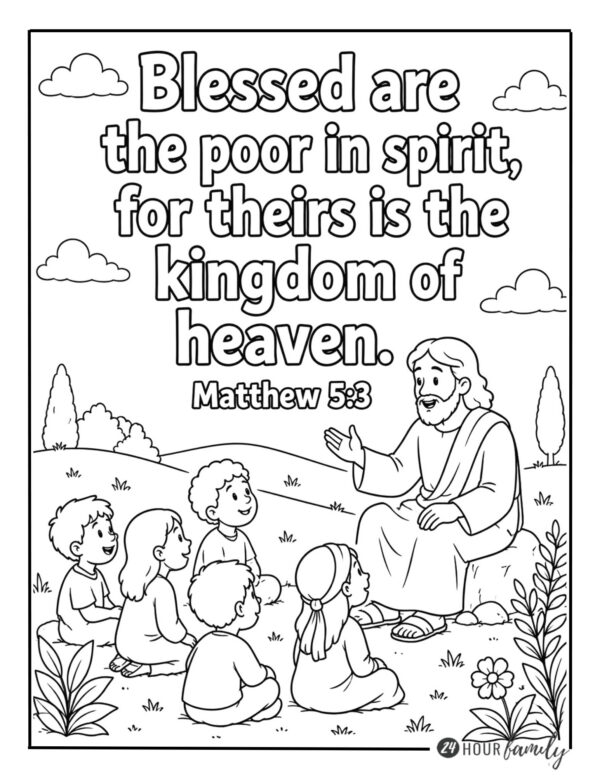
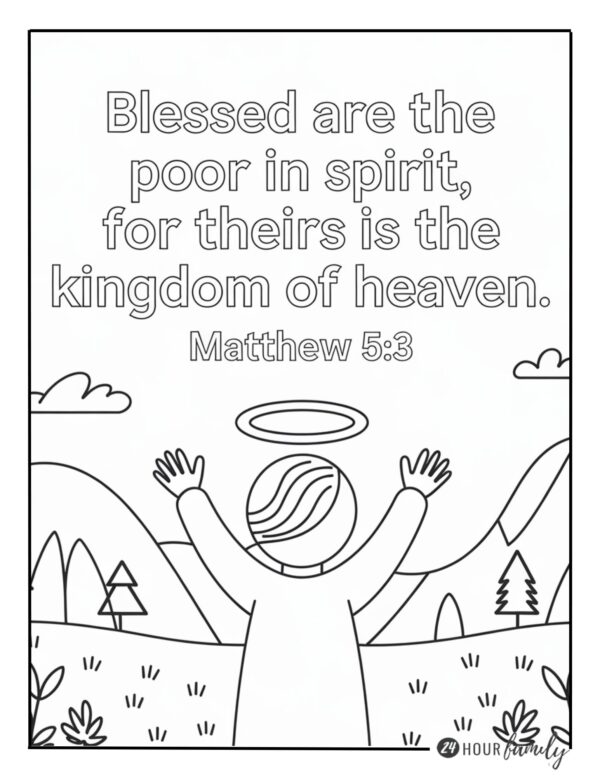
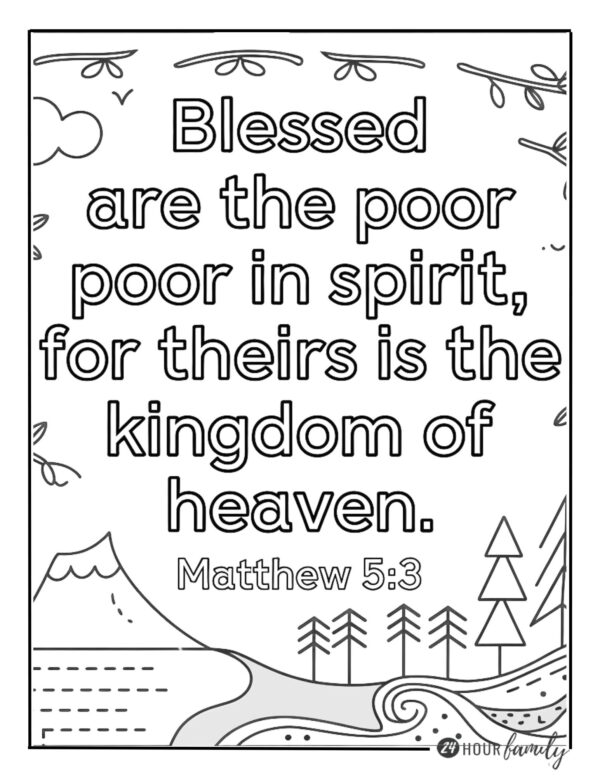
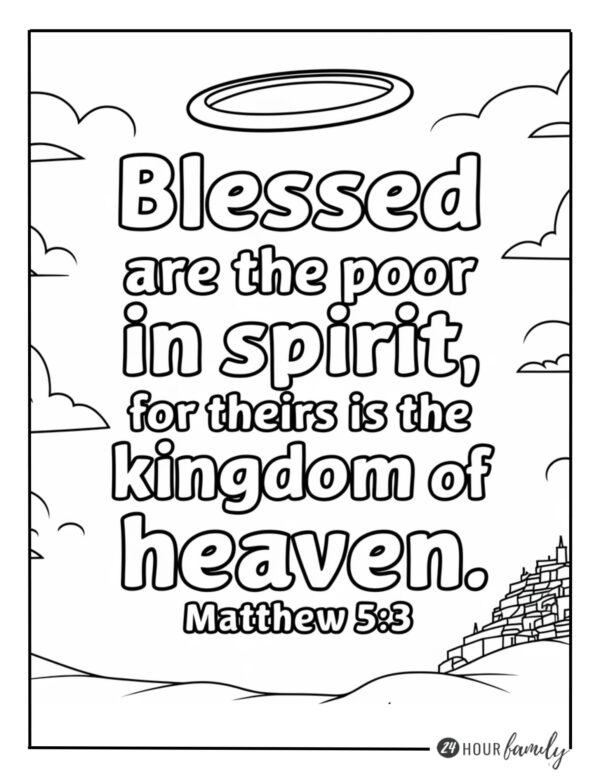
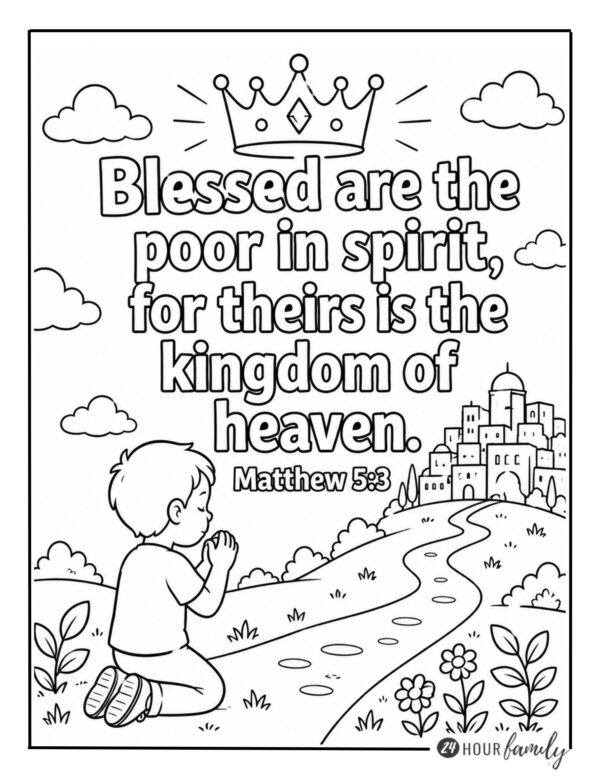
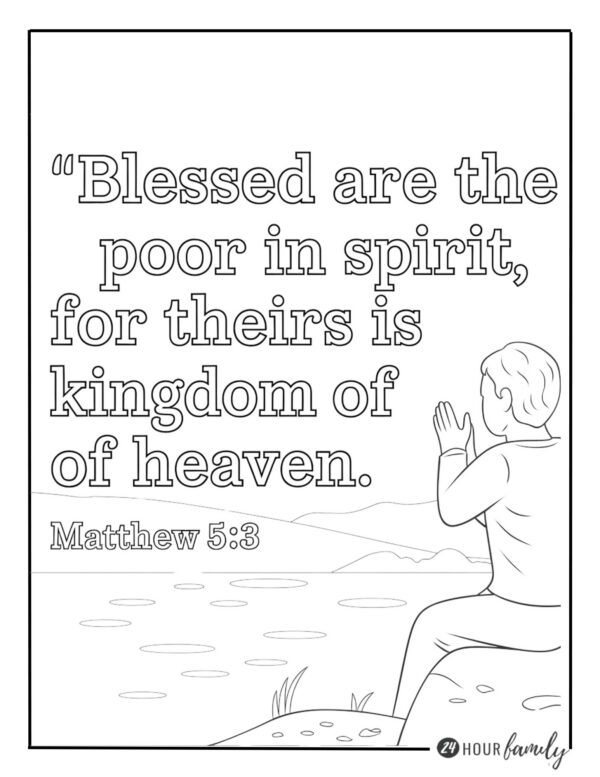
The printable set includes 10 different Bible verse coloring sheets. Children can color large outlined words, nature scenes, a crown, praying figures, halos, clouds, flowers, and other illustrations connected to the meaning of the verse.
Use the pages during a lesson about the Beatitudes, the Sermon on the Mount, Christian character, humility, or what it means to trust God.
Keep reading for a child-friendly explanation of Matthew 5:3, lesson ideas, and the free printable coloring pages available near the end of this post.
What Is Included in the Printable Set?
The free printable collection includes 10 Matthew 5:3 coloring pages featuring the words:
“Blessed are the poor in spirit, for theirs is the kingdom of heaven.”
Children can choose from pages with:
- Large bubble letters
- Clouds and stars
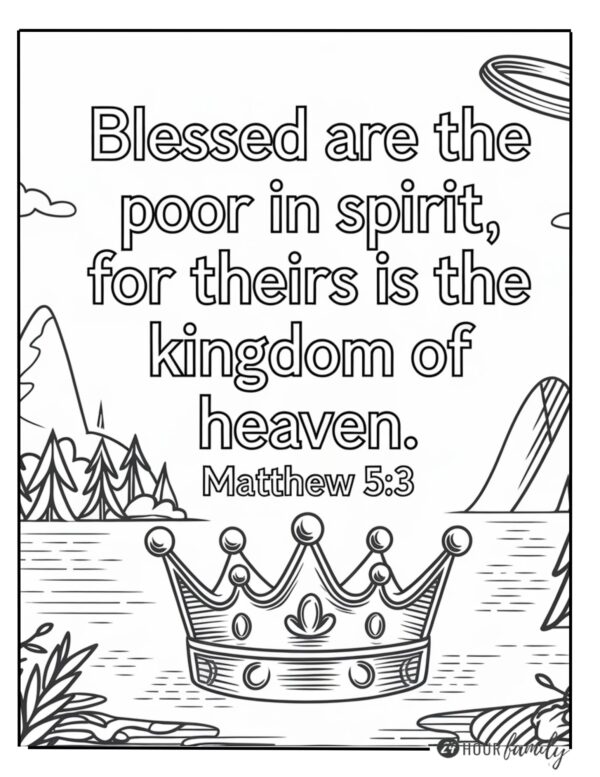
- A crown representing God’s kingdom
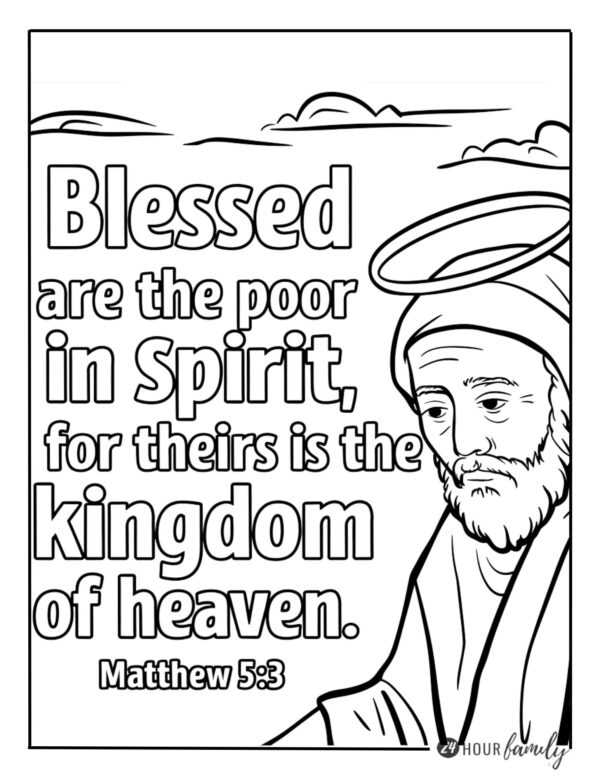
- A figure with a halo
- A praying child
- Mountains, trees, and water
- Flowers and leafy borders
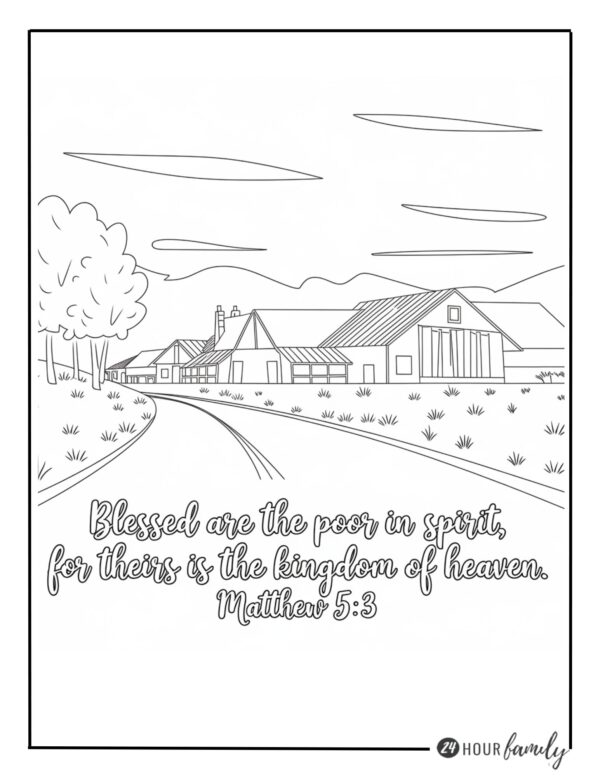
- A peaceful country scene
- Open areas for younger children
- More detailed designs for older children
Several pages focus primarily on the words of the Bible verse, while others combine Scripture with meaningful illustrations. This variety makes the set suitable for different ages and coloring abilities.

What Does “Blessed Are the Poor in Spirit” Mean?
“Poor in spirit” does not mean that a person has no confidence, value, or joy. It describes someone who understands that they need God.
A person who is poor in spirit does not approach God by saying:
- I can do everything on my own.
- I am better than everyone else.
- I never make mistakes.
- I do not need forgiveness.
- I can earn God’s love by being perfect.
Instead, that person humbly says:
- I need God’s help.
- I need God’s forgiveness.
- I want God to guide me.
- Everything good I have comes from Him.
- I cannot live the way God wants without His grace.
Many children’s Bible lesson resources explain “poor in spirit” through the ideas of humility, recognizing our spiritual need, and depending on God rather than relying entirely on ourselves.
A Child-Friendly Definition
You might explain Matthew 5:3 to children this way:
Being poor in spirit means knowing that we need God and humbly asking Him to help us.
That definition is simple enough for younger children while preserving the verse’s central meaning.

What Does “Blessed” Mean in the Beatitudes?
Children may hear the word “blessed” and think only of receiving presents, having a comfortable life, or getting something they want.
In the Beatitudes, being blessed does not mean that life will always be easy. Jesus describes the deep favor, hope, and belonging experienced by people who live as members of God’s kingdom.
The Beatitudes introduce the values of God’s kingdom and describe attitudes that followers of Jesus should develop.
A child-friendly explanation might be:
Blessed means being cared for by God and living in the joy and hope He gives us.
Where Is This Beatitude Found in the Bible?
Matthew 5:3 is the first Beatitude recorded in the Gospel of Matthew.
Jesus taught the Beatitudes near the beginning of the Sermon on the Mount. In Matthew 5:1–12, He described the character and hope of those who belong to God’s kingdom.
The Beatitudes include:
- Blessed are the poor in spirit.
- Blessed are those who mourn.
- Blessed are the meek.
- Blessed are those who hunger and thirst for righteousness.
- Blessed are the merciful.
- Blessed are the pure in heart.
- Blessed are the peacemakers.
- Blessed are those who are persecuted because of righteousness.
The Beatitudes show that God’s kingdom values humility, mercy, righteousness, purity, peace, faithfulness, and dependence on Him.
Why Does Jesus Begin With Being Poor in Spirit?
The first Beatitude provides an important starting point for the others.
Before children can learn to be merciful, pure in heart, or faithful during difficult situations, they must recognize that they need God’s help. Spiritual growth does not begin with pretending to have everything figured out. It begins with humility.
Being poor in spirit means coming to God with open hands rather than a proud heart.
You can illustrate this for children with two imaginary prayers.
One child prays:
“God, I already know everything. I am always right, and I do not need anyone to help me.”
Another child prays:
“God, I need You. Please forgive me, teach me, and help me make good choices.”
Ask children which prayer demonstrates a humble heart. This makes an abstract Bible phrase much easier to understand.
This post may contain affiliate links. As an Amazon Associate and a participant in other affiliate programs, I earn a commission on qualifying purchases. Read our disclosure policy here.



How to Use the Matthew 5:3 Coloring Pages
These Scripture coloring sheets can be used in several Christian learning settings.
Sunday School
Give each child a page after reading Matthew 5:1–12 together.
While the children color, discuss the difference between being proud and being humble. Remind them that humility does not mean believing they are unimportant. It means understanding that God is great and that we need Him.
Children’s Church
Use the coloring pages as a quiet activity following a children’s sermon about the Beatitudes.
Choose one design for the entire group or allow children to select the page they prefer. The large-letter designs work especially well with younger children.
Christian Homeschool
Add a coloring page to a Bible lesson, morning basket, copywork assignment, or Scripture memory activity.
Children can color the verse one day and complete a writing or reflection activity the next.
Christian Classroom
Use the pages during:
- Bible class
- Chapel follow-up
- Morning work
- Indoor recess
- Early-finisher time
- Quiet reading time
- A lesson about Christian character
Vacation Bible School
The printables can supplement a VBS lesson about Jesus’ teachings, humility, prayer, heaven, or God’s kingdom.
Family Devotions
Read the Beatitude together and let each family member choose a page to color.
Even older children and adults may enjoy coloring while discussing the passage’s meaning.
A Simple Blessed Are the Poor in Spirit Bible Lesson
This short lesson can be used with the printable pages at home, in Sunday school, or in a Christian classroom.
Read the Bible Passage
Read Matthew 5:1–12 aloud.
Explain that Jesus taught these words while speaking to a crowd. The statements are called the Beatitudes.
Introduce the First Beatitude
Read Matthew 5:3 again:
“Blessed are the poor in spirit, for theirs is the kingdom of heaven.”
Ask:
- What words do you understand?
- Which words sound confusing?
- What do you think “poor in spirit” might mean?
Allow children to respond before explaining the phrase.
Explain the Meaning
Tell the children:
Being poor in spirit means knowing that we need God. We cannot remove our own sin, make ourselves perfect, or live faithfully through our own strength. We come to God humbly and trust Him to forgive, teach, and help us.
Give a Simple Example
Hold up an empty cup.
Ask whether an empty cup can fill itself. Explain that the cup must receive what is poured into it.
Similarly, a humble person recognizes the need to receive wisdom, forgiveness, strength, and grace from God.
Avoid suggesting that people are literally empty or worthless. The illustration is about our need for God—not a lack of personal value.
Color the Bible Verse
Give each child a coloring page.
As they color, repeat the verse several times. Encourage them to notice the words blessed, poor in spirit, and kingdom of heaven.
Close in Prayer
Pray:
God, thank You for loving us. Help us remember that we need You. Forgive us when we are proud, and teach us to have humble hearts. Help us listen to You and trust You each day. Amen.
Discussion Questions for Children
Use a few of these questions while children color or after they finish:
- What does it mean to be poor in spirit?
- Why do we need God?
- What is humility?
- How is humility different from thinking badly about yourself?
- What does a proud attitude sound like?
- What does a humble prayer sound like?
- When is it difficult to ask for help?
- How can we depend on God this week?
- What did Jesus promise to the poor in spirit?
- What do you think the kingdom of heaven means?
- How can prayer help us remember that we need God?
- What is one area in which you need God’s help today?
For younger children, keep the questions concrete. Ask them to name a time when they needed help or when they prayed about something difficult.
Poor in Spirit Object Lesson
An object lesson can help children understand the verse before beginning their coloring pages.
You Will Need:
- Two cups
- Water
- A small pitcher
- A tray or towel
Demonstration:
Place one cup upside down and the other cup upright.
Try pouring water into the upside-down cup. The cup cannot receive the water because it is turned away.
Next, pour water into the upright cup.
Explain that a proud heart can be like the upside-down cup. It says, “I do not need anything. I will not listen.”
A humble heart is willing to receive from God. It listens, prays, learns, and asks for help.
Clarify that the water does not represent God Himself. It simply helps demonstrate the difference between refusing help and being ready to receive it.
Activities to Use With the Coloring Pages
Matthew 5:3 Scripture Copywork
Ask children to copy the verse beneath their completed coloring page or in a Bible notebook.
Younger children can trace selected words:
- Blessed
- Spirit
- Kingdom
- Heaven
Older children can copy the complete verse.
Humble Heart and Proud Heart Sorting Activity
Write different actions on slips of paper and ask children to sort them into two groups.
Examples of humble actions include:
- Admitting a mistake
- Asking God for help
- Listening to wise advice
- Apologizing
- Thanking someone
- Letting another person go first
Examples of proud actions include:
- Refusing to apologize
- Bragging
- Blaming everyone else
- Believing we never need help
- Ignoring correction
- Trying to make others feel unimportant
Explain that everyone struggles with pride sometimes. The purpose is not to label people as “good” or “bad,” but to recognize attitudes and ask God to help us grow.
Prayer Hand Activity
Have children trace one hand on paper.
Inside each finger, they can write one area in which they need God’s help:
- Family
- Friendships
- School
- Choices
- Fears
Children can decorate the hand and keep it as a prayer reminder.
Kingdom Crown Craft
The printable set includes a page featuring a crown, which can lead naturally into a lesson about God’s kingdom.
Make simple paper crowns and write Matthew 5:3 across the front. On each point of the crown, children can write a word connected to the lesson:
- Humility
- Prayer
- Grace
- Trust
- God
Remind children that the verse is not teaching that humility makes us earthly kings or queens. The crown represents belonging to the kingdom of heaven.
Complete the Sentence
Ask children to finish one or more of these prompts:
- I need God when…
- I can show humility by…
- One thing I want God to teach me is…
- I can ask for help when…
- God is greater than…
- This Beatitude teaches me…
Beatitudes Memory Book
Use Matthew 5:3 as the first page in a Beatitudes booklet.
As children study each Beatitude, add another coloring page, verse, explanation, or reflection. Staple the pages together when the study is complete.
How Coloring Supports a Bible Lesson
Coloring gives children time to slow down and remain engaged with the words of Scripture.
As they work, teachers and parents can repeat the verse, introduce vocabulary, ask questions, and connect the passage to everyday experiences.
The activity should support the Bible lesson rather than replace it. Children will understand Matthew 5:3 more fully when the coloring page is paired with:
- Reading the passage
- Clear explanation
- Conversation
- Prayer
- Scripture memory
- A practical example
Tips for Teaching This Beatitude to Younger Children
The phrase “poor in spirit” is abstract, so preschool and early-elementary children will need a very simple explanation.
Try saying:
“Jesus says we are blessed when we know we need God.”
You can also explain:
“A humble heart asks God for help and listens to Him.”
Avoid giving children the impression that “poor” is a negative label for people experiencing financial hardship. Matthew 5:3 specifically uses the phrase “poor in spirit” and emphasizes a humble spiritual posture before God.
For younger children:
- Use one central idea.
- Repeat the verse several times.
- Give concrete examples.
- Avoid a long theological explanation.
- Connect humility to asking for help.
- End with a brief prayer.
Tips for Teaching Older Children
Older elementary students may be ready to discuss the difference between humility and low self-esteem.
Humility does not mean:
- Pretending you have no talents
- Allowing others to mistreat you
- Believing you are worthless
- Refusing appropriate praise
- Never speaking confidently
Biblical humility means seeing ourselves honestly in relationship to God. We recognize our gifts while understanding that they come from Him. We admit our mistakes, accept correction, and know that we need His grace.
Older children can also compare pride and humility in different Bible stories.
Bible Stories That Reinforce the Lesson
The Pharisee and the Tax Collector
In Luke 18:9–14, one man boasts about his religious behavior while the other humbly asks God for mercy.
This story provides a clear contrast between spiritual pride and the recognition of one’s need for God. Some Beatitude lesson resources use this passage to teach children about being poor in spirit.
Jesus Welcomes the Children
In Mark 10:13–16, children come to Jesus with dependence and trust.
This story can help children understand that God welcomes those who come to Him rather than relying on status or importance.
Peter Learns to Depend on Jesus
Peter often acted with great confidence, but he also learned that he needed Jesus’ forgiveness, guidance, and strength.
His story can help older children see that following Jesus involves both courage and humility.
Ways Children Can Practice Humility
Children can practice a humble attitude when they:
- Ask God for help
- Admit when they are wrong
- Apologize sincerely
- Listen when someone teaches them
- Accept correction without making excuses
- Thank God for their abilities
- Celebrate another person’s success
- Serve without needing attention
- Ask questions when they do not understand
- Remember that everyone needs grace
These actions do not earn God’s love. They are ways children can respond to His love and grow in Christlike character.
How to Print the Bible Coloring Pages
Download the PDF and save it to your computer or device before printing.
For full-page coloring sheets:
- Open the file in a PDF reader.
- Select the page or pages you want.
- Choose portrait orientation.
- Select Fit to Printable Area if the border is being cut off.
- Print on white letter-size paper.
- Use black-and-white or grayscale printing.
Regular copy paper works well with crayons, colored pencils, and washable markers.
Use slightly heavier paper when children plan to paint the pages, although very wet paint may still cause the paper to curl.
Recommended Coloring Supplies:
Children can use:
- Crayons
- Colored pencils
- Washable markers
- Fine-tip markers for older children
- Twistable crayons
- Gel pens
- Watercolor pencils
- Dot markers on pages with larger spaces
Place a protective sheet beneath the coloring page when using markers.
Use them as part of a complete Beatitudes study, a stand-alone Bible lesson, Scripture memory practice, or a peaceful activity during family devotions.
As children color the words of Jesus, remind them of the central truth:
A humble heart knows that it needs God.
What does “poor in spirit” mean for children?
Being poor in spirit means humbly understanding that we need God. We need His forgiveness, wisdom, strength, and guidance. It does not mean thinking we are worthless or unimportant.
Is Matthew 5:3 about financial poverty?
Matthew 5:3 specifically says “poor in spirit.” The verse focuses on a person’s spiritual posture before God. It teaches humility and dependence on Him rather than self-sufficiency.
What are the Beatitudes?
The Beatitudes are blessings Jesus taught near the beginning of the Sermon on the Mount in Matthew 5. They describe the attitudes, character, hope, and values associated with God’s kingdom.
Why does the verse say “theirs is the kingdom of heaven”?
Jesus promises that the kingdom of heaven belongs to those who humbly recognize their need for God. The promise emphasizes present belonging as well as future hope.
Is being humble the same as having low self-esteem?
No. Humility does not mean thinking you have no value. It means seeing yourself honestly, acknowledging God’s greatness, recognizing your need for Him, and treating other people with respect.
What ages are these coloring pages for?
The collection can be used with preschoolers, elementary-age children, older students, and adults. Pages with large lettering and open spaces are easiest for younger children, while the more detailed designs are suitable for older children.
Can these pages be used for Sunday school?
Yes. They can be used in Sunday school, children’s church, Christian school, homeschool, Vacation Bible School, family devotions, or a study of the Sermon on the Mount.
Can children memorize Matthew 5:3 with a coloring page?
A coloring page can support Scripture memorization by keeping the verse visible while children work. Repeat the verse aloud, cover selected words, and invite children to say the missing parts from memory.
Do I need to use all 10 coloring sheets?
No. Print the complete collection or select the pages that best fit your children’s ages and your lesson. Different children may enjoy choosing their own designs.
Download the Free Blessed Are the Poor in Spirit Coloring Pages
These printable Matthew 5:3 coloring pages offer a meaningful way to introduce the first Beatitude and to help children reflect on humility, prayer, and their need for God.
