
Free Pledge of Allegiance Worksheets And Posters Printable PDF (10 Pages)
Help kids learn the Pledge of Allegiance with this free 10-page printable PDF bundle! The collection includes colorful patriotic displays, a coloring sheet, handwriting practice, vocabulary exercises, and learning materials for elementary children.
These free Pledge of Allegiance printables make learning the 31 words of the American Pledge more engaging for preschoolers, kindergarteners, and older kids. They’re also useful for homeschool lessons, daily school routines, and national celebrations.
Check out more Fourth of July crafts and printables and our Educational printables for more themed learning ideas.
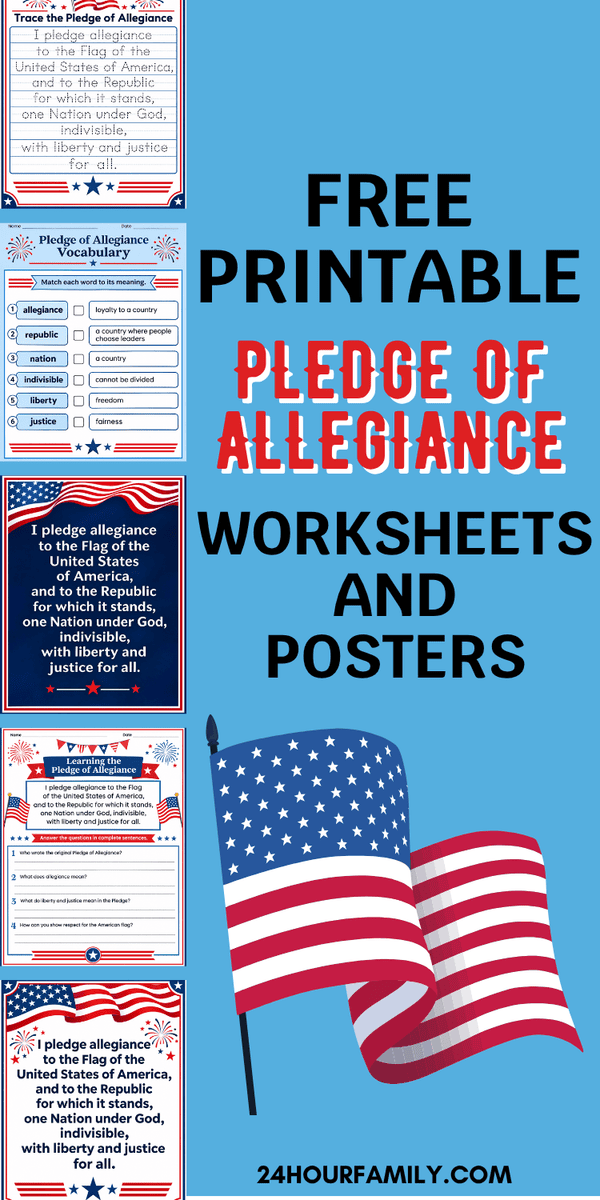
Across the collection, children will see U.S. flags, fireworks, and the Statue of Liberty illustrated in shades of red, white, and blue.
Whether you’re teaching the Pledge for the first time or helping children explore its message, this collection offers several ways to practice reading, handwriting, memorization, and American history.
Free Pledge of Allegiance Printable PDF Download
Our free bundle includes 10 printable pages you can use individually or together as an educational pack.
The collection includes:
- Five colorful Pledge of Allegiance posters
- One black-and-white coloring page with the Pledge
- One handwriting tracing sheet
- One vocabulary matching exercise
- One cut-and-paste sequencing sheet
- One reading comprehension and learning sheet
Each page serves a different purpose, from displaying the words during group lessons to helping children understand vocabulary such as allegiance, republic, liberty, and justice.
Print your favorite wall display or use the exercises during an American history or social studies lesson.
A Look Inside the 10-Page Learning Bundle
This set combines decorative artwork with hands-on learning activities. The wall displays provide a visual reference, while the practice sheets help children explore the words and ideas behind the Pledge.
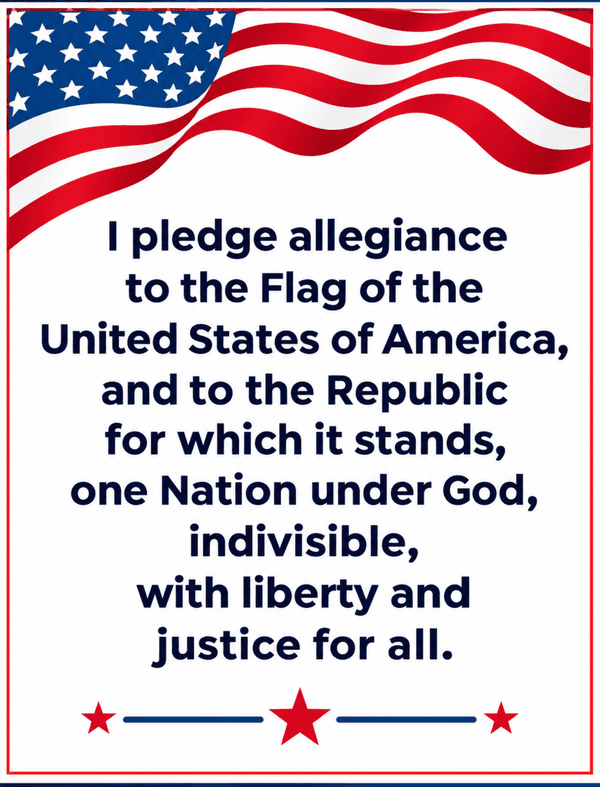
1. Classic Pledge of Allegiance Poster
The first wall display features the complete words in large, easy-to-read lettering, surrounded by stars and a U.S. flag.
Its clear font and simple layout make it a practical choice for bulletin boards, homeschool learning spaces, and morning meeting areas.
Teachers can laminate this page for repeated use or place it beside a flag so young learners can refer to the words during lessons.
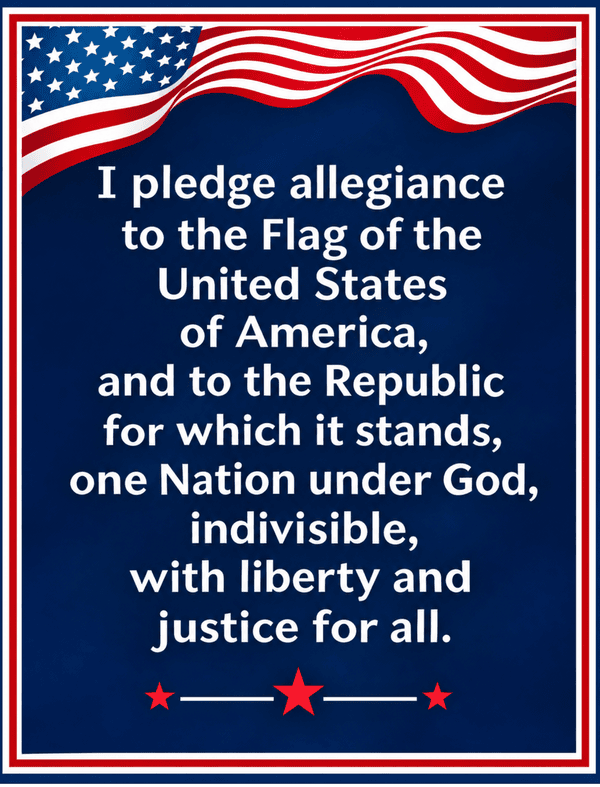
2. Navy Blue Pledge Wall Display
This wall chart features a dark navy background with white lettering and flag decorations.
The contrasting colors make it suitable for a school display, especially when paired with other American-themed decorations.
Use this design for Constitution Day lessons, bulletin boards, or an American symbols learning center.
3. Statue of Liberty Pledge Printable
This kid-friendly version includes a colorful Statue of Liberty illustration alongside the complete Pledge of Allegiance.
It’s a useful addition to a lesson about American landmarks and national symbols.
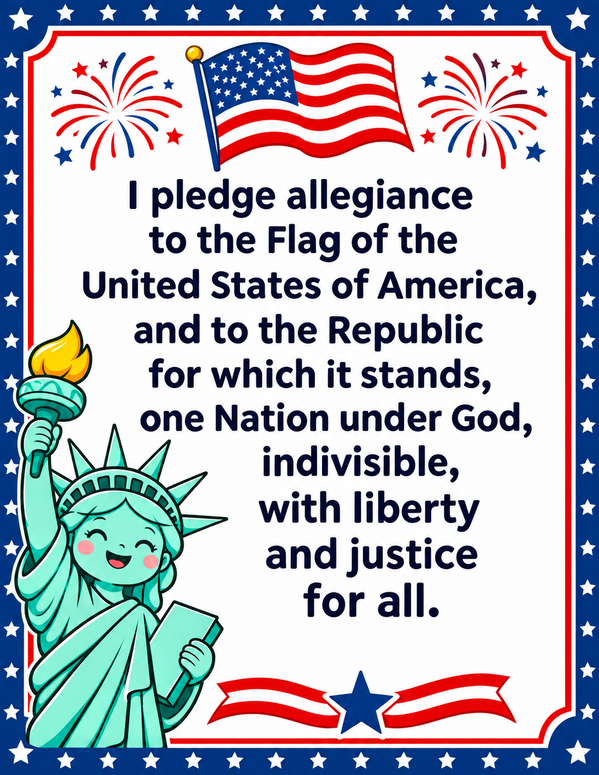
Children can learn that the Statue of Liberty represents freedom and discuss how the word liberty appears in the Pledge.
For another patriotic craft, try making our Uncle Sam paper bag puppet using the free printable template.
4. Vintage Patriotic Wall Art
This design features bunting, stars, and a soft vintage-inspired background.
The traditional colors make it an attractive addition to an American history display or homeschool learning area.
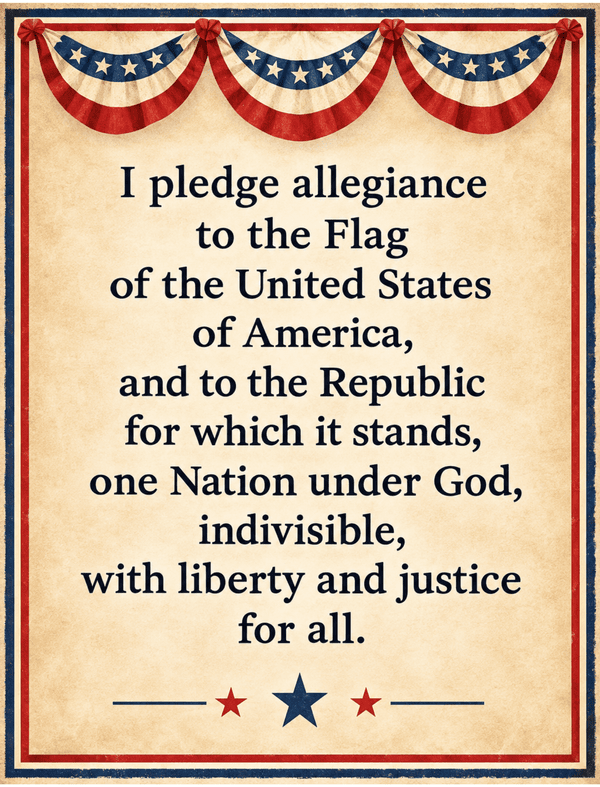
It can also be framed or laminated for use throughout the school year.
5. American Flag Pledge Display
The fifth design features the complete Pledge in large, easy-to-read lettering, surrounded by patriotic red, white, and blue decorations.
With American flag bunting, stars, and a vintage-inspired background, it’s perfect for classrooms, homeschool rooms, morning routines, and patriotic celebrations like the Fourth of July and Veterans Day.
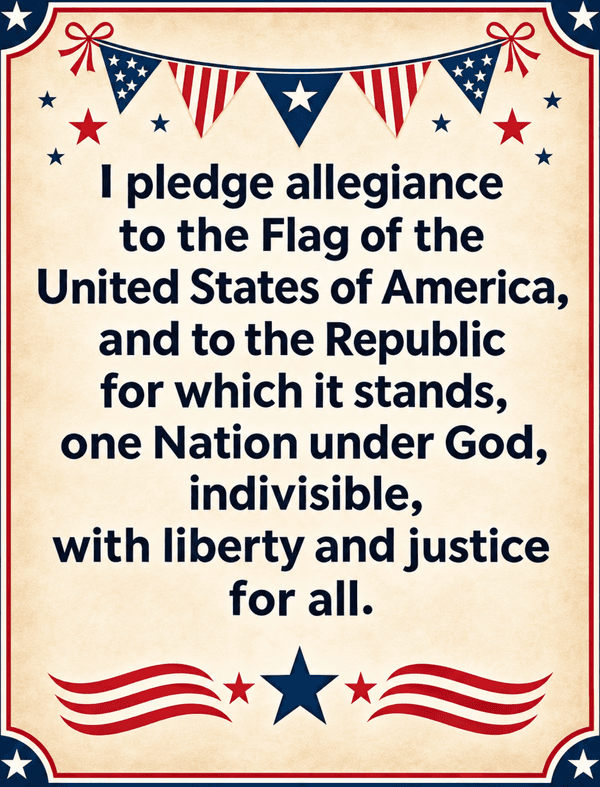
You can also use it during a lesson about the significance of the flag’s 50 stars and 13 stripes.
6. Patriotic Pledge Coloring Sheet
Outlines of a U.S. flag, stars, and fireworks surround the full Pledge, ready for children to decorate.
It’s a simple way to familiarize preschoolers and kindergarteners with the words while giving them an opportunity to practice coloring and fine motor skills.
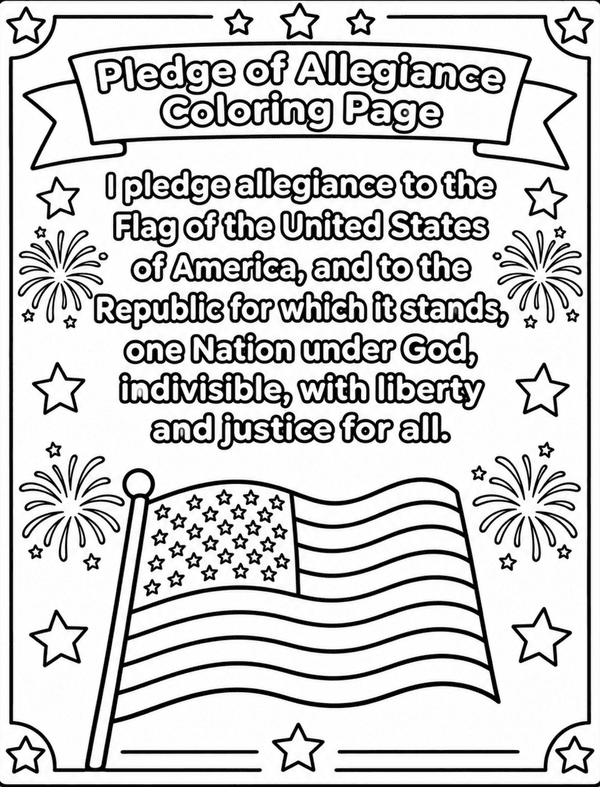
Kids can decorate the illustrations in red, white, and blue or choose their favorite colors to personalize the sheet.
For another coloring activity, try our Fourth of July color-by-number printables, featuring illustrations that help children practice number and color recognition.
7. Pledge of Allegiance Tracing Worksheet
The handwriting sheet features the complete Pledge in dotted letters that children can trace.
This tracing sheet can be used for writing practice, letter recognition, and early reading lessons.
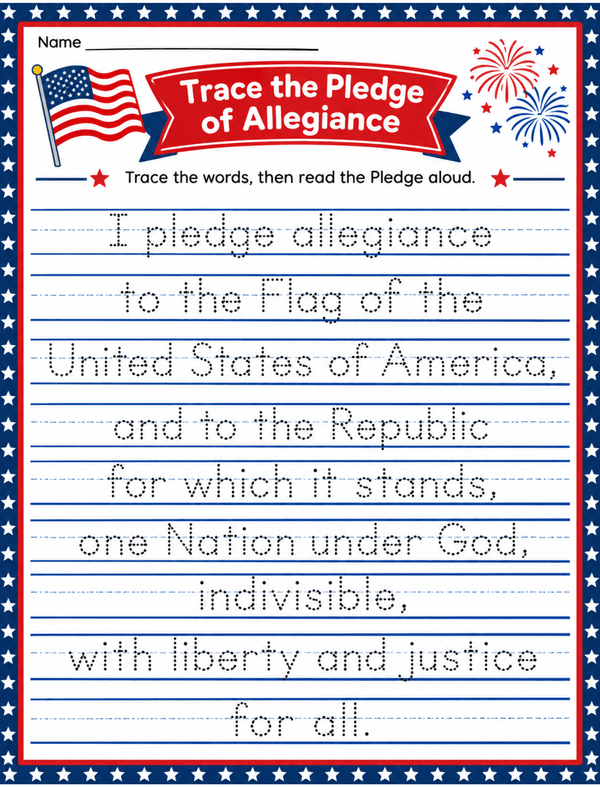
As children trace the words, encourage them to say each phrase aloud. Saying each line while tracing helps children remember what they write.
Younger children may prefer to complete a few lines at a time, while older learners can trace the entire passage in one sitting.
8. Pledge Vocabulary Matching Worksheet
Some words in this civic promise can be unfamiliar to young learners.
This matching exercise covers six important words:
- Allegiance
- Republic
- Nation
- Indivisible
- Liberty
- Justice
Children match each word with a simple definition to develop their understanding of the text.
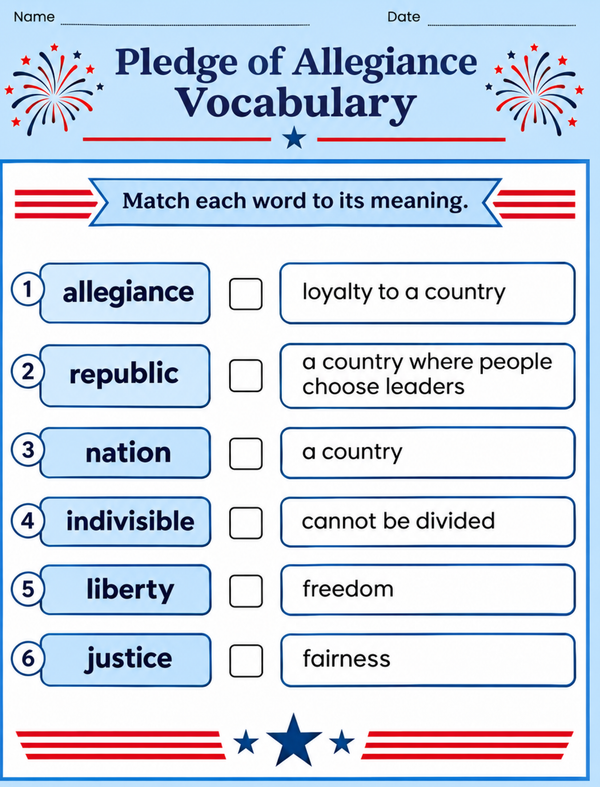
For kindergarten learners, read the words and definitions aloud before completing the exercise together.
First through third graders can work more independently and discuss how the vocabulary relates to American citizenship.
9. Pledge Cut-and-Paste Sequencing Worksheet
This hands-on exercise helps children put the phrases of the Pledge in the correct order. Learners cut out the printed phrase strips and arrange them in numbered spaces.
They can use one of the wall displays as a reference while completing the task. For younger children, provide assistance with scissors or pre-cut the strips before the lesson.
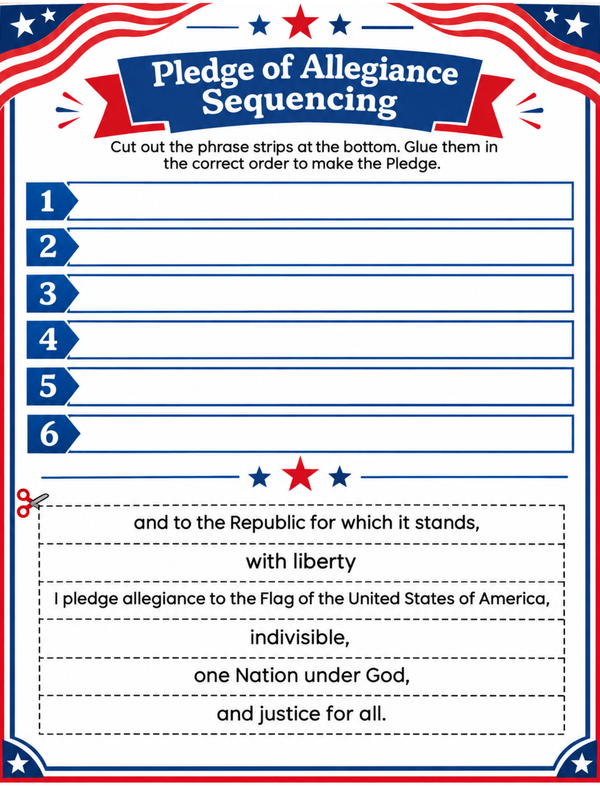
This activity combines reading comprehension, sequencing, and fine motor practice while helping children become more familiar with the Pledge.
10. Check Understanding With Four Questions
On the last sheet, children find the full Pledge followed by four questions they can answer in their own words. The questions cover who wrote the original Pledge, what three important terms mean, and how to show respect for the U.S. flag.
After the other sheets are complete, discuss these four prompts with children at home or during a civics lesson.
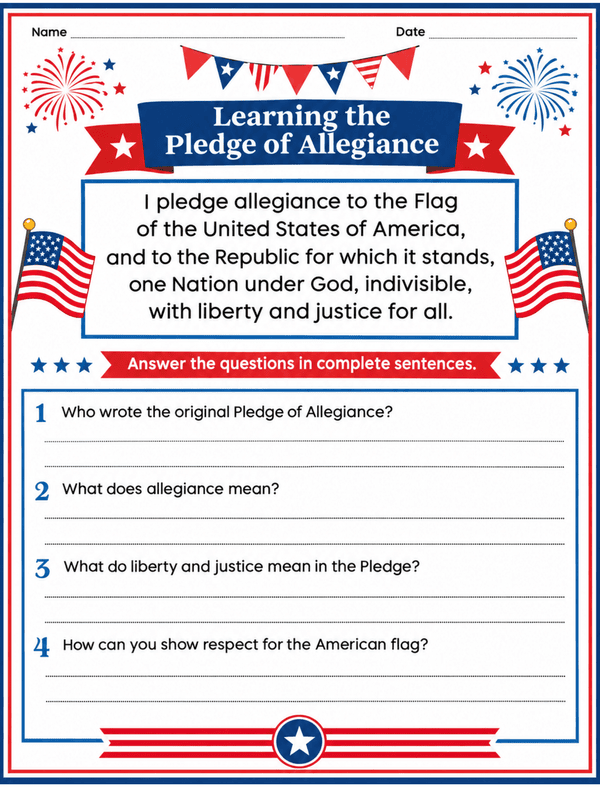
Pay attention to which answers children explain confidently and where they might benefit from another example.
The Pledge as Written in U.S. Law
This collection uses today’s 31-word Pledge, which differs from the shorter version first published in 1892.
The posters and selected practice sheets include these words:
I pledge allegiance to the Flag of the United States of America, and to the Republic for which it stands, one Nation under God, indivisible, with liberty and justice for all.
The flag gives this promise a visible symbol, while the words refer to the country and the principles it seeks to uphold.
Children often memorize these words during their early school years, but understanding them is equally important.
Having a printout lets learners follow along as the words are read aloud and revisit unfamiliar phrases during lessons.
Exploring the Pledge’s Word Count
Counting each word in today’s version gives a total of 31.
The original Pledge was written in 1892, and its wording has changed several times.
The phrase “under God” was added on June 14, 1954, when President Dwight D. Eisenhower signed legislation changing the official wording.
No further official wording changes have been made since that 1954 revision.
You can turn this fact into a simple learning exercise by asking children to count the words on one of the printed displays.
Guide younger kids word by word as you read; those who can read on their own might tally the total or look for especially long vocabulary.
Helping Children Understand the Pledge
Reciting these words expresses loyalty to the United States while acknowledging values such as unity, freedom, and fairness.
Kids may understand these ideas more easily when an adult discusses a few words at a time.
Understanding the First Line
A pledge is a commitment a person makes. Allegiance means loyalty or faithfulness. The speaker directs this promise toward the country, using its flag as a symbol.
For children, explain that the national banner is an important symbol of our country.
What the Flag Represents: The Republic
In the American system of government, voters choose representatives to make many public decisions on their behalf. Tell children that voting gives adults a say in who represents their communities.
The words refer not only to the flag itself but also to the nation and its elected government.
“One Nation under God”
A nation is a country whose people share a political community. The phrase “one Nation” emphasizes the country’s unity despite its many states and communities.
The phrase “under God” was added in 1954 and reflects a reference to God in the official wording.
“Indivisible”
If something is indivisible, it is meant to stay whole rather than be separated. In this context, the word reflects the ideal of keeping the country united.
You can explain this idea by discussing how people from different states and backgrounds are part of one country.
Understanding Liberty, Justice, and Fair Treatment
Liberty means freedom. Justice involves treating people fairly and applying laws without favoritism.
These words express important American ideals, including the belief that everyone should be free and treated fairly under the law.
For younger children, discuss everyday examples of fairness, respecting other people, and following rules that protect everyone’s rights.
How to Teach the Pledge to Preschool and Kindergarten Students
Helping kids recite the Pledge of Allegiance is easier when you teach the words through short lessons and hands-on practice.
Rather than asking children to memorize all 31 words immediately, begin with a simple explanation and build familiarity over time.
Display a Pledge Poster
Choose one of the five wall displays and place it near your school or homeschool learning area. Point to the words as you read aloud so children can connect spoken words with printed text.
The large-print versions are especially useful for beginning readers.
Build Familiarity in Small Sections
Work through a short portion each day instead of reviewing every line at once. Begin by reading only the first line and discussing what it says about the flag. Add another short section when children can comfortably say the first one.
The goal is to help children recognize the language without making memorization overwhelming.
Practice Handwriting With the Tracing Sheet
Use the tracing worksheet to combine writing practice with reading. Children can trace a few lines each day while saying the words aloud.
This exercise is particularly useful for kindergarten and first-grade handwriting lessons.
Work Through the Vocabulary Together
Review all six words on the matching sheet, then help children pair each term with its definition. Ask children to share everyday examples of freedom and fairness.
These conversations help kids connect abstract ideas with familiar experiences.
Use the Cut-and-Paste Exercise
Once children recognize the words, bring out the sequencing sheet. Learners arrange the phrases in the correct order, using a printed reference as a guide if needed.
This provides an interactive way to practice reading and memorization.
Traditional Etiquette When Saying the Pledge
Customs for recitation are outlined in the U.S. Flag Code.
The customary steps are:
- Face the American flag while standing at attention.
- Keep the right hand over the heart.
- Speak at a steady pace and use a respectful tone.
The Flag Code also provides customs for people in uniform, military personnel, and veterans.
Children can learn about these traditions as part of a lesson on American symbols, citizenship, or school assembly.
The Supreme Court has recognized that public school children have a constitutional right not to participate in reciting the Pledge or saluting the flag. Teachers can explain the customary practice while respecting anyone who chooses not to participate.
A Brief History of the Pledge of Allegiance
The Pledge of Allegiance dates back to 1892.
Francis Bellamy is generally credited with writing the original Pledge for The Youth’s Companion, a magazine for young readers.
The words were first presented as part of a patriotic school celebration intended to encourage national unity.
The original version began:
I pledge allegiance to my Flag
Over time, the wording changed to more specifically identify the flag of the United States.
Here are some important dates in its history:
- 1892: Francis Bellamy’s original Pledge was published.
- 1923–1924: Changes were made to the wording identifying the national flag.
- 1942: Congress formally recognized the Pledge in federal law.
- 1954: The phrase “under God” was added.
The 1954 wording remains the official version today.
For more information about the official Pledge and flag customs, visit the United States Code, Title 4, Section 4.
Patriotic Learning Activities to Pair With the Printables
These Pledge of Allegiance worksheets work well alongside other themed lessons and crafts. For preschool and kindergarten learners, pair the coloring sheet with a simple American flag activity.
Older children may enjoy discussing American symbols, Flag Day, and the history of the United States. You can extend your unit study with these ideas from 24 Hour Family.
Fourth of July Color-by-Number Pages
Our patriotic color-by-number worksheets feature festive illustrations that help children practice counting, number recognition, and color matching.
These are useful for younger kids during an Independence Day or American symbols lesson.
Memorial Day Coloring Pages
Use our Memorial Day coloring pages to teach children about Memorial Day and the importance of remembering military service members who died while serving the United States.
Patriotic Handprint Art
Our July 4th handprint art offers a creative way for children to make a red, white, and blue keepsake.
This project works well alongside the Pledge coloring sheet for younger learners.
Fireworks Pop-Up Cards
For a hands-on paper craft, try our printable fireworks pop-up cards.
Children can practice cutting, folding, and assembling their own festive creations.
You can find even more educational activities in our collection of free kids printables.
Download the Free Pledge of Allegiance Printable Bundle
Our free 10-page bundle helps children learn the words while practicing reading, handwriting, vocabulary, and sequencing.
Choose a patriotic wall display for your learning space, provide the coloring sheet for younger kids, or use the educational exercises during your next social studies lesson.
With several styles and activities in one collection, you can adapt the materials to different ages and learning needs.
Print your favorite pages and enjoy learning about the American flag, the Pledge, and the ideals of unity and fairness for all.
What are the 31 words of the Pledge of Allegiance?
The current Pledge of Allegiance contains 31 words. It begins with “I pledge allegiance to the Flag of the United States of America” and closes with a promise of freedom and fair treatment for everyone.
The complete official wording is included earlier in this article and on the included wall displays.
Is there a free printable Pledge of Allegiance PDF?
Yes! This free 10-page bundle includes five decorative displays, a coloring sheet, a tracing worksheet, a vocabulary exercise, a sequencing worksheet, and a learning worksheet.
You can download the file and print the pages you need.
Who wrote the original Pledge?
Francis Bellamy is generally credited with writing the original Pledge in 1892. It was published in The Youth’s Companion magazine.
What year was “under God” added to the Pledge?
The phrase “under God” was added on June 14, 1954, during the presidency of Dwight D. Eisenhower.
How can kindergarteners learn the Pledge?
Kindergarten children can begin by listening, following along with a printed display, learning short phrases, and practicing with coloring, tracing, and sequencing exercises.
What does allegiance mean in the Pledge?
Allegiance means loyalty or faithfulness. In the Pledge, it refers to loyalty to the United States of America.
What is the difference between the Pledge and the national anthem?
The Pledge of Allegiance is a spoken promise of loyalty to the United States. The national anthem, “The Star-Spangled Banner,” is a song.
Both are associated with American ceremonies and traditions, but they are not the same.
Can I use these Pledge materials in a classroom?
Yes. These free materials are made for home and classroom learning. Teachers and homeschool families can use the displays as references and the learning sheets for educational practice.
