
20 Body Parts Activities for Preschoolers
Children are often eager to learn how their bodies work. They want to know why they have two eyes, what their bones look like, how their hearts beat, and what happens to food after they swallow it.
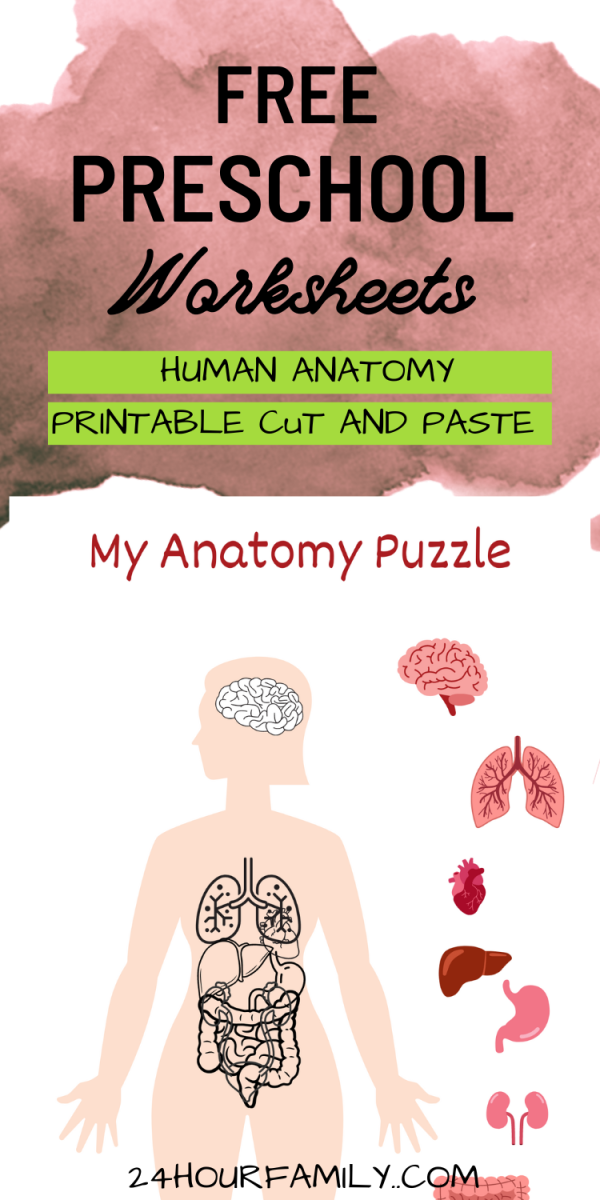
These body parts activities for preschoolers introduce basic anatomy through movement, music, art, games and activities, and free printable cut-and-paste worksheets.
As a Registered Nurse and longtime homeschool mom, I have found that early anatomy is one of the best ways to teach body parts when lessons remain simple, visual, and active. Young children do not need to memorize complicated body systems. They need opportunities to point, move, ask questions, and connect new vocabulary with their own experiences.
20 Body Parts Activities for Preschoolers
Children can identify external body parts, learn the names of major internal organs, practice matching, and discover some of the important jobs their bodies perform every day. They offer an engaging way for children to explore how their bodies work.
Free Body Parts Printables
The free learning pages featured in this post introduce two levels of anatomy.
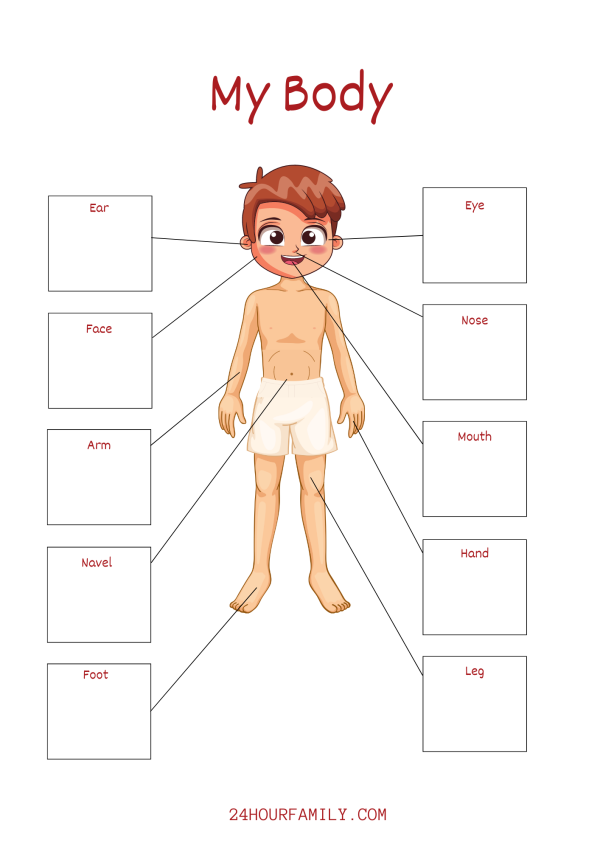
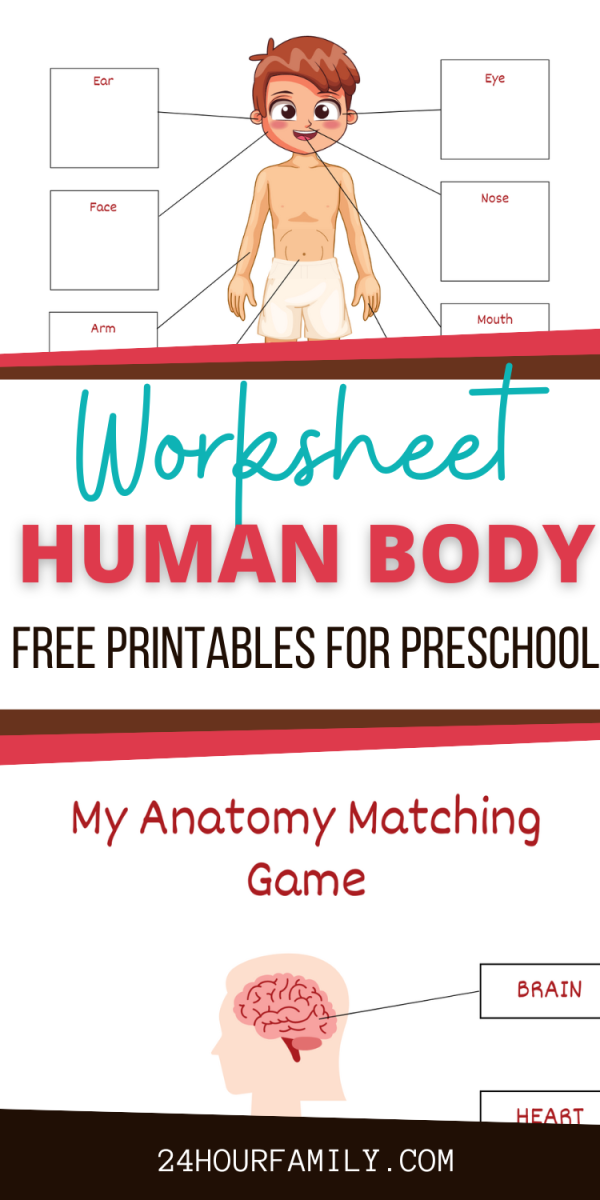
The first activity focuses on visible or external body parts, including:
- Face
- Eyes
- Ears
- Nose
- Mouth
- Arm
- Hand
- Leg
- Foot
- Navel
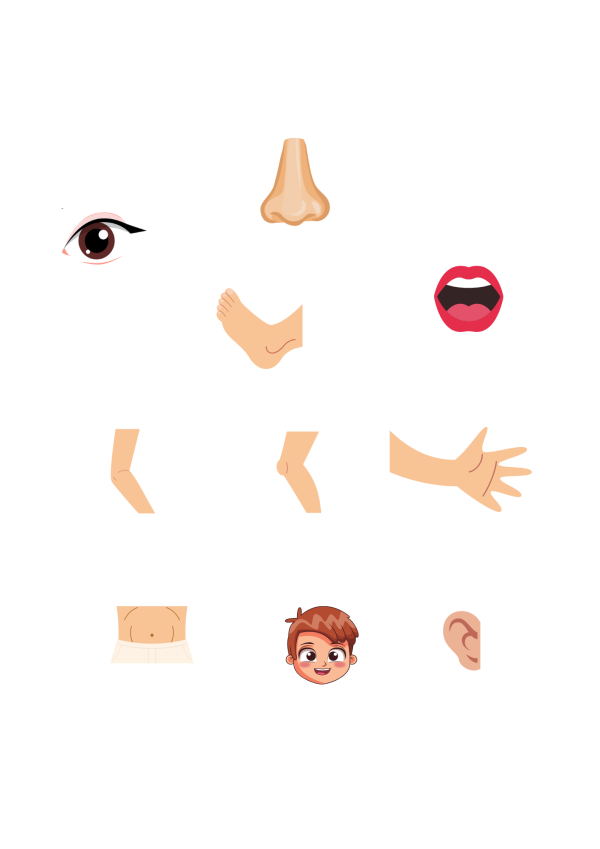
Children cut out the picture cards, words, or illustrations and place them in the correct locations on the body.
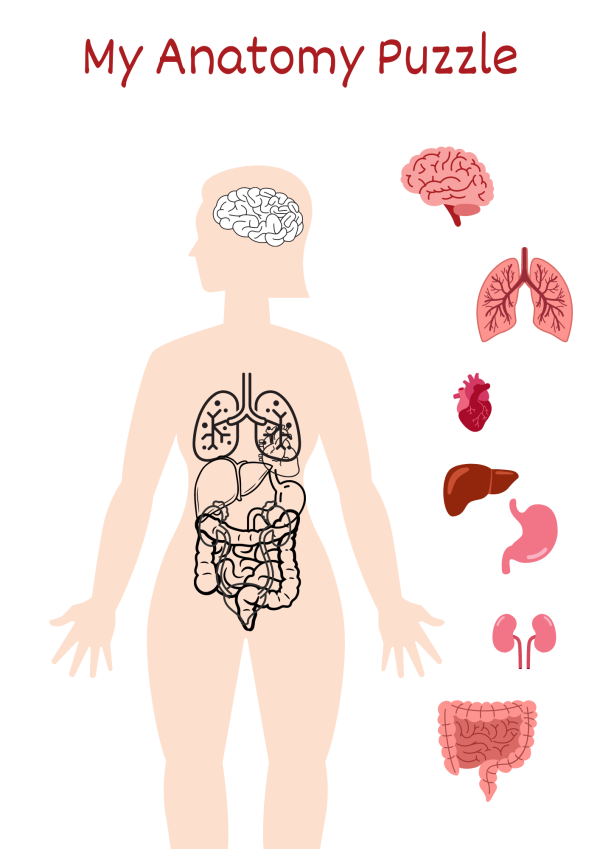
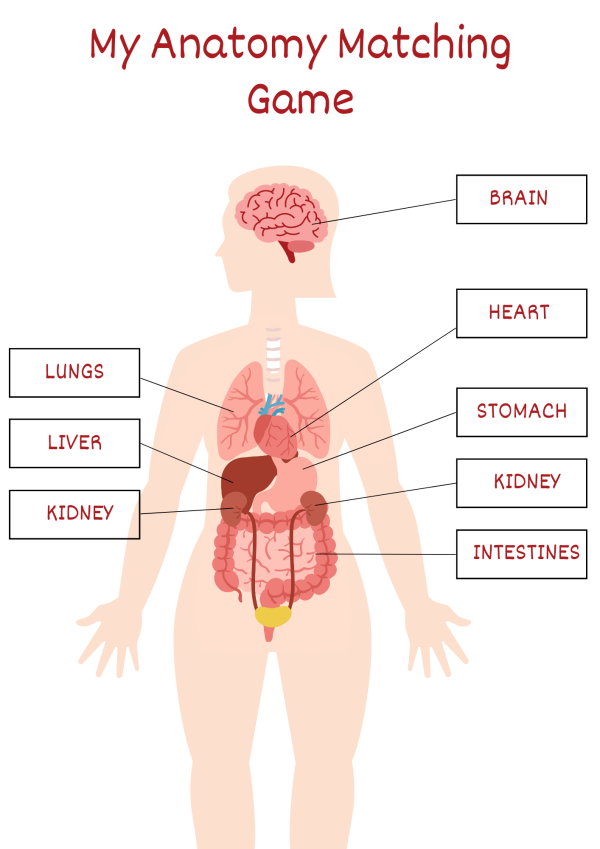
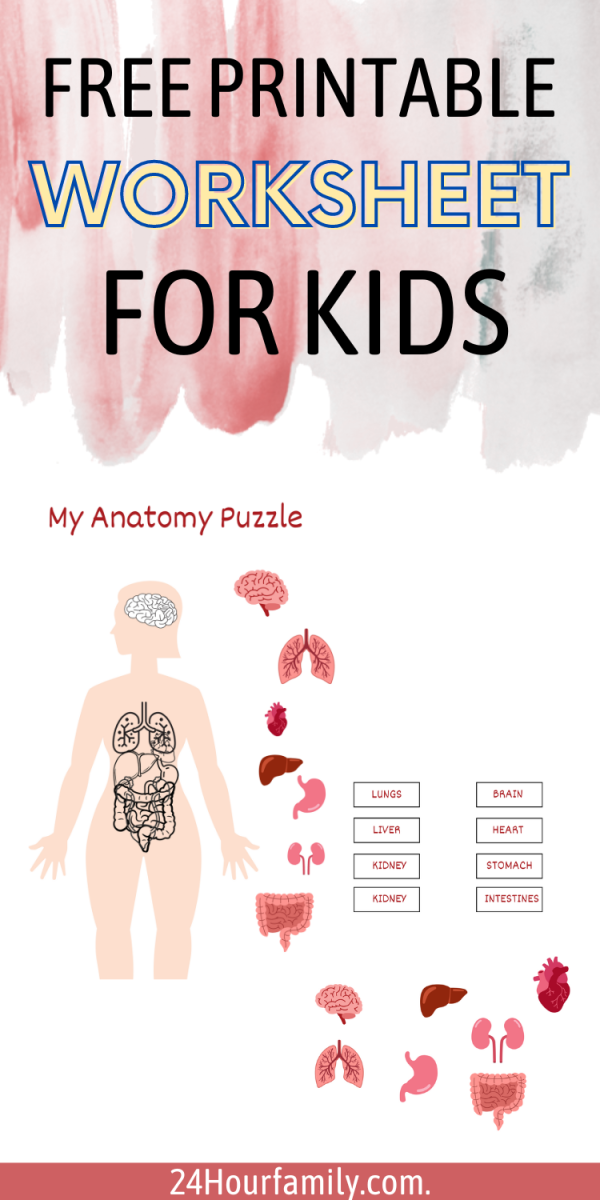
The anatomy matching pages introduce several major internal organs:
- Brain
- Heart
- Lungs
- Liver
- Stomach
- Kidneys
- Intestines
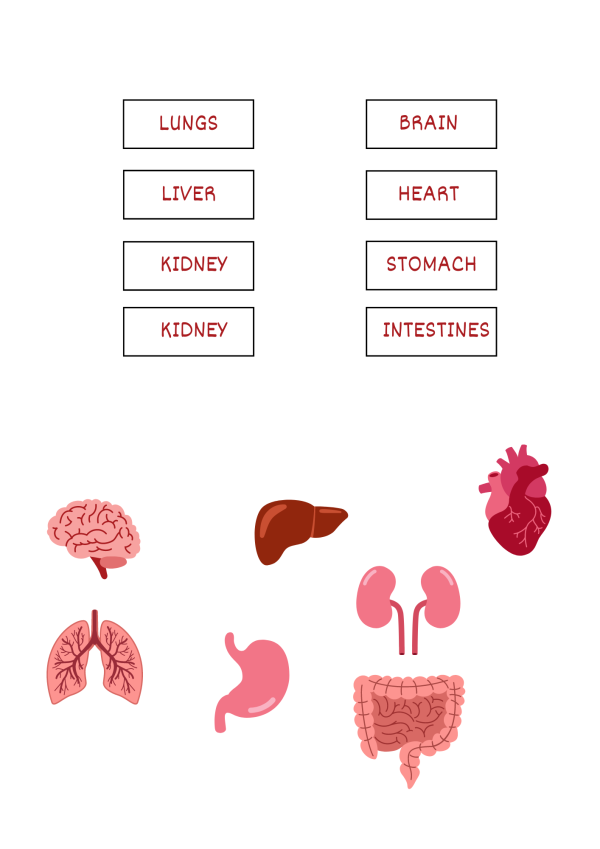
Children can complete a simple matching activity by matching each organ with its name and placing it in the approximate location on the body outline.
These are simplified learning pages rather than detailed medical diagrams. The goal is to introduce names, locations, and basic functions in an age-appropriate way.
Learning About Body Parts for Preschoolers
Begin with the common body parts children can see and move:
- Head
- Hair
- Face
- Eyes
- Ears
- Nose
- Mouth
- Neck
- Shoulders
- Arms
- Elbows
- Hands
- Fingers
- Chest
- Stomach or abdomen
- Back
- Hips
- Legs
- Knees
- Ankles
- Feet
- Toes
Once children recognize these external features, they can begin to learn body parts inside the body as well by exploring a few major organs and their basic jobs.
A few examples:
- The brain controls how we think, learn, remember, and move.
- The heart helps move blood to all parts of the body.
- The lungs help us breathe.
- The stomach helps break down food.
- The intestines continue digesting food and absorbing nutrients.
- The liver performs many jobs, including processing substances in the blood.
- The kidneys help clean the blood by removing waste and making urine.
Young learners do not need lengthy explanations. One short, accurate sentence about each organ is usually enough.
Recommended Ages
These activities can be adapted for:
- Toddlers with adult guidance
- Preschool
- Pre-K
- Kindergarten
- First grade
- Homeschool science
- All About Me units
- Early childhood health lessons
Toddlers can point to and name familiar external features. Preschool and kindergarten children can use the matching pages and begin learning about internal organs.
Supplies for a Body Parts Unit
The exact supplies depend on which activities you choose, but helpful materials include:
- Free body learning pages
- Printer
- White paper or cardstock
- Crayons and washable markers
- Child-safe scissors
- Glue sticks
- Large roll of paper
- Painter’s tape
- Small adhesive notes or stickers
- Play dough
- Building blocks
- Mirror
- Paper fasteners, optional
- Dice, optional
- Vocabulary cards or flashcards, optional
- Children’s anatomy books
A handheld or unbreakable classroom mirror is especially useful for lessons about faces, expressions, and the five senses.
Complete the Body Parts Cut-and-Paste Printable
Begin with the free external anatomy page.
Review each word or picture before children begin cutting. Ask them to point to the matching feature on their own bodies.
Then have them:
- Color the body outline.
- Cut out the labels or pieces.
- Put every piece in its proper location.
- See if everything is placed correctly.
- Glue each piece in place.
Children will practice body vocabulary, visual matching, cutting, and hand coordination during one activity.
Build the Human Anatomy Puzzle
The anatomy puzzle introduces the brain, heart, lungs, liver, stomach, kidneys, and intestines.
Before children glue the organs down, encourage hands-on learning by letting them move the pieces around and experiment with placement.
Use simple descriptions:
Organ – Preschool explanation
Brain- Helps us think, remember, learn, feel, and move
Heart – Pumps blood through the body
Lungs – Help us breathe in oxygen and breathe out carbon dioxide
Liver – Helps process nutrients and remove some waste substances
Stomach – Begins breaking down the food we swallow
Kidneys – Filter the blood and help make urine
Intestines – Digest food further and absorb nutrients and water
The organ locations on these learning pages are approximate. Explain that real organs have more complicated shapes and positions.
Play the Anatomy Matching Game
Cut out the organ cards and name labels from the printable.
Mix them up and invite children to play a game by matching each picture with its correct name.
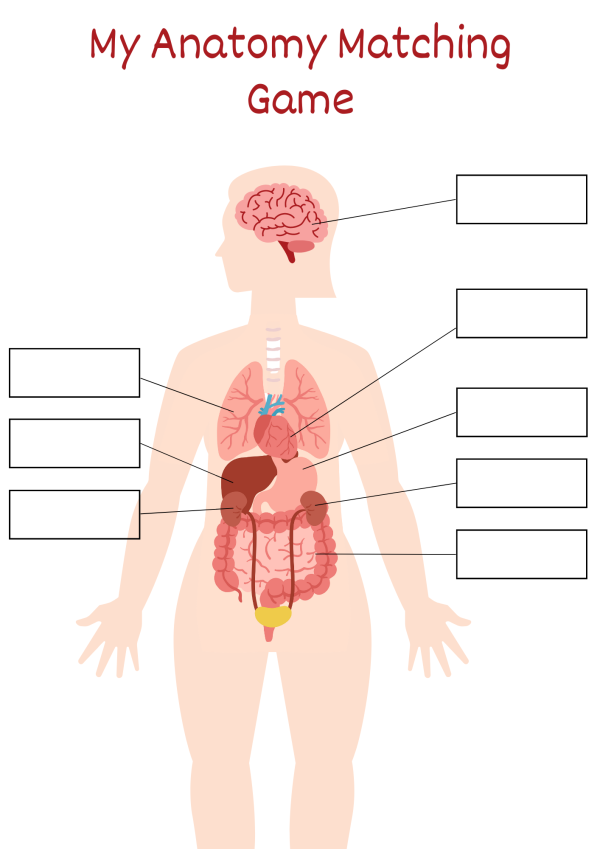
For beginners, place only two or three organs on the table. Add more after children become comfortable with the first set.
You can also place all the organ pictures face up and ask:
- Which organ helps you think?
- Which organs fill with air?
- What organ pumps blood around your body?
- Which organ helps digest food?
- Which organs help filter your blood?
Make a Life-Size Body Outline
Ask a child to lie on a large sheet of paper while an adult outlines the body.
The child can then add:
- Facial features
- Hair
- Clothing
- Hands and fingers
- Feet and toes
- Major internal organs
- Labels
Always ask permission before tracing a child’s body. A child who does not want to participate can outline an adult, use a doll, or work from a pre-drawn outline.
Display the finished picture during your All About Me or human body unit.
Sing “Head, Shoulders, Knees, and Toes”
This familiar song combines vocabulary, rhythm, listening, and movement.
Begin slowly and touch each feature as it is named. Repeat the song at different speeds.
Once children know the song, replace some words with:
- Elbows
- Wrists
- Hands
- Fingers
- Ankles
- Back
- Hips
- Chin
You can also stop before naming a feature and let children supply the missing word.
Play a Body Parts Listening Game
Give simple movement directions, such as:
- Touch your shoulders.
- Extend your fingers, then make a fist.
- Let’s bend our knees.
- Place your hands on your elbows.
- Stand with one foot raised.
- Hold your hips with your hands.
- Turn your head gently from one direction to the other.
Children should only follow directions that begin with the game phrase.
For younger children, skip the elimination rule. Let everyone remain in the game and focus on listening skills while identifying the correct feature.
Dance the Hokey Pokey
The Hokey Pokey encourages children to move different areas of their bodies while following directions.
Use the familiar verses for hands, feet, arms, legs, head, and whole body.
Add new verses using:
- Elbow
- Knee
- Shoulder
- Fingers
- Toes
- Hips
- Back
Ensure children have enough open space to move safely without bumping into furniture or one another.
Put a Sticker on the Body Part
Give each child removable stickers.
Call out a feature and ask the child to place a sticker on that area of a large paper person, doll, or body outline.
Examples include:
- Put a sticker on the hand.
- Put a sticker on the knee.
- Put a sticker on the shoulder.
- Put a sticker on the foot.
- Put a sticker on the elbow.
Using a doll or picture avoids attaching adhesive directly to a child’s skin.
This is one of many simple activities to teach anatomy vocabulary through play.
Play “Name That Body Part”
Point to a feature on yourself, a doll, or a picture and ask the child to name it.
Begin with familiar areas such as the head, arms, hands, legs, and feet.
Gradually add:
- Elbow
- Wrist
- Ankle
- Chin
- Forehead
- Cheek
- Shoulder
- Navel
- Heel
Reverse the game by saying the name and asking the child to point to it. This activity reinforces body-part identification while building confidence with new words.
Create Body-Part Flashcards
Use your vocabulary cards, flashcards, or draw simple picture cards.
Hold up one card at a time and invite children to:
- Name the feature.
- Show where it is.
- Move that body part.
- Describe what it does.
- Make a sentence using the word.
For example, after showing a hand card, children might clap, wave, pick up a block, or wiggle their fingers.
These cards are a simple way to reinforce part vocabulary through everyday play.
Practice Memory with Body-Part Cards
Print an additional set of the body-part cards.
Spread the cards face down in rows. Players reveal two cards each turn.
If a matching pair is found, the player collects it. If they are different, flip them back over.
Begin with three or four pairs for younger children. Add more cards as their concentration and visual memory develop for an extra challenge.
Assemble a Body Puzzle
Draw or print a simple person and separate it into large pieces:
- Head
- Torso
- Two arms
- Two hands
- Two legs
- Two feet
Mix up the pieces and ask children to assemble the body so they can see how different body parts fit together.
As each piece is added, say its name and discuss where it connects.
For a reusable puzzle, laminate the pieces and attach removable Velcro dots.
Make a Play-Dough Person
Invite children to build a person from play dough.
Ask them to include:
- One head
- Two eyes
- Two ears
- One nose
- One mouth
- Two arms
- Two hands
- Two legs
- Two feet
This activity teaches counting, planning, and gives children opportunities to practice fine motor skills.
There is no need for every play-dough person to look realistic. The learning happens as children make choices and explain their creations.
Build a Person with Blocks
Use building blocks, pattern blocks, or magnetic tiles to build a human figure.
Children can use:
- A square or circle for the head
- A rectangle for the torso
- Long pieces for arms and legs
- Smaller pieces for hands and feet
Ask children how many of each feature their figure needs.
This adds early math, spatial awareness, and problem-solving while reinforcing anatomy vocabulary.
Explore Faces with a Mirror
Give children an unbreakable mirror and ask them to observe their faces. This also works well during circle time or small-group discussions.
Discuss:
- Eyes
- Eyebrows
- Eyelashes
- Nose
- Mouth
- Lips
- Teeth
- Tongue
- Cheeks
- Chin
- Forehead
- Ears
- Hair
Invite children to make happy, sad, surprised, excited, tired, and silly expressions.
Explain that faces can give us clues about feelings, but we cannot always know exactly how someone feels simply by looking.
Draw a Self-Portrait
After exploring faces in a mirror, give each child paper and drawing supplies.
Ask them to draw themselves and include as many details as possible.
Avoid correcting unusual proportions. A preschool self-portrait reflects what the child notices and understands at that developmental stage.
Label the portrait with the child’s own words or ask them to point out each feature they drew. This helps reinforce body vocabulary while encouraging observation.
Play a Body-Part Movement Game
Call out a feature and a movement.
For example:
- Wave your hands.
- March with your feet.
- Do a tiny squat.
- Lift your shoulders toward your ears.
- Give your eyes a quick blink.
- Move your fingers away from each other, then bring them back together.
- Slowly look from one side to the other by turning your head.
- Touch the floor with your toes.
- Extend your arms to the sides.
- Raise one foot while standing.
This activity teaches vocabulary while moving and learning, helping children develop coordination and body awareness.
Try a Body-Part Dice Game
Create a large paper cube or assign a body feature to each number on a standard die:
- Hands
- Feet
- Arms
- Legs
- Head
- Shoulders
Children roll the die so students practice listening, following directions, and movement.
Add a second die containing actions such as shake, stretch, tap, bend, wiggle, and turn.
This is one of many fun activities that can be repeated throughout the week.
Match Body Parts with Their Jobs
Gather body-part cards and activity pictures.
Help children make simple matches:
- Eyes — seeing
- Ears — hearing
- Nose — smelling
- Tongue — tasting
- Hands — holding and touching
- Legs — standing, walking, and running
- Feet — balancing and moving
- Mouth — eating and speaking
- Teeth — biting and chewing
- Lungs — breathing
- Heart — pumping blood
- Brain — thinking and controlling the body
Point out that different body parts often work together to complete everyday activities.
Create a Five Senses Sensory Bin Station
Set up five supervised exploration areas as part of your sensory play activities.
Sight
Provide colorful objects, magnifying glasses, mirrors, or simple picture-matching cards.
Hearing
Use bells, shakers, rhythm sticks, or sealed sound containers.
Smell
Offer sealed containers holding safe, familiar scents such as lemon, cinnamon, vanilla, or coffee.
Touch
Provide fabrics and objects with different textures, such as soft, rough, smooth, bumpy, and fuzzy. You can also include a small sensory bin filled with safe classroom materials.
Taste
Only include a tasting activity if food allergies, dietary needs, hygiene, and school policies have been addressed.
Explain that the senses gather information and send messages to the brain.
These exploration stations are a great way to make learning fun while encouraging curiosity.
Bonus Body Parts Activities
Trace Hands and Feet
Trace a child’s hands and feet on paper. Compare their sizes and count the fingers and toes.
This simple body tracing activity also encourages observation and early math skills.
Make Fingerprints
Use a washable ink pad to create fingerprint art.
Explain that fingerprints have patterns and that each person’s prints are unique.
Listen to a Heartbeat
After a quiet moment, let children place a hand over their chest.
Then complete a brief movement activity and check again. Explain that the heart usually beats faster when the body is active because working muscles need more oxygen and nutrients.
Practice Deep Breathing
Place a hand on the chest or abdomen and take a slow breath.
Notice how the body moves as the lungs fill and empty.
Do not ask children to hold their breath or compete to see who can go longest without breathing.
Create a Skeleton with Cotton Swabs
Arrange cotton swabs on dark construction paper to resemble bones.
This is an art representation rather than an accurate skeleton, but it can introduce the idea that bones support the body.
External Body Parts and Internal Organs
Young children may use “body parts” to describe everything in and on the body. Introduce the distinction gradually.
External Body Parts
External body parts can usually be seen or touched from outside the body.
Examples include:
- Head
- Eyes
- Ears
- Nose
- Mouth
- Arms
- Hands
- Fingers
- Legs
- Knees
- Feet
- Toes
Internal Organs
Internal organs are inside the body.
Examples include:
- Brain
- Heart
- Lungs
- Liver
- Stomach
- Kidneys
- Intestines
Explain that skin covers and helps protect the tissues and organs inside the body.
Where Are the Major Organs Located?
Use these simple descriptions with the anatomy printable:
- The brain is protected inside the skull.
- The heart is in the chest, behind the breastbone and slightly left of center.
- The lungs are in the chest on either side of the heart.
- The liver is primarily in the upper-right portion of the abdomen.
- The stomach is in the upper-left portion of the abdomen.
- The kidneys are toward the back of the upper abdomen, below the ribs.
- The intestines fill much of the lower and central abdomen.
A preschool diagram simplifies organ shapes, sizes, and positions. It should not be treated as a detailed medical illustration.
Introduce Body Safety and Personal Boundaries
A body-parts unit is a natural time to teach simple safety concepts.
Children can learn that:
- Their bodies belong to them.
- They may say no to unwanted touch.
- They can choose whether to give a hug, high-five, wave, or another greeting.
- Private parts are the areas covered by a swimsuit.
- Learning the correct body parts names helps children communicate clearly.
- They should tell a trusted adult if a touch, request, or secret makes them uncomfortable.
- Medical care involving private areas should be explained and ordinarily happen with a trusted caregiver present.
Use calm, matter-of-fact language. Do not force children to participate in body tracing, touching, or movement activities that make them uncomfortable.
Questions to Ask Preschoolers
Use open-ended questions to encourage observation:
- Which body parts help you walk?
- What do you use to pick up a toy?
- Which parts help you see and hear?
- What happens when you bend your elbow?
- Why do you think we have bones?
- What happens to your breathing when you run?
- Can you feel your heart beating?
- Which body parts come in pairs?
- Which body parts can turn or bend?
- What are some ways you care for your body?
Accept simple answers and introduce new vocabulary gradually by building on what children already know.
Books About the Human Body
Pair the activities with age-appropriate books about:
- External body parts
- The five senses
- Bones and muscles
- Digestion
- The heart and lungs
- Healthy habits
- Personal boundaries
Books with clear illustrations and simple explanations are usually more useful for young children than detailed anatomy encyclopedias.
Skills Children Practice
These activities help young learners develop:
- Anatomy vocabulary
- Body awareness
- Listening
- Following directions
- Gross motor coordination
- Fine motor skills
- Visual matching
- Memory
- Counting
- Speaking and describing
- Scientific observation
- Personal safety vocabulary
More Human Body Activities for Kids
If your little learners enjoyed these body parts activities, here are more hands-on printables and resources to help them discover how the human body works through fun, interactive learning.
- Human Body Worksheets for Kids – Build early science skills with printable worksheets that introduce body parts and their important functions.
- Human Body Systems Worksheet – Help kids learn about the major body systems through simple, engaging activities and illustrations.
- Anatomy Flashcards – Practice identifying body parts and organs with printable flashcards that make learning more interactive.
- Printable Human Organs Playdough Mats – Strengthen fine motor skills while exploring the location and shape of different organs with hands-on playdough mats.
- Body Parts Coloring Pages – Reinforce body part vocabulary with educational coloring pages that combine creativity and learning.
- Body Parts Flashcards Printable – Introduce or review body part names with colorful flashcards that are perfect for preschool and early elementary learners.
What body parts should preschoolers know?
Most preschoolers can begin learning the names of the head, face, eyes, ears, nose, mouth, neck, shoulders, arms, elbows, hands, fingers, legs, knees, feet, and toes.
Should preschoolers learn about internal organs?
Yes, but keep the information simple. Introduce a few major organs, such as the brain, heart, lungs, stomach, liver, kidneys, and intestines, along with one basic function for each.
What is included in the free printable?
The learning pages include external body-part labeling and an anatomy matching puzzle featuring major internal organs.
Are the printables medically accurate?
They introduce correct organ names and approximate locations, but they are simplified learning materials rather than detailed medical diagrams.
What ages are these activities for?
They are primarily designed for preschool, Pre-K, and kindergarten. Some can be simplified for toddlers or extended for first-grade students.
How do you introduce body parts to preschoolers?
Begin with features children can see and move. Use songs, mirrors, movement directions, dolls, pictures, and simple matching activities to teach body parts in a fun, age-appropriate way.
How can I teach body parts without worksheets?
Use Simon Says, the Hokey Pokey, sensory play, play dough, mirrors, self-portraits, body outlines, songs, movement games, and flashcards.
Do these activities help with fine motor skills?
Yes. Cutting, gluing, coloring, placing stickers, manipulating play dough, and matching cards all help children practice fine motor skills.
How long should a preschool anatomy lesson last?
A focused group lesson may last 10–20 minutes. Longer units work best when divided into short activities involving movement, discussion, books, and hands-on play.
Can I use the printables in a classroom?
Use them according to the personal or classroom-use terms provided with the download.
Download the Free Body Parts Printables
These free body parts activities for preschoolers give young learners a hands-on introduction to external body parts and major internal organs.
Begin with familiar features such as the eyes, ears, nose, hands, and feet. Then use the anatomy puzzle to introduce the brain, heart, lungs, liver, stomach, kidneys, and intestines.
