
African Savanna Diorama: Printable Shoebox Project
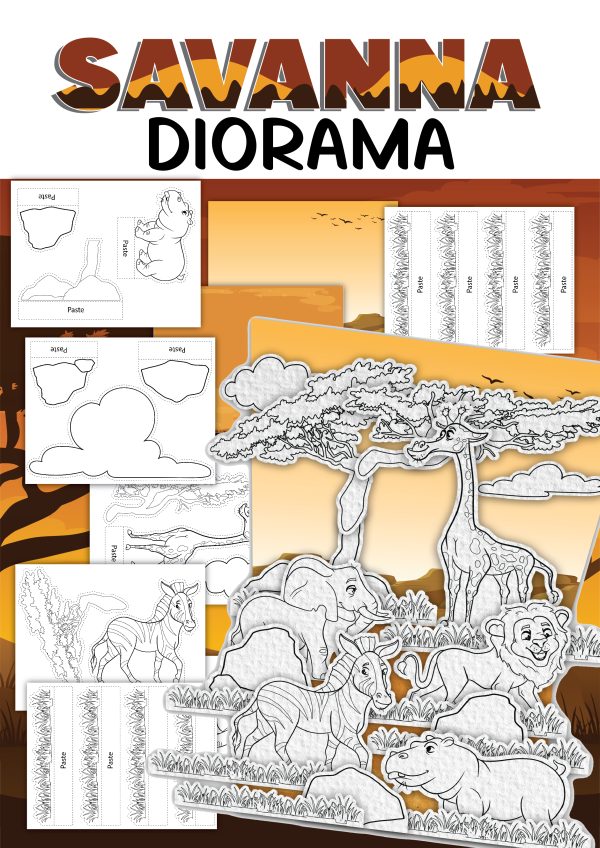
Turn an ordinary shoebox into an African grassland filled with lions, elephants, giraffes, zebras, and other wildlife. This printable African savanna diorama gives children the animals, plants, and scenery they need to build a three-dimensional habitat for a science lesson or school project.
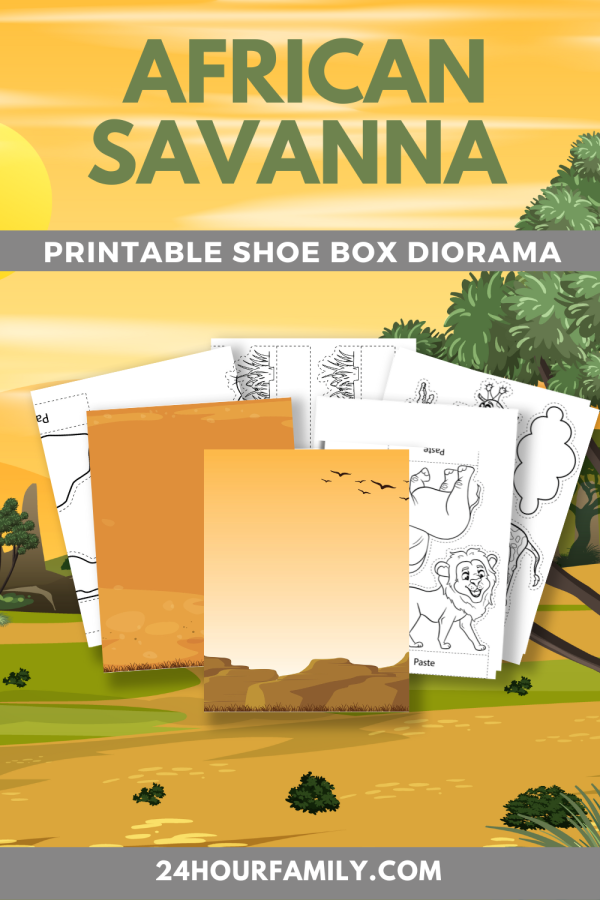
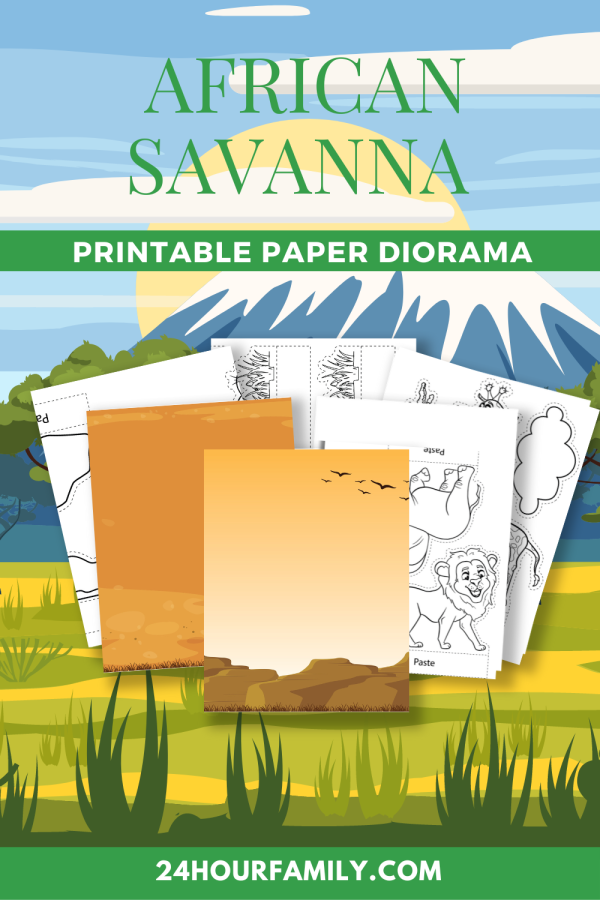
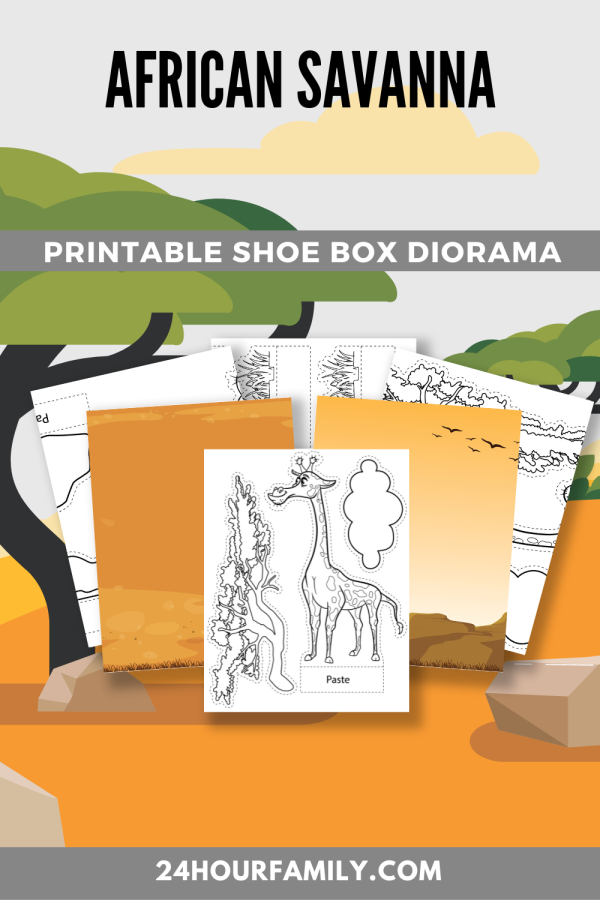
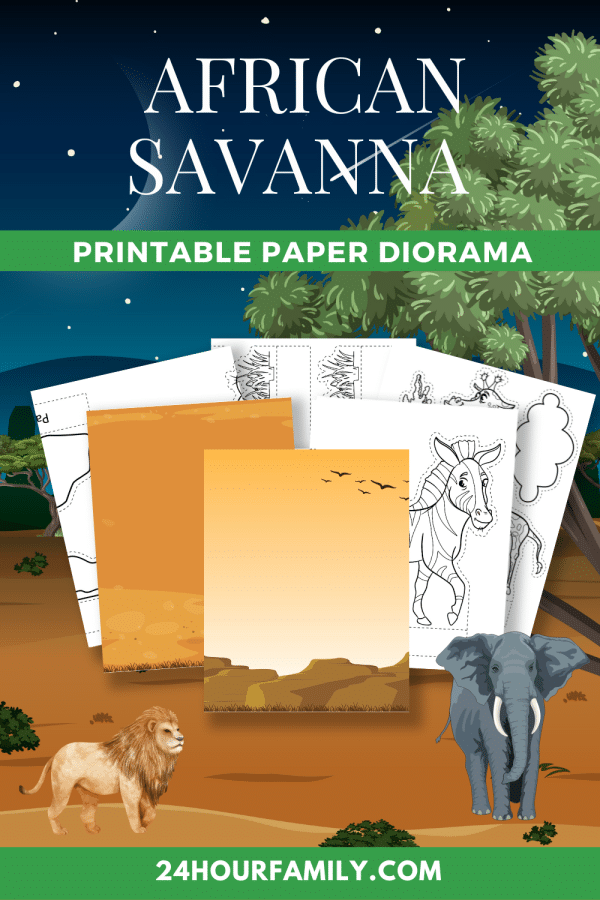
The nine-page printable pack includes a savanna backdrop, animal cutouts, trees, grasses, rocks, and other habitat details. Children can color the pieces, arrange the animals, and create a model showing how plants and wildlife share the savanna ecosystem.
Use this project during a unit about Africa, animal habitats, grassland biomes, food chains, adaptations, or ecosystems.
Printable African Savanna Diorama
A diorama is a three-dimensional model used to represent a place, habitat, or event. In this project, a shoebox becomes a miniature African savanna.
The printable pack supplies the primary scenery and wildlife. Children can then customize the habitat with construction paper, paint, sand, pebbles, dried grass, and other craft materials.
The project can be as simple or as detailed as needed. A younger child might color and arrange the printable animals, while an older student can add labels, animal facts, a food chain, and information about wet and dry seasons.
What Is Included in the Printable?
The complete PDF includes nine printable pages with African savanna animals and habitat pieces.
The designs include:
- Savanna backdrop
- Lion
- Elephant
- Giraffe
- Zebra
- Rhinoceros
- Baobab tree
- Grasses
- Rocks
- Clouds
- Additional landscape pieces
The black-and-white designs allow children to color the animals and scenery before assembling the habitat.
The individual pages can also be used as animal coloring sheets, research prompts, or visual aids during a grassland lesson.
You Can Purchase the 9-Page African Savanna Shoe Box Diorama Here
Recommended Ages
This savanna shoebox project can be adapted for:
- Preschool with adult assistance
- Kindergarten
- First grade
- Second grade
- Third grade
- Fourth grade
- Fifth grade
- Homeschool science
- Elementary biome projects
- Classroom habitat studies
Preschool and kindergarten children will need help with detailed cutting and assembly.
Older students can complete the project more independently and include written research about climate, plants, animals, adaptations, and food webs.
This post may contain affiliate links. As an Amazon Associate and a participant in other affiliate programs, I earn a commission on qualifying purchases. Read our disclosure policy here.
Supplies Needed
Gather the following supplies:
- African savanna diorama printable
- Shoebox or similar cardboard box
- White cardstock
- Printer
- Crayons, markers, or colored pencils
- Child-safe scissors
- Glue stick
- School glue or craft glue
- Blue and tan construction paper, optional
- Yellow or brown paint, optional
- Paintbrush, optional
- Clean sand or fine gravel, optional
- Small pebbles, optional
- Dried grass or raffia, optional
- Clear thread, optional
White cardstock is recommended for the animals and standing habitat pieces. Regular printer paper can be used for the background.
Adult supervision is required if a craft knife or hot glue is used.
How to Make an African Savanna Shoebox Diorama
Choose a Shoebox
Remove the lid and place the shoebox on one of its long sides with the opening facing forward.
The back and side walls will hold the savanna background. The bottom of the box will become the grassland.
A small shipping box or cardboard display box can be substituted if you do not have a shoebox.
Prepare the Background
Cover the back and inside walls with the printable savanna backdrop.
You can also use blue construction paper or paint the inside walls to create the sky. A pale blue sky works well for a daytime habitat, while orange and yellow can create a savanna sunset.
Smooth each piece carefully as you glue it to prevent wrinkles and air bubbles.
Make the Savanna Ground
Cover the bottom of the box with tan, golden yellow, or light brown construction paper.
For additional texture, spread a thin layer of school glue over the surface and sprinkle clean craft sand or fine gravel on top. Shake away the excess after the glue dries.
Raffia, dried grass, or short strips of tan paper can be used to create clumps of grass.
Print the Diorama Pieces
Print the nine-page PDF.
Use white cardstock for pieces that will stand upright. Select “actual size” or “100%” in your printer settings unless the printable includes different instructions.
Print one test page before printing the entire pack to confirm that the margins and scale are correct.
Color the Animals and Scenery
Color the printable animals, trees, grasses, rocks, and other habitat elements.
Children can look at wildlife photographs for color inspiration. Encourage them to notice details such as:
- The zebra’s black-and-white stripes
- The giraffe’s patterned coat
- The elephant’s gray skin
- The lion’s tawny coloring
- The rhinoceros’s thick gray or brownish skin
- The baobab’s wide trunk and spreading branches
- The savanna’s golden dry-season grasses
The savanna also has a rainy season when grasses may appear greener. Either a dry-season or wet-season scene can be accurate.
Cut Out the Pieces
Carefully cut around the outside of each printable element.
Keep all the cutouts in a shallow container or envelope until assembly. Small grass, cloud, and rock pieces can easily become misplaced.
Young children may need an adult to cut the animals while they work on the larger scenery.
Plan the Habitat
Arrange the pieces inside the box before gluing them down.
Place:
- Trees and taller grass near the back or sides
- Rocks and short grasses along the ground
- Giraffes near trees
- Zebras in an open grassland area
- Elephants near an open area or water source
- Lions where they can use the grass as cover
- Rhinoceroses on the ground with enough open space
The exact arrangement can be creative, but encourage students to think about how each animal uses the habitat.
Make the Pieces Stand Up
Create a small folded tab at the bottom of each animal.
Bend the tab backward and glue it to the diorama floor. This allows the animal to remain upright.
For pieces without a tab, glue a small L-shaped strip of cardstock to the back. Attach the lower portion of the strip to the ground.
Place some animals close to the front, others in the middle, and a few near the back to create depth.
Add Trees, Grass, and Rocks
Glue the baobab tree and other tall scenery to the background or support them with folded cardstock tabs.
Arrange grass and rocks around the animals. Avoid placing every piece in one line, since scattered placement will look more natural.
Add a Watering Hole
Cut a small oval from blue paper or blue cellophane.
Glue it flat to the savanna floor and add a narrow border of sand, brown paper, or pebbles. Place animals such as elephants and zebras nearby.
A flat paper watering hole is simpler and safer than cutting through the bottom of the shoebox or using resin.
Label the Project
For a school assignment, add a title to the outside of the box:
African Savanna Habitat
Children can also add labels identifying:
- Savanna
- Grassland
- Baobab tree
- Watering hole
- Herbivores
- Carnivores
- Producers
- Consumers
Allow the Diorama to Dry
Let all glue and paint dry completely before moving the project.
Lift the box from underneath rather than carrying it by the sides. This helps prevent loose pieces from falling over.
What Is an African Savanna?
A savanna is a tropical grassland with grasses, scattered trees, and a climate shaped by wet and dry seasons.
African savannas are warm throughout the year. Most rainfall occurs during part of the year, followed by a long dry season. The limited and seasonal rainfall prevents dense forests from covering the landscape.
The savanna is not the same as a desert or rainforest:
| Habitat | Primary characteristics |
| Savanna | Tropical grassland with scattered trees and wet and dry seasons |
| Desert | Very low rainfall and sparse vegetation |
| Rainforest | Frequent rainfall, dense vegetation, and layered tree canopy |
| Temperate grassland | Grass-dominated habitat with greater seasonal temperature changes |
Savannas are found in Africa, but savanna habitats also occur in South America, Asia, and Australia.
Plants of the African Savanna
Grasses dominate much of the savanna landscape. Many grasses can survive dry periods because their roots extend underground and their growing points remain close to the soil.
Scattered trees and shrubs also grow in savanna habitats.
Baobab Trees
Baobabs are known for their enormous trunks and distinctive branching shape. They are well adapted to seasonal environments and can store water in their trunks.
Acacia Trees
Various trees commonly described as acacias grow in African savannas. Their small leaves and thorns help them tolerate dry conditions and browsing animals.
Savanna Grasses
Grasses provide food for zebras, wildebeest, antelope, and other grazing animals.
After rain, the grasses may grow green and abundant. During the dry season, they often become golden or brown.
Animals of the African Savanna
African savannas support a wide variety of mammals, birds, reptiles, insects, and other organisms.
Lions
Lions are social cats that usually live in groups called prides. They are predators that hunt animals such as zebras, wildebeest, and antelope.
Although lions are often called “kings of the jungle,” most African lions live in savannas, grasslands, and open woodlands rather than tropical jungles.
African Elephants
African savanna elephants are the largest living land animals.
They eat grasses, bark, leaves, fruit, and other vegetation. Elephants can also shape the habitat by knocking down trees, opening pathways, and creating access to water.
Giraffes
Giraffes use their height and long necks to reach leaves that many other animals cannot access.
Their patterned coats provide camouflage among trees and broken light.
Zebras
Zebras are grazing herbivores that live in groups. Their teeth and digestive systems allow them to eat tough grasses.
Different zebra species live in different regions and habitats across Africa.
Rhinoceroses
Both black and white rhinoceroses can occupy African savanna and woodland habitats, although their diets differ.
White rhinos are primarily grazers, while black rhinos generally browse leaves and shrubs.
Cheetahs
Cheetahs have slender bodies, long legs, and flexible spines that help them run at very high speeds for short distances.
Open grassland gives cheetahs room to chase prey.
Hyenas
Spotted hyenas are skilled hunters as well as scavengers. They live in social groups and communicate through several sounds and body signals.
Ostriches
Ostriches are the largest living birds. They cannot fly, but their strong legs allow them to run quickly.
African Wild Dogs
African wild dogs, sometimes called painted dogs, are social predators that live and hunt in packs.
Their irregular coat patterns differ from one animal to another.
Herbivores, Carnivores, and Omnivores
Use the diorama to introduce animal diets.
Herbivores
Herbivores eat plants.
Savanna examples include:
- Elephants
- Giraffes
- Zebras
- Rhinoceroses
- Wildebeest
- Many antelope species
Carnivores
Carnivores primarily eat other animals.
Examples include:
- Lions
- Cheetahs
- African wild dogs
- Servals
Omnivores
Omnivores eat both plant and animal matter.
Examples may include:
- Baboons
- Warthogs
- Some bird species
Animal diets are more complex than these basic categories, but the groupings provide a useful introduction for elementary students.
A Simple Savanna Food Chain
A food chain shows how energy moves from one living thing to another.
One simplified example is:
Sun → Grass → Zebra → Lion
- Grass uses sunlight to make food.
- A zebra eats the grass.
- A lion may eat the zebra.
A food web is more realistic because most animals eat or are eaten by more than one species.
Older students can add arrows between organisms in the diorama to represent a simple savanna food web.
Animal Adaptations
Ask children how each animal’s body or behavior helps it survive.
Examples include:
- Giraffes reach leaves high in trees.
- Zebras have teeth suited to grazing.
- Cheetahs use speed to chase prey.
- Lions use strong bodies and cooperative hunting.
- Elephants use their trunks to gather food and water.
- Rhinoceroses have thick skin and powerful bodies.
- Ostriches use long legs to run.
- Vultures locate and consume animal remains.
- Many animals move in search of water and fresh grass.
Wet and Dry Seasons
The African savanna generally experiences distinct wet and dry periods.
Wet Season
During the wet season:
- Rainfall increases.
- Grasses become greener.
- Watering holes fill.
- Plants grow more actively.
- Food may become more abundant.
Dry Season
During the dry season:
- Rain becomes limited.
- Grasses turn brown or golden.
- Some water sources shrink.
- Animals may travel farther for food and water.
- Fire can spread through dry vegetation.
Children can choose one season for their diorama or divide the box to compare both.
The Role of Fire
Natural and human-set fires have long influenced many savanna ecosystems.
Fire can remove old dry vegetation and limit the spread of some trees and shrubs. Many grasses can regrow because their roots and growing points survive below or close to the ground.
Fire should be discussed as part of ecosystem science only. Children should never experiment with fire for a diorama or science project.
Savanna Diorama Ideas for School
Add Animal Fact Cards
Choose three animals and create a small card for each one.
Include:
- Animal name
- Diet
- Habitat
- One adaptation
- One interesting fact
Label Producers and Consumers
Label grass and plants as producers.
Label animals as consumers and identify them as herbivores, carnivores, or omnivores.
Create a Food Web
Draw arrows on thin strips of paper to show how energy moves between organisms.
Explain that the arrow points in the direction the energy travels.
Compare Seasons
Decorate one half of the diorama for the wet season and the other for the dry season.
Use green grass on one side and golden grass on the other.
Focus on One Animal
Choose an animal such as a lion, elephant, giraffe, zebra, or rhinoceros.
Make the diorama represent that animal’s habitat and add information about its food, shelter, adaptations, and behavior.
Classroom Uses
Habitat Science Center
Display the completed savanna diorama with:
- Books about African wildlife
- A map of Africa
- Animal figures
- Magnifying glasses
- Habitat vocabulary cards
- Photographs of wet and dry seasons
Research Project
Assign each student one savanna animal to research. Students can present their findings and place the corresponding animal in a class diorama.
Creative Writing
Ask students to imagine spending one day observing the savanna.
They can write from the perspective of:
- A wildlife scientist
- A park ranger
- A giraffe
- An elephant
- A migrating zebra
- A bird flying over the grassland
Compare Biomes
Build additional printable dioramas and compare:
- Savanna
- Desert
- Rainforest
- Tundra
- Ocean
- Polar habitat
Discuss differences in climate, water, vegetation, and animal life.
More Printable Habitat Dioramas
Continue learning about habitats with:
- Shoebox Diorama Printables
- Polar Habitat Diorama
- Water Cycle Diorama
- Taiga Biomes Diorama
- Ocean Triorama Diorama
- Solar System Diorama
- Layers of the Ocean Diorama
- How to Make a Desert Diorama
- Make this Ocean Diorama (Free Printable)
- Rainforest Diorama
Purchase the African Savanna Diorama Printable
You Can Purchase the 9-Page African Savanna Shoe Box Diorama Here
The complete nine-page African savanna diorama printable gives children a ready-to-color background, animals, grasses, trees, rocks, and other pieces for building a detailed shoebox habitat.
Use it for an elementary science project, homeschool biome unit, classroom display, wildlife study, or hands-on lesson about ecosystems.
How many pages are included?
The complete African savanna diorama printable contains nine pages.
Is the printable free?
No. The complete nine-page printable is available for purchase through the 24 Hour Printables shop.
Which animals are included?
The visible printable pieces include a lion, elephant, giraffe, zebra, and rhinoceros, along with savanna plants and landscape elements.
What kind of paper should I use?
White cardstock is recommended for the animals and freestanding pieces. Regular printer paper can be used for the background.
What age is this project for?
The project can be adapted for kindergarten through fifth grade. Preschool children can participate with adult help, while older students can add research, labels, and food-web information.
How long does the diorama take?
Plan for approximately 60–90 minutes. Detailed coloring, painting, research, or drying time may extend the project.
Can I make it without a shoebox?
Yes. Use a small shipping box, cereal box, cardboard display box, or folded cardstock base.
What colors should the savanna be?
A dry-season habitat may feature golden grass and tan soil. A wet-season habitat may have greener grass and fuller vegetation. Both can accurately represent the savanna at different times.
Are savannas found only in Africa?
No. Savannas also occur in South America, Asia, and Australia. This printable specifically represents an African savanna.
Are lions really jungle animals?
Most African lions live in savannas, grasslands, and open woodlands. The familiar phrase “king of the jungle” is not an accurate description of their primary habitat.

African Savanna Diorama
Embark on an exciting adventure to the heart of the African Savanna with our African Savanna Shoe Box Diorama kit!
Materials
- Your choice of printing paper - preferably white cardstock
- Printed Savanna Diorama template
- Coloring materials
- A pair of scissors
Tools
- Printer
Instructions
- To begin your African Savanna Diorama adventure, print our comprehensive kit, which you can conveniently purchase below. I recommend using sturdy paper, preferably white cardstock, to ensure a stable and durable diorama.
- Grab your favorite coloring materials and dive into the vibrant world of the African Savanna. As you color each page, let your imagination run wild with unique African Savanna colors.
- Grab your scissors and carefully cut out each printable, following along the dotted lines as accurately as possible. Taking your time with cutting will ensure that each element of your diorama is neatly trimmed and ready to be assembled.
- Begin by applying a thin layer of glue to the inside walls of your shoebox, one at a time. Take care to paste each page onto the corresponding side of the shoebox, ensuring that the scenes accurately mirror the layout of the Savanna biome. As you glue each page into place, smooth out any air bubbles or wrinkles to ensure a clean and professional finish. Take time with this step, as the accurate placement will help create a more realistic and immersive diorama.
- With your African Savanna Diorama taking shape inside the shoebox, it's time to add the finishing touches—the colored animals! Using your glue stick, carefully attach each of the colored animals to its corresponding habitat within the diorama. Place the lions prowling through the grasslands, the elephants roaming near the waterhole, and the giraffes grazing among the trees.
